Pet Feeder Not Working? 4 False Leads to Rule Out
The short answer: before you return a feeder that looks broken, rule out four things that have nothing to do with the feeder. Another device in the same room can knock it offline, the microchip or the battery can be the failing half of the pair, the cat can be the reason a cycle never finishes, and the app can report a meal that was never served. In the owner threads below, the machine’s own status screen is the least reliable part of the system. A feeder that says “completed” while the lid stayed shut, a new microchip feeder that stopped reading every cat after five days, and a kitten that interrupted a litter box cycle for months all fall to the same test, and it takes about 30 minutes.
I spent this week in the threads where owners debug reports rather than machines: a Petlibro owner who came home from a 12-hour shift to untouched food, a Sure Petcare owner five days into a new feeder, and a Litter-Robot household with a six-month kitten. Four of those cases ended with a fix that cost nothing, and each one started with a confident diagnosis that turned out to be wrong.
petiqlab earns a commission from the Amazon links on this page. Everything below comes from owner posts, public threads and manufacturer pages read on September 21, 2026, with the links in the sources at the end. petiqlab has not tested these devices, and every quote is the owner’s own.
Why does the app say the meal was served when the bowl is still full?
The short answer: because the app is a report about the feeder, and reports fail in both directions. They invent meals that never happened, and they stay quiet when a meal fails.
A Petlibro Polar owner wrote on September 17 that she opened the feeder after a 12-hour shift and “surprisingly the food is still there,” adding that “my schedule says its active” while the feeder “didn’t open on its scheduled time.” She ended by worrying about the owners who are “on vacation or out of town right now who relies on this wet food feeder.”
The most useful reply, with 8 upvotes, described a replacement that changed nothing. “That happened a lot when I had one. They sent me a replacement even though I was pretty sure the problem was actually just in the app. Confirmed when the new one started having the same issue.” The same owner reported the cooling chip beginning to malfunction “within less than a year” and the replacement eventually rotating endlessly.
A Trustpilot reviewer on the same brand documented the harder version of the same bug on September 16. She saw the app display “Failed to open lid. Please try again” while the feeder showed a red indicator light, and then something worse: the app “reported that a scheduled feeding was ‘completed’ even though the feeder did not successfully open.” Her other Polar feeder worked correctly in the same house. For a device sold on feeding your cat while you are away, a completed stamp on a meal that never landed is the failure that matters.
Silence is the second half. In a thread from August 25, an owner learned his cat had missed three meals not from an alert but from the cat looking hungry, because the app marked dinner the day before, breakfast and dinner again as FAILED. A reply with 3 upvotes names the gap precisely: the app “knows the program itself has failed” and still does not push a notification, so “when I am on the home screen it should say that the program failed, plus a push notification.” The counter-reply in the same thread is fair and worth keeping: someone who plans meals and never checks for 24 hours is relying on a human safety net that no device replaces.
The smallest version of this fault is a UI problem with real consequences. One owner on September 20 had a feeder that was working normally, with three meals logged in the history, while the home screen showed no feeding times at all. A reply explained that the top panel counts what the feeder dispensed and the bottom panel counts what the cat ate, which is not obvious when both panels can read as empty.
| What the screen says | What is actually happening | What to do |
|---|---|---|
| Meal completed | Lid never opened (documented on a Polar) | Photograph the bowl around a meal |
| Schedule active | Feeder never fired (12-hour shift case) | Read the device panel and history list |
| No feeding time | Feeder dispensed and the history logged it | Check both app panels, then trust the device |
| Nothing | Meals marked FAILED with no push alert | Ask the seller what failure alerts exist |
Can a device in the next room knock a feeder offline?
The short answer: owners report it twice in the last month, on two different brands, and both cases resolved by unplugging the other gadget.
The clearest is a Petlibro thread from September 13. Two Furbo Mini 360 cameras went up in the evening. Within an hour, “both of my polar wet food feeders began to have connectivity issues,” with the machines blinking white and red and the app reporting that “the device network is abnormal or the device is offline.” The owner unplugged the cameras the next morning, and “within a minute both feeders were working completely fine again.” Two days later he confirmed the pattern again: “as soon as I unplug the cameras, the feeders are working as intended immediately.”
The second case is on the microchip side and it arrived with a hypothesis rather than a diagnosis. A Sure Petcare owner posted on September 17 that a brand new SureFeed Connect “after 5 days, stopped reading all my cats microchips.” Support shipped a replacement and told her to dispose of the first unit. The most interesting reply asks a question: “Do you happen to have a PetLibro fountain or any other type of device near it? I had a similar problem and it turned out my fountain was interfering with my Surefeed Connect feeders. Replaced the fountain with a different brand and the problem was solved. If you have a PetLibro anything, try unplugging it and see if the feeders work again.”
Write that one down as a user report and a single case, not as a mechanism. What is worth taking from it is the test, because it costs nothing and it beats a warranty claim you do not need. The fountain being blamed has its own record too: a Dockstream 2 owner reported on September 20 that his unit, bought about a year earlier, started running its flow rate too fast and overflowing, which is the kind of fault that makes a suspected interferer worth replacing on its own merits.
- Pick a test moment. Twenty minutes before a scheduled meal, with the app, the device panel and the hopper all visible.
- Unplug one neighbor, not all of them. Start with a water fountain, a camera or a smart speaker within a few feet, and leave everything else running.
- Re-test at the device. Press the manual feed, watch the panel, and check the reader with the cat at the bowl. Repeat between unplugs.
- Give a suspect a full day. Interference that appears within an hour can also build over hours, so a ten-minute test clears nothing.
- Write down what changed. A fault that disappears while one particular device is unplugged is a real answer, and it is also the sentence you send to support.
Why did my microchip feeder stop reading the cat?
The short answer: because a microchip feeder reads a chip, and the chip is the half of the pair that owners never test.
A Sure Petcare owner learned this the expensive way. His dualscan feeder “will only scan 2 out of 4 cats,” and a reply suggested a scanner rather than a return. He bought one and reported back on September 13: “i bought a scanner today to check this and it picks up the 2 perfectly the other 2 it says no tag.” The reader was not failing. Two of the cats’ chips were not answering, and the same reply points to an extended range mode that widens the radio’s tolerance for detuned chips, which is the setting to try before you box up the feeder. The microchip feeder guide covers the chip types and the placement problems that produce the rest of the no-tag cases.
The battery is the other silent variable, and it produces reports that look like hardware failure. Two Sure Petcare owners in the same community describe rechargeable cells at 1.2 volts against the 1.5 volts the hardware expects. One wrote that the app “shows that the battery is getting low but on the then on the physical pet door it seems to have full battery,” and a 3-upvote reply from a two-door owner says both of his units “exhibit the same behaviour.” The same reply points out that notifications run backwards in curfew mode, with a lock at night announced as an unlock. The practical fix in the thread is a Home Assistant connection, because “the API reports out an actual battery percentage.”
Cross-brand, the failure repeats. A one-star review of the PetSafe microchip cat door says the door is sold as programmable for 99 cats and that with two cats in the house it recognized one.
Why does my cat keep interrupting the cycle?
The short answer: because a motorized box is the best toy in the house, and the machine logs those interruptions as faults.
The 90-upvote thread from September 20 is the clearest one: a six-month kitten who “won’t leave the robot alone.” The two cats “took to it immediately and needed almost no adjustment time,” so this was not the usual litter box rejection. The kitten waited for the cycle and swatted at the globe to stop it. The owner’s summary is the line to remember: “I’ve spent hundreds of dollars on stimulating cat toys … He just loves gadgets.”
What the community prescribed is patience with a schedule. The 27-upvote answer says “my adult and kitten both did this for several months. Now they’re over it. You just have to wait it out.” Another owner, with 9 upvotes, shortened the fight instead: “we have it set to a 30 minute cycle or we put it on sleep mode for a few days to get rid of the novelty.”
The false-alarm version of the same problem sits on the Evo. An owner with major back problems reported the box “consistently telling me to ‘reinsert drawer’ even when it’s all the way in,” with the sensors cleaned and the base vacuumed, and asked for the function to be overridable. Whisker’s own account answered inside that thread and asked for a serial number, which is worth noting next to brands that route every report back into their app.
How do you tell a real fault from a false one?
Six steps, cheapest first. This is the order that matters, because the expensive steps are the ones owners take first.
- Build evidence that is not the app. Photograph the bowl and the hopper around a scheduled meal, or record it on a camera that stores footage locally. The feeder guide on skipped meals walks through the mechanical causes if the photographs show a real miss.
- Read the long list, not the tile. Open the full history, then the device panel. A feeder that dispensed and a feeder that failed look identical on a summary screen.
- Clear the neighbors. Unplug the other 2.4GHz and RFID devices in the room one at a time, starting with fountains and cameras. This is the step that saved two feeders and one reader in the threads above.
- Test the tag and the battery. A scanner separates a dead reader from a weak chip, and matching the battery chemistry to the device’s mode removes a whole class of phantom low-battery and behavior faults. The camera cost comparison is the other half of this step if you want a second view of the bowl that does not depend on the vendor’s cloud.
- Watch one full cycle, in the room. The kitten in the 90-upvote thread produced the same log entries as a mechanical fault, and only a person standing there can tell them apart.
- Check that the failure has a voice. Ask before buying, and test after: unplug the machine at feeding time and see whether you get a notification. A device that knows a meal failed and says nothing is not a remote feeder. The no-subscription camera guide covers the cheapest way to get a second pair of eyes on the bowl, and the offline-first guide covers which functions survive a dead cloud.
The counter-argument, because it is real
Threads about faults select for faults, and the same subreddits carry the correction. One owner runs “4 RFID feeders and 2 RFID water fountains and they work flawlessly.” Another has “three of their feeders and they’ve been absolutely fantastic.” A third reports three Petlibro products over “the last 3 years” and “only had great experiences with Customer Service.” The reply with the most sense in it comes from an owner who buys deliberately: “I do intentional buy ones that don’t require apps, or internet connections. Their water fountains are, by far, the best I’ve ever used.”
The local-control crowd reports the same thing from another angle. In an r/homeassistant thread from September 13, one owner called the official Litter-Robot integration “flawless” and said the waste drawer level is his most used entity, another runs Petkit and Whisker through custom cards, a third has an Aqara Pet Feeder C1 that has worked “for over 4 years,” and a Petlibro owner with four devices is “still happy with them personally” despite a recent server problem. When the machine reports honestly to software you control, the false leads get easier to spot.
The brand-level numbers as measured on September 21, 2026 put the support question in perspective. Petlibro sits at 3.4 across 982 reviews with replies to 62% of negative reviews, Whisker at 3.2 across 598 with replies to 96%, PETKIT at 3.6 across 299 with 81%, and PetSafe at 2.2 across 228 with no reply badge at all. Furbo (2.9 across 132) and Petcube (3.2 across 765) both carry Trustpilot’s “Hasn’t replied to negative reviews” label, while the newer brands Meowant (4.1 across 4,823) and Neakasa (4.4 across 159) answer 99% and 88% of negative reviews respectively. A brand that answers is not the same as a brand that resolves, and neither is the same as a device that reports the truth.
What petiqlab recommends instead
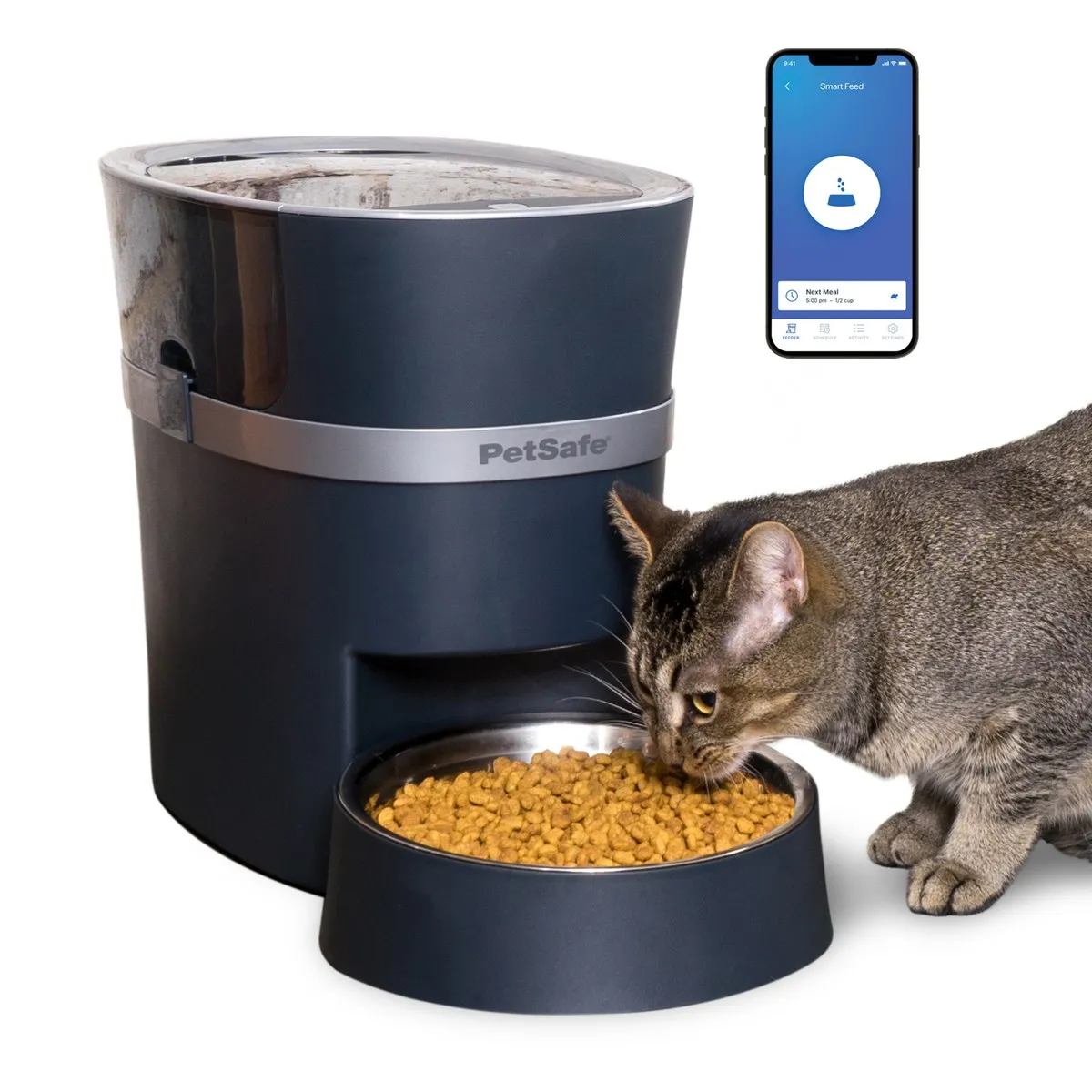
The pick for this page is the feeder whose report you can read at the machine. The PetSafe Smart Feed keeps its schedule on the device with a battery backup, lists at $134.99 with a 45-day return window, and its parts go in the top rack of a dishwasher. Treat it as a product rather than a brand badge, because PetSafe’s brand-level Trustpilot score is 2.2 across 228 reviews, which is the lowest in this comparison.
For checking what actually happened at the bowl, the TP-Link Tapo C210 records to a local microSD card without a subscription, so the footage survives the router restart and the server outage that take app cameras offline. It is the cheap answer to the app question: when the report and the bowl disagree, a recording settles it.
For multi-cat homes where the fault is a reader that will not open a bowl, the SureFeed microchip feeder has no app, no account, no server and no firmware channel, and it carries a three-year warranty with a sealed bowl that keeps the registered pets in memory when the batteries come out. Two disclosures travel with it. Owners in the brand’s own community report sensor faults that needed a reset, and the connected version of the line is where the chip-reading complaints cluster, which is the reason this pick is the offline one.
The PETKIT Eversweet 3 Pro is here for the part you can buy: its wireless pump is sold on its own for about $16, which keeps a fountain with a worn pump on the counter instead of in the bin. The honest caveats, from this month’s threads, are that the pump can need 20 to 30 minutes of retries to restart after a refill and that the brand’s Trustpilot score is 3.6 across 299 reviews, with the newest reports landing on other models.
FAQ
Why does my pet feeder say it fed my cat when it did not? Because on several models the app status and the machine disagree, and the app is the newer, less tested half. A PETLIBRO Polar owner came home after a 12-hour shift to find the food untouched while the schedule screen still read active. A Trustpilot reviewer documented the app reporting a scheduled feeding as completed even though the lid never opened, and a separate Polar in her house worked correctly, which points at the report rather than the machine. Before you replace anything, check the hopper level, the device panel and the full history list, and photograph the bowl around a scheduled meal.
Why has my microchip feeder stopped reading my cat’s chip? Test the chip before you condemn the reader. In a September 2026 thread, a dualscan feeder read only two of four cats, and a cheap scanner then confirmed the other two chips gave no tag at all, which made the cats’ tags the problem and not the machine. Chips can sit too deep or read weakly, and the hardware supports an extended range mode for detuned chips. If every chip fails at once, look at power first and then at the devices around the feeder, because owners report other gadgets in the same room disturbing the reader.
Can another device in my house knock my pet feeder offline? Owners report exactly that. In one Petlibro thread, two Furbo Mini cameras went up in the evening and both Polar wet food feeders lost connectivity within an hour; unplugging the cameras had both feeders working normally again inside a minute, a result the owner confirmed two days later. In another, a brand-new SureFeed Connect stopped reading every chip after five days, and a reply blamed a water fountain in the same room. Treat both as user reports rather than a proven mechanism, then run the test: unplug the neighboring devices one at a time and watch what the feeder does.
Why does my cat keep interrupting the litter box cycle? Mostly because the machine is interesting. A 90-upvote post from September 2026 describes a six-month kitten that guarded the globe and swatted at it mid-cycle, while both cats in the house had adapted to the box with almost no adjustment time. The owner of a smart litter box reads those interrupted cycles as a fault. The remedies in the same thread are a longer delay between cycles, sleep mode for a few days to wear the novelty off, and patience. One owner’s adult cat and kitten played with the machine for months before losing interest.
How do I tell a real device fault from a false one? Run four checks in order. Photograph the bowl and hopper across a scheduled meal so you have evidence that does not come from the app. Read the device panel and the full history list rather than the summary tile. Unplug the other 2.4GHz and RFID devices in the room one at a time, testing the suspect between unplugs. Scan the microchip if the fault is a reader that will not recognize a cat. If the machine, the power, the tag and the neighbors are all clear, you have a real fault and the return is justified.
Which pet feeder has the most reliable status reporting? Prefer devices whose schedule and history live on the machine and are visible without an account. The PetSafe Smart Feed stores its schedule on the device with a battery backup and lists at $134.99 with a 45-day return, and the SureFeed microchip feeder has no app, account or server at all. Both trade app polish for a report you can verify at the device. Also check that a feeding failure produces a push notification, because a machine that knows a meal failed and stays quiet cannot be trusted while you travel.
Updated: 2026-09-21. Sources: r/Petlibro post 1wiewta (a 12-hour shift ending with the food “still there,” the schedule reading active while the feeder never opened, an 8-upvote reply describing a replacement unit that proved the app was the fault and a cooling chip failing “within less than a year,” a 3-upvote note that feeding two bowls instead of three needs a manual confirmation step, and the manufacturer’s reply directing the owner to the in-app feedback form, September 17, 2026), r/Petlibro post 1vxmcjz (three meals marked FAILED, discovered because the cat looked hungry, the 3-upvote request for a push notification when the app already knows the program failed, and a French reply arguing that no device replaces a daily human check, August 25, 2026), r/Petlibro post 1wlh5qg (a working feeder with three meals in the history but no feeding times on the home screen, and the reply explaining that the two panels count different things, September 20, 2026), r/Petlibro post 1wf2rsh (two Furbo Mini 360 cameras installed in the evening and both Polar wet food feeders offline within an hour, blinking white and red with the app reporting an abnormal network, the feeders working “completely fine again” within a minute of the cameras being unplugged, and the owner’s confirmation two days later that “as soon as I unplug the cameras, the feeders are working as intended immediately,” September 13, 2026), r/SurePetcare post 1wi6gt4 (a brand-new SureFeed Connect that stopped reading all cats after five days, support shipping a replacement and advising disposal of the first unit, the 1-upvote hypothesis that a PetLibro fountain in the same room was interfering with the feeders and that replacing the fountain solved it, and a reply advising a check of battery contacts and power first, September 17, 2026), r/SurePetcare post 1wf1n52 (a dualscan that scanned two of four cats, the owner’s scanner test returning “no tag” for the other two, and the extended range setting for detuned microchips, September 13, 2026), r/SurePetcare post 1wcds8x (the app reporting a low battery while the door showed full, a 3-upvote two-door owner calling it a multi-unit behaviour and noting reversed curfew notifications, and the Home Assistant workaround reading an actual battery percentage from the API, September 10, 2026), r/litterrobot post 1wlkohe (a 90-upvote, 50-comment thread about a six-month kitten that would not leave the robot alone, both cats adapting with almost no adjustment time, the 27-upvote “several months. Now they’re over it. You just have to wait it out,” the 9-upvote 30-minute cycle and sleep mode advice, and the owner’s “I’ve spent hundreds of dollars on stimulating cat toys,” September 20, 2026), r/litterrobot post 1wk4qnl (an owner with back problems reporting repeated “reinsert drawer” alerts with the drawer fully in and the sensors cleaned, the request for an override, and Whisker’s official account answering in the thread to request a serial number, September 19, 2026), r/Petlibro post 1wkzv92 (a Dockstream 2 whose flow rate ran too fast and overflowed at the one-year mark with the manual support line unanswered, September 20, 2026), r/homeassistant post 1wfb6rd (the Litter-Robot integration called “flawless” with waste drawer level as the most used entity, Petkit and Whisker custom cards, an Aqara Pet Feeder C1 working for over four years, and a four-device Petlibro owner who is “still happy with them personally” despite a recent server problem, September 13, 2026), r/Petlibro post 1wj6zcg (the counter-evidence quoted in this article: “4 RFID feeders and 2 RFID water fountains and they work flawlessly,” three feeders called “absolutely fantastic,” three years of products with “only had great experiences with Customer Service,” and the owner who deliberately buys “ones that don’t require apps, or internet connections,” as quoted in this site’s teardown analysis of the year-two failure wall, September 18, 2026), r/Petlibro post 1whvz6f (a camera indicator light flashing at varying frequencies after a firmware update to V3.1.54, owners covering the lens with a sticky note, the official explanation that the light flashes whenever the camera streams or records even with Device Indicator off, and two reports that the light continues with the camera switched off in the app and that only one of two units does it, September 16, 2026), Trustpilot’s one-star review pool for petlibro.com (the reviewer who documented the app showing “Failed to open lid” beside a red indicator light and reporting a scheduled feeding as “completed” when the lid never opened, with a second feeder working correctly in the same house, September 16, 2026, and the one-star review stating that every update “either makes their devices worse or bricks them entirely” with ticket #680135, whose official reply acknowledges that after the update “the indicator light began flashing continuously and this affected motion detection and recording behavior”), Trustpilot profiles for litter-robot.com (3.2 across 598 reviews, replies to 96% of negative reviews within a week), petkit.com (3.6 across 299, replies to 81%), petsafe.net (2.2 across 228, no reply badge, including the one-star review of the microchip cat door sold as programmable for 99 cats that recognized one of two), furbo.com (2.9 across 132), petcube.com (3.2 across 765), meowant.com (4.1 across 4,823, replies to 99% within 48 hours) and neakasa.com (4.4 across 159, replies to 88%), all read September 21, 2026, PetSafe’s Smart Feed product page (model PFD00-16828, $134.99, top-rack dishwasher-safe parts, 24 cups, a 45-day return window, and the official product photograph used as the hero image on this page, read September 21, 2026), the Sure Petcare microchip feeder page (a three-year warranty, a sealed bowl, and a memory that keeps registered pets with the batteries removed, read September 21, 2026), the PETKIT Eversweet 3 Pro page (the wireless pump sold as its own product, read September 21, 2026), Amazon listings for the SureFeed microchip feeder, PetSafe Smart Feed, TP-Link Tapo C210 and PETKIT Eversweet 3 Pro with its $16 spare pump, and the petiqlab articles linked above. Hero image: official PetSafe product photograph of the Smart Feed 2nd-generation automatic feeder from the manufacturer’s product page, read September 21, 2026.