Pet Tech That Works Without WiFi: 5 Cloud-Free Picks
On August 26, PETLIBRO owners in Japan reported feeders that would not connect. It was the second connection failure in two weeks, after the August 11 outage that turned the brand’s own subreddit into a gallery of open letters. The pattern behind both is a design choice: when a feeder needs the server to authorize a meal, a dead server makes it an expensive bowl. The devices below keep schedules on the machine, so they feed regardless of the vendor’s data center. Five picks across four categories, plus a 30-minute test you can run before your next trip.
I spent the weekend in the r/Petlibro threads from both outages, then in the r/BuyItForLife thread where owners started asking the question this guide answers: what still works when the app stops existing? The thread has 66 upvotes, and one line carries the whole argument: “I don’t want basic cleaning to depend on a phone, an account, a server, or whatever software still exists years from now.” That is the offline-first standard this guide is built from.
Why does a feeder care what happens at a server?
The short answer: because some vendors designed it that way, and the cost of that choice surfaced twice in August.
Feeding a cat on a timer is the simplest automation in computing. A 74-upvote r/Petlibro thread put it directly: “The feeding schedule is a basic cronjob and the feeders are always plugged in, a server or app connectivity shouldn’t be required and this is something simple enough to run on-device.” A cronjob runs on the machine itself. It does not phone home. A feeder with a cronjob keeps feeding when the internet goes away. A feeder that asks the server “may I dispense now?” goes quiet.
The August 11 outage ran along exactly that line. Ars Technica’s timeline: first failure at 05:20 PT, partial recovery at 06:20, a second crash at 06:43 when traffic surged back, and the underlying cache problem not fully fixed until 23:43 on August 13. The Verge confirmed the outage reached beyond feeders to PETLIBRO’s litter boxes and water fountains, which extends the blast radius from one bowl to the whole household. An open letter with 318 upvotes asked the question the company never answered: “If a feeder was powered, properly configured, and had a schedule already saved locally, how did a server outage prevent that meal from dispensing?”
Two weeks later, a Japanese owner reported the same failure on August 26: the feeder would not connect, and the only relief was relatives living nearby, so the cat did not go hungry. A thread on r/Catownerhacks from the first outage showed the pattern: “petlibro crashed yesterday and when I woke up this morning it had crashed again. Soooo I am looking for recommendations for new automatic feeders. Petlibro is all I’ve used.” When the all-time loyal buyer starts shopping, the category has a problem.
The cloud fails in more ways than outages
The short answer: outages are the dramatic failure. The quieter ones are worse: remote feature removal, paywalls on your own data, and cameras you cannot switch off.
Whisker, maker of the Litter-Robot 5, disabled the USB-C port on existing units with a firmware update, 259 upvotes, no prior warning. Owners bought the port; a software push removed it. If a feature can be switched off remotely, whatever you own is rented. The same architecture locks your data behind a paywall; our subscription wall investigation covers Litter-Robot and Whistle owners losing health history they used to see for free.
The paywall reaches absurd lengths. A 164-upvote thread on r/mildlyinfuriating covers an $80 “smart” fountain whose app claims to track the cat’s weight, litter visits, and activity. The owner’s response: “This is just a water fountain, mind you. No camera, no magical chip reader… How would it know all of these things?” It would not. The subscription is the product.
Then the security layer, covered in detail in our PETLIBRO security review: an authentication bypass into any Google-login feeder, and feeding recordings bulk-downloadable by sequential ID. A server that fails is a liability. A server that leaks is a bigger one.
The market is responding. A tweet about MoonBox, a manual litter box with no motors and no electricity, has 5,970 likes. The pitch: “No motors. No electricity. No scooping.” A viral Kickstarter that rejects the robot category entirely is the strongest signal yet that buyers are done paying for cloud dependence.
Five checks before you buy
The short answer: these five, in order.
- Where is the schedule stored? On the device, or on the vendor’s server? The August outage made the difference visible: device schedules feed, server schedules miss meals. If the seller cannot answer the question, that is the answer.
- Are there physical controls? A button that cycles the machine beats an app that needs a login; the litter box rejection guide makes the same point: physical buttons and offline cleaning cycles.
- Is a subscription mandatory? Mandatory subscriptions are cloud locks with billing attached. A “free tier” that expires after 30 days is the same lock with a delay.
- Can the wear parts be replaced? Pumps, motors, sensors. A fountain with a standard $15-30 pump keeps working for years; a sealed motor turns the whole unit into landfill, which is exactly the PetSafe Outlast problem.
- Where does the data live? An SD card in your hand beats a vendor database every time. Cameras are the obvious case; the no-subscription camera guide is built on it.
Which pet feeder works without WiFi?
The short answer: the PetSafe Smart Feed for a single cat or a simple schedule, the SureFeed microchip feeder for multi-cat households. Both were designed so the server is optional.
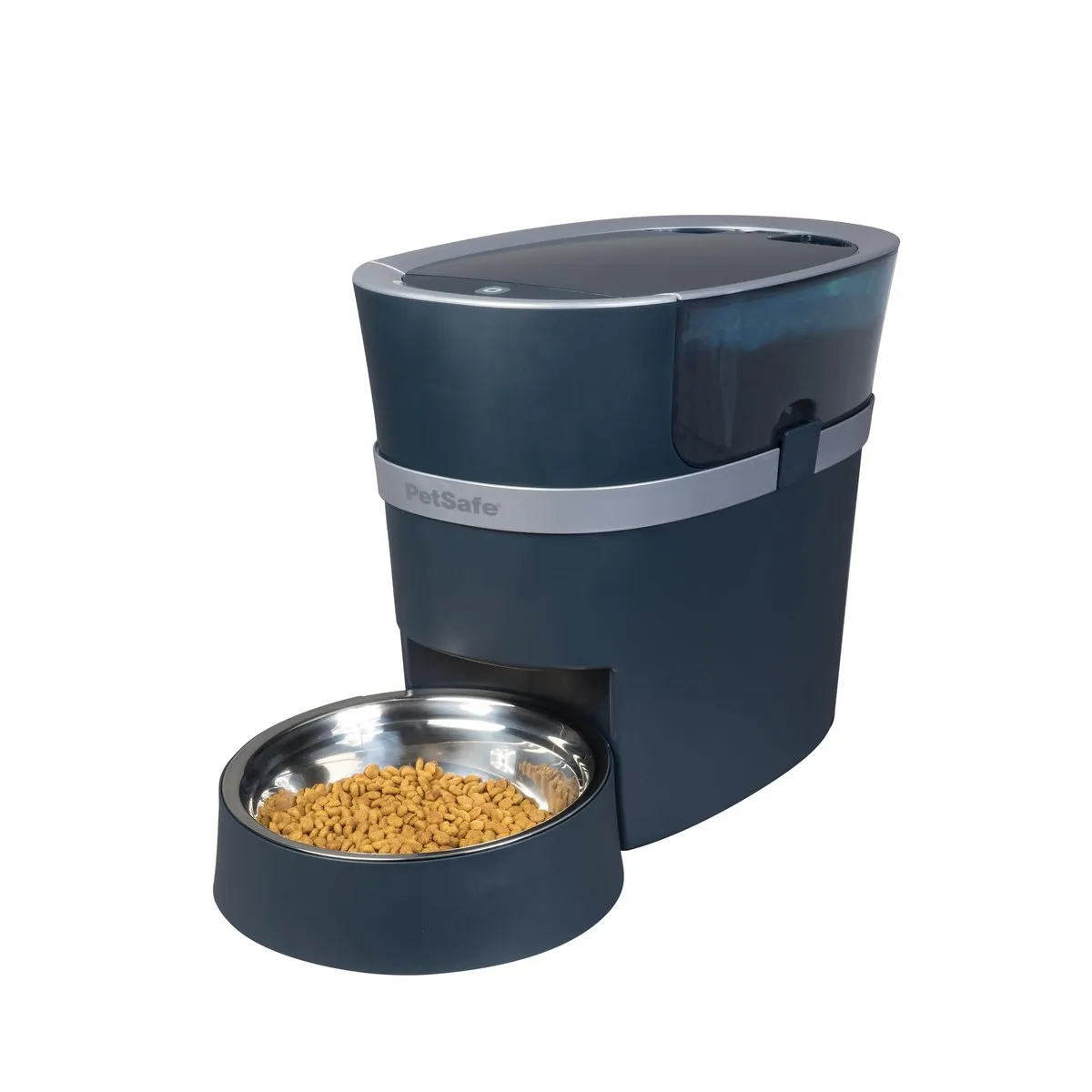
The PetSafe Smart Feed (on Amazon, about $120.99) stores its schedule on the device. The official product title advertises “backup batteries keep meals on schedule,” which also covers the power-outage case. No camera, no microphone, no subscription. It is the same pick in our feeder comparison and the reputation showdown: the least connected feeder that still feeds on time.
The SureFeed Microchip Pet Feeder (on Amazon) has no connectivity at all. It reads the chip already implanted in your cat, opens for that cat only, and runs on batteries. No app, no wifi, no cloud, no subscription. A feeder with no network stack cannot have a server outage, which is why the microchip feeder guide calls it the per-cat replacement PETLIBRO owners switched to after August 11.
One more data point: the HoneyGuardian S25, in our local scheduling investigation, kept dispensing during the outage because it runs on an internal clock. Owners who switched reported it working while the servers did not. Worth watching as proof the feature is cheap to build.
What about litter boxes, fountains, and cameras?
The short answer: offline-first exists in every category, but the honest picks carry caveats.
Litter box: PETKIT Purobot Max Pro 2 (on Amazon, $499.99). Two-year standard warranty, no subscription for the machine, physical controls, and a design philosophy that matches the safety evidence. A r/BuyItForLife owner described the safety logic: “I think incomplete rotation + no pinch points are key for safety,” with the cycle stopping when the cat gets close. The caveats are documented: some cats refuse enclosed automatic boxes entirely, and tofu litter is incompatible with most brands. Keep the old tray during the first weeks. By contrast, Whisker’s new models gate the camera behind $8 per month and firmware-cut existing features, which is why the LR5 review reads like a beta-test log.
Fountain: PETKIT Eversweet 3 Pro (on Amazon, $62.99). The pump runs the moment you plug it in. The app is optional: Bluetooth pairing within 30-50 feet, wifi features only when paired with a PETKIT main device. The replacement pump (B0B2DM5Q7N) ships in under a week, so the most common failure is a $20 part, not a new fountain. Full notes in our Eversweet review.
Camera: TP-Link Tapo C210 (on Amazon, about $35-40). Records to a microSD card in your hand, no subscription, free alerts. Over three years the camera cost comparison puts this at roughly $40 total against about $455 for a Furbo with a subscription. A camera that records locally has no vendor database to leak.
| Category | Pick | One-time price | Still works when… | Subscription |
|---|---|---|---|---|
| Feeder | PetSafe Smart Feed | about $120.99 | servers down, power out (battery backup) | none |
| Feeder, multi-cat | SureFeed microchip | hardware only | always, no network stack at all | none |
| Litter box | PETKIT Purobot Max Pro 2 | $499.99 | cleaning cycles via physical controls | none |
| Fountain | PETKIT Eversweet 3 Pro | $62.99 | pump runs with no app | none |
| Camera | TP-Link Tapo C210 | about $35-40 | local recording on SD card | none |
How to test your current setup in 30 minutes
The short answer: unplug the router, watch one meal cycle, read the fine print. That is the whole test.
- The 24-hour dry run. Unplug the router or switch it off for a full day, and watch whether scheduled meals dispense. Our outage coverage explains why this is the only honest test: if the schedule lives on the device, meals land; if it needs the server, you just found out for free.
- The battery check. Does the feeder have backup batteries? The Smart Feed ships with them. Power loss is the second half of “the internet died.”
- The fine-print check. Ask the seller two questions in writing: where is the schedule stored, and does the feeder contact the server to authorize a meal? A straight answer is a green flag. A marketing answer means the device depends on the cloud whether or not the box says it does.
What to buy instead
The short answer: the five picks above, and they share one trait. The server is optional. The device is the product.
The PetSafe Smart Feed (on Amazon, about $120.99) is the safest single-cat pick: device-stored schedule, backup batteries, no subscription, no microphone. The SureFeed (on Amazon) covers multi-cat households with zero network dependency. The PETKIT Purobot Max Pro 2 (on Amazon, $499.99) is the litter box with the cleanest warranty and no paywall, bought with the adaptation caveat in mind. The PETKIT Eversweet 3 Pro (on Amazon, $62.99) is a fountain whose core function predates the app era. The TP-Link Tapo C210 (on Amazon, about $35-40) records to a card you own.
None of these is a fortress. petiqlab’s testing notes flag the Purobot adaptation risk and the SureFeed’s per-unit hardware cost. But run the five checks against anything you are considering and the pattern holds: the devices that survived August 2026 are the ones that never asked permission to feed.
Updated: August 29, 2026. Sources: the r/BuyItForLife offline-first thread (66 upvotes), the open letter to PETLIBRO (318 upvotes), the r/Petlibro cronjob thread (74 upvotes), the August 26 connection report, the r/Catownerhacks switching thread, Ars Technica’s outage report, the Whisker firmware thread (259 upvotes), the $80 fountain thread (164 upvotes), the MoonBox launch tweet (5,970 likes), and the PETKIT safety thread. Prices and availability change; verify before purchase.
FAQ
Which pet feeder works without WiFi? The PetSafe Smart Feed stores its schedule on the device and ships with backup batteries, so meals dispense when the internet and the power are gone; about $120.99 with no subscription. For multi-cat households, the SureFeed microchip feeder has no network stack at all: no app, no wifi, no cloud. Avoid RFID feeders whose schedules depend on a vendor server; PETLIBRO owners saw two connection failures in August 2026 alone.
Do automatic litter boxes need WiFi to work? Not by design. Look for physical buttons and offline cleaning cycles, and avoid boxes whose features sit behind a subscription. The PETKIT Purobot Max Pro 2 ($499.99) has a 2-year warranty and no paid plan for the machine. Whisker’s new models are the cautionary tale: camera features behind $8 per month, and a firmware update that remotely disabled the USB-C port owners already paid for.
How do I test whether my pet tech really works offline? Unplug the router for 24 hours and watch whether scheduled meals dispense. If they do, the schedule lives on the device. Ask the seller two questions before buying: where is the schedule stored, and does the feeder contact the server to authorize a meal? A direct answer is a green flag. A marketing answer means the device depends on the cloud whether or not the box says it does.
Do I have to give up app features to go cloud-free? No. The TP-Link Tapo C210 records to a microSD card with free alerts. The PETKIT Eversweet 3 Pro pairs over Bluetooth within 30-50 feet, with wifi features optional. The SureFeed Connect adds activity tracking through a separate hub while feeding stays local. The difference is an optional app versus a mandatory server.
Are cloud-free pet devices more expensive? Usually the opposite. The PetSafe Smart Feed is about $120.99 once. The TP-Link Tapo C210 is about $35-40 once. Our camera cost comparison puts a Furbo with subscription at roughly $455 over three years. With no monthly fees, the one-time hardware cost is the total cost.