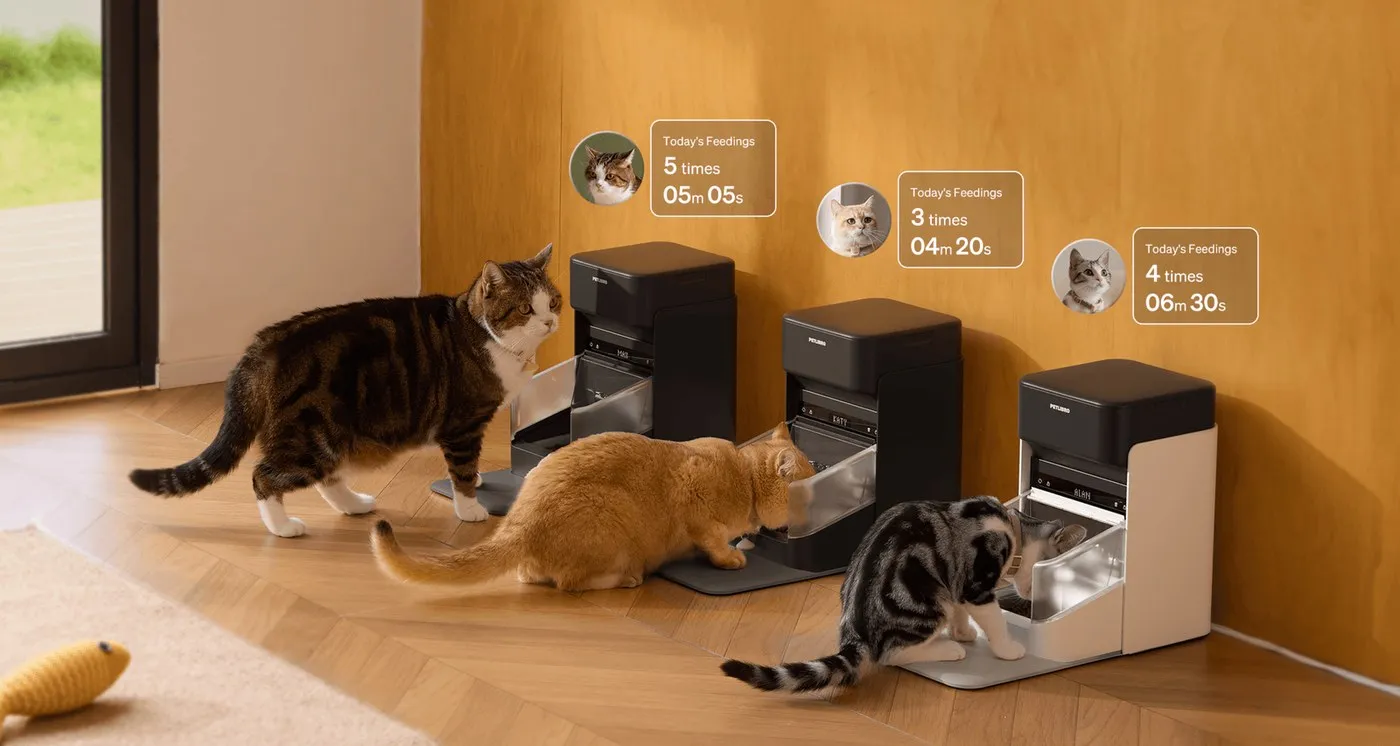
Two Feeders, Two Collars, One Cat That Ate Nothing
The short answer: PETLIBRO’s One RFID feeder opens for one thing only, a dedicated collar tag read by a pad under the bowl, and the app cannot tell you when that read stops. On October 18, 2026, an owner with two of the $149.99 feeders wrote that one unit had stopped recognizing either collar while the second unit read both, and PETLIBRO’s public reply confirmed that cross-testing the collars had narrowed the fault to the feeder. On November 4, 2026, a second owner feeding two cats separate prescription diets said one feeder stopped answering a collar overnight and would not re-pair with the other cat’s tag. One household had a ticket and no reply on the day the review went up; the other had waited three weeks.
I read the October 18 review on a Sunday and the November 4 review two days later, and the second one changed how I read the first. A feeder that misreads a tag is an annoyance. A feeder that stops reading tags in a house with two prescription diets is a cat going without food while a support queue decides what to do about it.
petiqlab earns a commission from the Amazon links on this page. Everything below comes from PETLIBRO’s product page and help center read on November 10, 2026, from owner reports held in this site’s material library, and from a Trustpilot reading taken on November 9, 2026. petiqlab has not run a One RFID feeder through a reader failure, and nothing here is veterinary advice. Prices are list prices on the date each one was read, and sales move them.
What does the One RFID feeder read, and what fails first?
PETLIBRO sells the One RFID Smart Feeder at $149.99 with a 3 liter tank, roughly 13 cups, a 4.2 g collar tag measuring 23 x 23 x 14.18 mm, and a 24-month warranty. The reader sits in the mat under the bowl, and PETLIBRO describes the logic in one line: “The RFID reader verifies the pet’s collar tag (not microchip), before allowing the lid to unlock and food to be served.” The same page states the reader works only with the dedicated collar tag, not microchips and not tags from other brands, and that one feeder syncs with one tag. The tag is splashproof only, needs no charging, and is made of a food-safe material the company describes as bite-proof. Two units need at least 10 inches (25 cm) of space between them, and a second RFID feeder inside that gap is on PETLIBRO’s own list of things that break recognition.
That list is worth reading closely, because every entry is physical. The prongs on the reader, the jack at the base, whether the base clicked into place, metal nearby, another feeder too close. One more line sits on the product page rather than the help page: pets that are too tall get poor or no recognition of the collar tag. Those are the documented ways a tag goes unread, and all of them are about geometry or contacts.
What the documentation does not describe is a reader that dies while the geometry stays put. That is the case the two reviews below describe, and it is the case an owner has to prove on their own, because the app has no error code for a reader that has simply stopped.
Why did both collars work on the second feeder?
The October 18 review is short and unusually well structured for a one-star post. The owner wrote that one of two RFID feeders had stopped recognizing the collar, that support had gone quiet since October 18, and that a ticket existed under the number 712484. Then came the sentence that carries the whole diagnosis: both collars still worked on the other feeder.
PETLIBRO’s public reply repeated the same fact back in different words, and that repetition is the useful part:
We understand that one of your two RFID feeders suddenly stopped recognizing either of your cats’ collar tags, even though both collars continue to work with your other feeder. We appreciate that you completed the requested checks and cross-tested both collars, which helped narrow down the issue to the affected feeder.
A company reply that describes the customer’s cross-test as the thing that located the fault is an admission that the cross-test worked. Two collars, two feeders, four combinations, and only one corner of that grid fails. Collar, cat, tag position and household wiring are all still in the room and all still working. What is left is the reader in the failed unit or the board behind it.
This is a controlled experiment a household can run in ten minutes, and it costs nothing. Most troubleshooting guides ask an owner to reset, re-pair and wait. A cross-test asks a question that has an answer, which is why it should be the first thing done and the first thing written down. The same read-zone geometry causes a softer version of the fault, a lid that closes on a cat still eating, and that case is covered in the One RFID lid article.
What does the app show while a cat is not eating?
The meal log records what the feeder was told to do. A scheduled dispense appears there whether or not a cat reached the food, and a feeder with a dead reader will still report the 6 AM portion if the schedule runs and the auger turns behind a shut lid. None of that is a measurement of food eaten, and no screen in the app adds one.
The gap widens on battery power. PETLIBRO states that batteries are emergency backup only, and that on battery power alone the Wi-Fi function and the reset button are both disabled while scheduled meals keep running. Meals continue, evidence stops. A reader fault during an outage would leave no log, no push and no remote view of the mistake.
Three checks replace the missing signal. Weigh the bowl on a kitchen scale that resolves 1 gram, before and after a meal, and write the number down. Point a camera at the bowl if the house has one, so the footage shows which cat arrived and whether the lid moved. Watch one full cycle at the feeder with a hand on the lid, which is unpleasant and takes four minutes.
Why does a dead reader cost more in a two-diet house?
Read the November 4 review and the arithmetic stops being about hardware. The owner bought two feeders five months earlier for cats that require separate prescription diet food. Three weeks before the review, one feeder stopped answering the collar in the middle of the night. The lid did not open, so that cat could not eat. The unit would not re-pair with the other cat’s collar either, which moved the fault off the collar and onto the feeder, in the owner’s reading.
Two cats, two foods, one working door. In that house the failure is not a missing meal. It is a cat on a therapeutic diet with no access to that diet, and a second cat with access to both bowls. Prescription food is prescribed for a reason, and a household where the two bowls are no longer separated has a problem the app will never show, because nothing in the log records a cat eating the wrong dinner.
The service side of the same review is worth quoting because it is a pattern rather than an accident. The owner emailed, then called twice. Both calls returned the same recorded line about higher than normal call volume, with an option to leave a message and no option to hold. That was three weeks before the review was written.
The October 22 review adds the second half of the pattern. A warranty claim on a different RFID feeder, case 715896, inside the two-year window, door no longer working. The reply came from a chat system that rejected the video three times on codec grounds, then promised a supervisor within 3 days. Nothing followed. A support process that cannot accept a phone video is a support process that cannot see the one piece of evidence that settles a reader fault.
Trustpilot’s summary page for petlibro.com read 3.2 out of 5 from 1,117 reviews on November 9, 2026, with replies to 77% of negative reviews within two weeks. A reply rate is a measure of presence. None of the three households above needed a reply. Each needed a part.
What do the four cross-test combinations prove?
Run the grid before opening a ticket, and photograph the result. The table is the evidence, and a support agent can read it faster than a paragraph.
| Collar | Feeder A (suspect) | Feeder B (known good) | Reading |
|---|---|---|---|
| Cat 1 tag | Lid stays shut, no dispense | Lid opens, dispense logged | Tag works, unit A does not read |
| Cat 2 tag | Lid stays shut, no dispense | Lid opens, dispense logged | Two tags eliminated, unit A is the fault |
| Cat 1 tag, held 2 in above the pad | Intermittent open | Opens | Reader alive but weak, check spacing and metal |
| Either tag, feeder A unplugged and replugged | Opens once, then fails again | Unchanged | Contact or board fault, not a settings fault |
Two rules make the grid trustworthy. Change one variable at a time, and keep both feeders powered so the logs keep running. A test run on a unit that has been factory reset and left offline proves nothing, because a reset erases the pairing and the log along with it.
If the grid shows the same result in the first two rows, the written script is finished. What remains is a claim, and a claim needs the video, the ticket number and the date of the first failed meal.
What can you do tonight with no reply from support?
Five moves, in this order.
- Feed the diet cat by hand. Split the daily ration across two or three timed servings and put the bowl down in a closed room, so the second cat cannot reach it. A feeder that opens for nothing is a bowl with a motor.
- Keep the failed unit powered and paired. The log is the evidence of when meals stopped, and a reset deletes the pairing. Photograph the log screen before touching anything in the app.
- Record one video that shows the failure end to end. Tag on collar, tag over the pad, lid staying shut, dispense line in the app. Mention the case number on camera. One clean clip beats three uploads that a chat system rejects on codec.
- Open the return path in parallel with the warranty claim. PETLIBRO gives 30 days from delivery with original packaging required, and returns that are not fault-related have shipping deducted. The warranty clause breakdown lists which parts the policy quietly calls normal wear. Two clocks run at once, and the shorter one is the return window.
- Borrow or buy a stopgap. A second-hand microchip feeder or a plain scheduled feeder with no tag reader at all will hold the diet line while the claim moves. The cost of a stopgap is smaller than the cost of a cat that stops eating.
None of this fixes a reader. All of it keeps the household fed while somebody else decides whether to send a part.
Which feeder separates two cats without a collar at all?
The SureFeed Microchip Pet Feeder reads identity from the animal rather than a 4.2 g collar tag. Sure Petcare lists a 400 ml bowl that holds two pouches of wet food, compatibility with all identification microchips worldwide plus SureFlap RFID tags, memory for 32 pet identities that survives battery removal, roughly 6 months of runtime on 4 C cells, and a 3-year warranty. A training mode introduces lid movement gradually. PetSafe takes the other route with the Smart Feed 2nd Generation: 24 cups of dry food, up to 12 meals a day, portions from 1/8 cup to 4 cups, four D-cell backup batteries, and a $134.99 listing when this site last read the page in September 2026. Neither device needs an account to open a lid. Neither dispenses a measured prescription ration on a schedule, which is the half of the problem a person still owns.
The microchip feeder comparison covers the rest of that category, including the Connect version that adds a hub and an app, and why the offline model is the one recommended for a two-cat house. The short version: every account, hub or cloud service added between the chip and the lid is one more thing that can stop answering, and this article exists because something stopped answering.
For a single-cat home the cheaper answer is a plain scheduled feeder with no pet detection. No reader, no tag, no identity to lose.
What should be set up before leaving two cats alone?
A five-minute inventory, and every item on the list has a failure behind it.
- Weigh both bowls for two days before the trip, so a normal portion has a number rather than an impression.
- Confirm which feeder each cat uses, and photograph the pairing screen for both units.
- Test the cross-grid once, on a day when someone is home, and keep the result.
- Put a camera on the food station if the house has one; the TP-Link Tapo C210 records to a microSD card with no subscription, which survives any account problem.
- Leave a written feeding plan for the sitter that assumes no app access at all.
- Keep one bag of each diet outside the feeders, so a failure does not become a shopping trip.
The point of the list is not the list. It is the assumption behind it: the machines are the convenience layer, and a person or a scale is the backstop.
Sources
- PETLIBRO One RFID Smart Feeder product page (read November 10, 2026)
- PETLIBRO help: collar tag not recognized near the RFID reader (read November 10, 2026)
- PETLIBRO warranty and return policy (read November 10, 2026)
- Trustpilot review, October 18, 2026, ticket 712484
- Trustpilot review, November 4, 2026, two prescription diets
- Trustpilot review, October 22, 2026, case 715896
- Trustpilot review, October 27, 2026, cat missed a day of food
- Sure Petcare Microchip Pet Feeder specifications (read November 10, 2026)
- Reddit r/Petlibro, October 24, 2026, lid behaviour on the same feeder line
FAQ
Why does my PETLIBRO One RFID feeder stop recognizing the collar?
PETLIBRO’s help center lists the physical causes first: the reader prongs, the jack at the base, whether the base clicked into place, metal objects and other electronics close to the feeder, and two RFID feeders standing closer than 10 inches (25 cm) apart. The product page adds a body-size limit, stating that pets which are too tall get poor or no recognition. Those checks explain one collar going unread. When both collars fail on one unit and both work on the other, the published list no longer covers it, because the tag and the cat have already been eliminated.
Can the feeder read a microchip instead of the collar tag?
No. PETLIBRO answers that question on the product page: the reader works only with the dedicated collar tag, not microchips or other brands, and the feeder can only sync with one tag. That is the difference between this unit and a microchip feeder such as the SureFeed, which reads an implanted chip and stores up to 32 identities. A household with two cats on separate prescription diets needs one feeder per cat here, because one unit cannot hold two tags.
What happens if the collar tag is lost or damaged?
The feeder keeps one identity in memory, so a lost tag means a feeder that will not open for any cat. The tag needs no charging, carries a QR code and is splashproof only, which makes a collar the weakest part of the system. While a replacement tag is arranged, feed both cats by hand and keep the two diets in separate rooms. The feeder cannot do that job without its tag, and no setting in the app changes that.
Does the feeder keep its schedule during a power cut?
Yes, with a catch. PETLIBRO states that batteries are emergency backup only and that on battery power alone the Wi-Fi function and the reset button are disabled while meal schedules carry out normally. So the meals continue and the evidence stops: no app log, no notification, no remote check. That matters in exactly the case this article covers, because a reader fault that occurs during an outage is invisible until the power returns.
How long can a cat safely go without food?
That is a question for your vet, not for a review site, and the answer depends on age, weight and existing conditions. What a feeder owner can control is the detection delay. A missed meal is noise. A missed day is a reason to call a clinic. The reports in this article show delays measured in days, not hours, which is why the verification steps above matter more than the app notification.
Which automatic feeder separates two cats without a collar?
A microchip feeder. The SureFeed Microchip Pet Feeder reads any implanted chip or a SureFlap tag, stores up to 32 identities, holds 400 ml or two pouches of wet food, runs about 6 months on 4 C cells and carries a 3-year warranty. No account, router or subscription sits in the chain, so a dead reader is a warranty claim rather than a software investigation. The trade is portion control: no microchip feeder dispenses scheduled meals, so a cat that needs measured meals still needs a second device.
Is the 24-month warranty long enough to cover a reader failure?
The warranty runs 24 months and the return window runs 30 days from delivery, with original packaging required and return shipping deducted for non-fault returns. The policy also names parts classed as normal wear, and the feeder rotor is on that list. A reader that stops authenticating is not a wear item in the published text, which makes it a stronger claim than a worn rotor. Document the fault on video while the unit is still powered, then open the claim inside the return window rather than after it.