Microchip Cat Feeders: Per-Cat Portions Without the Cloud
PETLIBRO’s August outage made its RFID feeders untrustworthy for the one job they exist to do: feeding the cat while you are away. Multi-cat owners bought those feeders for per-cat portion control, and now the moderator of the brand’s own subreddit has pinned a thread where people discuss what to replace them with. The answer owners keep naming is a feeder type that reads the cat’s implanted microchip, needs no collar tag, and has no server that can go down.
I spent an evening inside that alternatives thread. It is 123 upvotes and 118 comments of people doing the math on what to buy next, and the moderator’s opening line tells you how we got here:
In light of the recent server outages and customer service problems I have had a lot of requests for a pinned thread to discuss alternatives to Petlibro products.
A brand’s own community asking for an escape thread is a signal. The thread is the closest thing to a consumer referendum on RFID feeders that I have seen, and the feeder that keeps coming up is the SureFeed microchip feeder. Before I get to it, here is why these owners are so specific about what they need.
Why per-cat feeding is the reason people buy these at all
The short answer: for multi-cat households, the whole point of an RFID or microchip feeder is that each cat eats its own food, and losing that means the product failed at its only job.
The most useful comment in the thread comes from an owner with four cats on a weight-loss plan:
This is the most important feature so all 4 of my cats leave the others food alone and stay at a healthy weight. We bought this type of feeder to help them lose weight and 3 out of 4 of them have reached their target weight.
That is the real use case, not the marketing photos. Prescription diets, a senior cat on renal food, a chubby cat and a grazer under one roof, a bully who finishes everyone else’s bowl. For those households the feeder is the only way to make the food assignment stick. One commenter put it in four words: “It’s the whole reason I went with Petlibro.”
So when the platform underneath that job fails, the failure is not a firmware annoyance. The food-stealing problem the owner paid to solve is back.
The outage turned RFID feeders into a trust problem
The short answer: owners documented missed meals, the company’s local-scheduling claim was contradicted on video, and a 390-upvote thread called the product class-action territory.
The 390-upvote thread from mid-August is the clearest statement of the problem, and it is worth quoting at length:
I got this product so I could go for a couple days and know my cat would be fed. Now, because of your crappy app and servers, I can’t trust it to do the one thing I bought it for. What am I supposed to do when I’m 5 hours away and the servers go down again or my internet blips?
The same owner later: “If you can’t make the devices work if something as mundane and commonplace as the internet goes out or your servers melt down again, your product is bordering on a scam and honestly seems worthy of a class action.”
The top comment, 107 upvotes, frames the deeper fear: “what if they go out of business tomorrow? Now we have proof that all of the products we own would be paperweights without their servers.”
A 226-upvote thread covered the moment PETLIBRO claimed local schedules kept feeding. Owners filmed the opposite. The 35-upvote top comment: “Server outages happen, but they definitely lied about what happens to devices in such situations and were exposed big time. It’s cause for legal action, for sure.”
And when CEO York Wu posted an open letter, a registered user with connected devices answered with the detail that says everything about the support experience: “I am a registered user with connected devices and never received one of their emails. I have to come to Reddit to find these things out which is atrocious customer service.” 145 upvotes.
The RFID-specific record is not better. An owner of two RFID Smart Feeders and an RFID fountain reported all of them failing in different ways, with both feeders silently dropping the low-food notification, the alert that tells you the bowl is empty while you are out. That failure is documented in our PETLIBRO feeder review and it sits at the exact intersection of the two weak points in this product type: a cloud dependency and a collar tag.
Microchip vs RFID collar tag: what actually changes
The short answer: an RFID feeder identifies the cat by a battery-powered tag on a collar, a microchip feeder identifies the cat by the implant it already has, and only one of those survives a lost collar and a dead server.
Two differences matter, and they are not the same difference.
Identification. RFID feeders pair with a small tag the cat wears on its collar. The tag holds a battery. Batteries die. Tags snap off on branches, get pulled off in fights, and get removed by owners of cats that refuse collars entirely. A microchip feeder reads the transponder already implanted under the cat’s skin, the same chip the shelter or breeder registered at adoption. Nothing to charge, nothing to lose, nothing for the cat to fight. One owner in the alternatives thread put the mechanism plainly: “it only opens up for whichever cat you registered the microchip with.”
Architecture. PETLIBRO’s RFID feeders keep their schedule logic tied to the app and the server. When the server melts down, so does breakfast. The local scheduling follow-up covers what happened when the company claimed otherwise. A microchip feeder of the SureFeed type does not have this failure mode because it does not have the architecture: no app, no account, no server. The schedule lives in the device.
SureFeed: the feeder owners name when they leave
The short answer: the SureFeed Microchip Pet Feeder is the alternative most often named in the escape thread, and its design removes both failure points: it reads the implant and it has no cloud to fail.
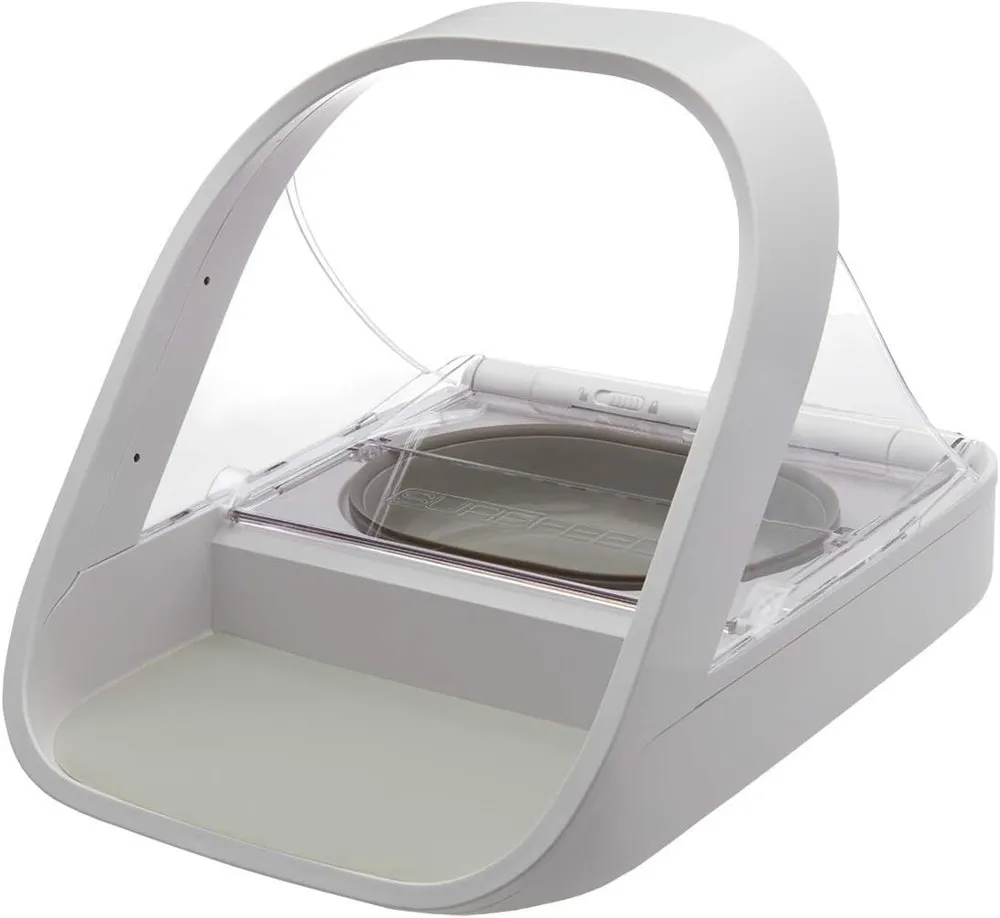
Sure Petcare makes the SureFeed, a battery-powered feeder with a lid that opens only for registered microchips and closes again when the cat steps away. It is not a smart feeder in the app sense. There is nothing to sign into, no subscription tier, no firmware update that can brick it while you sleep. The optional Connect version adds activity tracking through a Hub sold separately, but the feeding function does not depend on the Hub, and the standard unit has no connectivity at all.
The company profile backs up the “it just works” positioning better than most in this category. Sure Petcare’s Trustpilot page shows 4.5/5 across 3,760 reviews, and the platform’s own summary of the recent pool highlights “replacement parts or complete units are shipped promptly without extra cost when items malfunction.” The profile says the company replies to 85% of negative reviews, typically within 48 hours. Contrast that with the PETLIBRO thread where the CEO’s open letter never reached registered users.
A commenter in r/SurePetcare described the warranty the same way owners describe PetSafe in our files: “Their products carry a 3 year warranty period, and when one of ours went funny a few years ago, they were really good at sending a new one out. We have four cats.”
The owner reports that keep me honest
The short answer: microchip feeders have their own documented faults, but the failure mode is local, rare, and backed by a warranty desk that answers, which is the opposite of a server outage.
I checked the complaint side before recommending this, because every feeder category on this site has one. The freshest SureFeed complaint in my files is an August 15 thread in r/SurePetcare: a feeder stopped opening for the cat, worked for a day or two after a factory reset and retrain, then stopped again. That is a real fault and I will not wave it away. Note what it is not: it is not 100,000 devices going dark at once because one company’s cloud died. It is one unit with a sensor problem, and the support culture around it is the difference. The same thread’s reply mentions the 3-year warranty and a past replacement that shipped quickly.
Trustpilot’s five-star pool has the same shape. A July 2026 review from New Zealand reads: “Great support and warranty service in NZ, just wish didn’t have to use it so much. First installed Microchip CatFlap Connect + hub 6 years ago. I am now on my 2nd hub and 4th catflap.” That is the honest version of this brand: the hardware is not immortal, the support is. Compare that to PETLIBRO owners who could not get a reply about a feeder that stopped feeding.
What to buy instead
The short answer: for multi-cat per-cat feeding, the SureFeed Microchip Pet Feeder is the alternative our research lands on; for a single cat on a simple dry-food schedule, the PetSafe Smart Feed remains the cheaper no-subscription pick.
The SureFeed reads each cat’s implant, so there is no collar tag to charge, lose, or fight over. It runs on batteries with no app and no account, which is the entire point after August 2026: there is no server between your cat and its breakfast. One unit serves one cat at a time, split bowls let two cats share a unit on different portions, and larger households run multiple units side by side. Budget for hardware, because that is the only cost.
Know the caveats before you click. Cats can need a few days to accept a closed lid they have to trigger. The feeder recognizes microchips, so every cat needs one, which most pet cats already have. And the documented sensor faults above mean you buy from the warranty desk as much as from the product. That desk, per 3,760 Trustpilot reviews and the replies-to-negative-reviews rate, is the part of Sure Petcare that actually shows up.
For a single cat or a simple two-meal schedule, the PetSafe Smart Feed in our comparison stores its schedule on the device and charges nothing per month. It cannot split meals between cats, so it is not the answer to the multi-cat problem this article is about.
Five questions before you buy a per-cat feeder
This is the list I wish someone had handed the owners in the escape thread. It takes ten minutes and it catches every failure mode in this category.
| # | Question | What a good answer looks like | What a red flag looks like |
|---|---|---|---|
| 1 | How does the feeder identify each cat? | Implanted microchip, nothing to wear | A collar tag with a battery |
| 2 | Where does the feeding schedule live? | On the device, offline | On the vendor’s server |
| 3 | What happens when the company’s cloud goes down? | Nothing, there is no cloud | Meals stop until it comes back |
| 4 | Is there a subscription? | No | A fee tier that grows with your cats |
| 5 | What does the warranty desk do when a unit fails? | Answers, replaces, ships parts | Ghosts emails and closes tickets |
The architecture question is the one that costs the least to ask and the most to skip. Every feeder brand will tell you its app is great. Ask instead what the feeder does when the app’s servers are unreachable, then unplug your router for a day and watch. That test would have saved the PETLIBRO owners their August.
FAQ
What is a microchip cat feeder? A feeder that reads the microchip already implanted in your cat and opens its lid only for registered pets. The SureFeed from Sure Petcare is the best-known unit: it runs on batteries, needs no app, no wifi, and no subscription, and it works with both wet and dry food. It solves per-cat feeding because each cat is identified by its own implant, not by a collar it might lose.
Microchip vs RFID collar tag: which is better for a feeder? For reliability, the microchip. An implanted microchip is permanent, has no battery, and cannot fall off. An RFID collar tag is a small battery-powered disc the cat wears; the battery dies, the tag can snap off, and a cat that hates collars will fight it. The catch with microchip feeders is that they only recognize chips, so every cat in the house needs one, which most pet cats already have.
Do microchip feeders need wifi or a subscription? The standard SureFeed does not. It is a standalone, battery-powered device with no connectivity at all, which is exactly why a server outage cannot stop it from feeding. SureFeed Connect adds activity tracking through a separate Hub, and the Hub needs wifi, but feeding still runs locally on the feeder either way. No subscription is required for the feeder itself.
Why are PETLIBRO owners switching to microchip feeders? PETLIBRO’s August 2026 server outage took RFID feeders offline and missed scheduled meals, and the company’s claim that local schedules kept running was contradicted by owners filming the opposite. A 390-upvote thread called the products worthy of a class action, and the moderator had to open a pinned thread for alternatives. Owners with multiple cats specifically named microchip feeders like SureFeed as the replacement, because per-cat feeding is the one job the feeders must do.
How many cats can one SureFeed handle? One unit serves one cat at a time, but Sure Petcare sells split bowls that let a single feeder portion meals for two cats, and multiple feeders can sit next to each other for larger households. The trade-off: a two-cat setup with split bowls means the cats share the feeder’s bowl area, and each additional pair of cats wants its own unit. Budget for the hardware, not for software, because there is no subscription.
What should I buy for multi-cat per-cat feeding? The SureFeed Microchip Pet Feeder is the pick our research points to: microchip identification, no cloud, no subscription, and a company Trustpilot score of 4.5/5 across 3,760 reviews with replies to 85% of negative reviews within 48 hours. For a single cat or a simple dry-food schedule, the PetSafe Smart Feed remains the no-subscription pick at a lower price. Avoid RFID collar-tag feeders whose schedules depend on a vendor server.
PETLIBRO sold multi-cat owners a promise: each cat eats its own food. Then the servers went down and the promise went with them. The microchip feeder is the boring answer to that problem, and boring is the point. A feeder with no app, no account, and no server has nothing left to fail while you are five hours away.
Updated: August 25, 2026. Owner reports from r/Petlibro (August 2026: the 390-upvote class-action thread, the 226-upvote local-scheduling rebuttal, the 82-upvote CEO letter thread, the 123-upvote alternatives thread), r/SurePetcare (August 15 2026), and the Sure Petcare Trustpilot profile (4.5/5, 3,760 reviews). Prices and warranty terms change; verify before purchase.