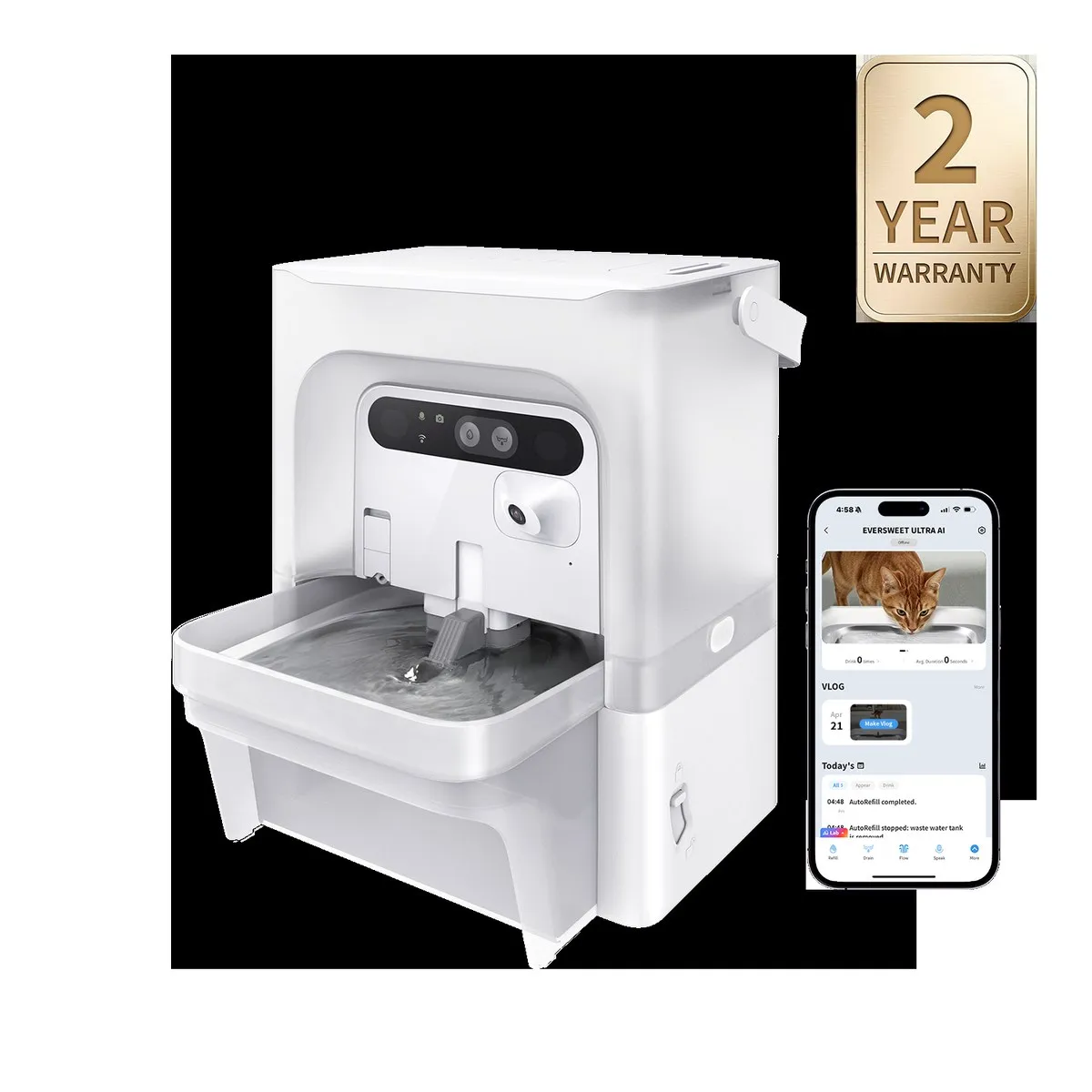
PETKIT's $249.99 Fountain Has a Camera. Where Does Footage Go?
The short answer: the EverSweet Ultra is the only fountain PETKIT sells with a camera in its name, and the camera is not decoration. It reads the water tray, identifies up to 15 pets at 140 degrees, and triggers a refill when the tray drops below 220 ml. The product page promises one-tap camera shutoff and end-to-end encryption. The privacy policy, updated September 3, 2025, says personal data may sit on servers in the United States, sets no retention period, and never mentions video. On October 21, 2026, one owner posted a traffic log claiming hundreds of megabytes leaving the unit. PETKIT answered that the footage was probably the app’s sample videos. Five tests below settle the question on your own unit.
I read that thread on a Wednesday morning with a fountain humming two rooms away, and the megabytes were not the part that stuck. The closing question was. Why does a machine that moves water into a bowl need a wide-angle camera with night vision in the first place?
My guess, and it is only a guess, is cost. A float switch reports one water level. A camera reports a level plus which cat drank plus a hydration chart, and PETKIT needed the last two to sell a $249.99 fountain in a category where $59.99 buys a working one. That is a reasonable product decision. It also puts a network camera in the one room of the house where nobody expects one, and it moves a decision that used to belong to a switch into a cloud service.
petiqlab earns a commission from the Amazon links on this page. Everything below comes from PETKIT’s product page, privacy policy and app page, all read on November 11, 2026, from an owner report held in this site’s material library, and from a Trustpilot reading taken the same day. petiqlab has not run an EverSweet Ultra and has not captured its own traffic. The packet-level claims in the middle of this article belong to one owner, and the article says so every time.
What does the camera on the EverSweet Ultra actually do?
PETKIT lists the EverSweet Ultra at $249.99, model P4117, with a 5 L clean tank and a 1.8 L waste tank. The unit weighs 7.71 lb (3.5 kg) and measures 11.41 by 11.96 by 13.89 inches, runs on 12V 2A, and connects over 2.4 GHz and 5 GHz Wi-Fi plus Bluetooth 4.0. A 140-degree AI camera recognizes up to 15 pets from photos added in the PETKIT app, and PETKIT states that no further training is required. That same camera measures the tray, with refills starting below 220 ml and stopping once the tray is full. Sound is rated 26 dB, close to a whisper. Cube C, the filter cube, carries a 30-day replacement interval and must stay installed at all times. The product page showed 98 reviews on November 11, 2026. The tray, fountain outlet and magnetic strainer are dishwasher safe, PETKIT lists ABS, 304 stainless steel, PP and PPO among the materials, and the unit is rated for cats and small-breed dogs.
Read that list twice and the architecture is clear. This is a two-tank design with no recirculating pump and no filter cartridge in the old sense. Fresh water leaves the 5 L tank, lands in a stainless tray, and used water drains into the 1.8 L tank on a schedule or on command. Nothing loops back, so PETKIT can advertise a fountain with no filter to change and still sell a cube.
The cube is the part worth noticing. PETKIT tells buyers to replace Cube C every 30 days for water quality, and calls it a structural component that must stay installed at all times. A filter subscription is a recurring cost. A structural consumable with a 30-day clock is a different kind of recurring cost, because the fountain stops being a fountain without it.
One question that the page raises and does not answer: whether automatic refills survive with the camera switched off. The tray level is measured by the camera. The privacy paragraph says one tap turns the camera off. Those two statements sit on the same page and nobody at PETKIT has published what happens in between, which makes it the first thing to test rather than assume.
Why does a water fountain need a camera in the first place?
Because the camera is a cheaper multi-purpose sensor than the alternative. A float or a conductivity probe answers one question, is the tray empty. It cannot tell a cat from a dog, cannot name the cat, cannot chart intake per animal, and cannot tell a full tray from a blocked drain. An optical sensor with recognition software answers all of those, and PETKIT had already built that software for two other categories.
The trade is visible in the product line. Five fountains sit on petkit.com, and exactly one of them carries a camera.
| Model | Price on Nov 11, 2026 | Camera in the listing | What you give up |
|---|---|---|---|
| EverSweet Ultra | $249.99 | 140-degree AI camera, 15 pets | Nothing on paper, everything on network exposure |
| EverSweet Max 2 (UVC) | $99.99 | None | Per-pet intake data |
| EverSweet 3 Pro (UVC) | $79.99 | None | Per-pet intake data, wireless pump sold separately |
| EverSweet Solo 2 | $59.99 | None | Per-pet intake data, app features |
| EverSweet Solo SE | $29.99 | None | Everything above, plus app control |
The last column is the honest one. A camera-free fountain is not a stripped Ultra with a smaller bill. It is a different product with a narrower job, and buyers who want to know which of two cats drinks less in a day do not have a camera-free option in this line. The pump guide covers the part that actually fails on the cheaper models, and the Eversweet 3 Pro review covers the model this site has recommended for two years.
What does PETKIT’s privacy policy actually promise?
PETKIT’s privacy policy carries a September 3, 2025 update date, and section 20 states that personal information may be maintained or accessed in servers or files in the United States of America. The same section tells anyone who does not consent to that processing not to provide the information at all. Section 5 sets no fixed retention period, only a promise to keep data as long as necessary to fulfill the purpose. Section 14(c) lists PETKIT’s GDPR legal bases and names Pixieset, a photo-gallery company, as the operator pursuing those interests. A separate sentence states that PETKIT is not responsible for security incidents that result in the wrongful access to your Personal Data. The policy also reserves the right to amend the document at any time, with or without notice, and states that revisions are not retroactive. The mailing address on the policy is 13353 Benson Ave, Chino, California, and the support address is service@petkit.com.
Three gaps matter more than any single line. The policy never uses the words camera, video or footage, so a reader cannot tell whether a feed counts as Personal Data under the definitions the document does provide. The retention section covers purpose and law but never names a number of days. And the Pixieset reference, sitting inside a GDPR list about PETKIT’s own legitimate interests, shows that at least one paragraph was adapted from another company’s template.
A templated policy is not a crime. Almost every hardware company starts from a template, and the PETKIT document is more complete than most in this category. But a reader deciding whether to put a camera in a pet’s water bowl needs one specific answer, and a document that names the wrong company in its legal-bases list has not earned the benefit of the doubt on the specific answer.
The gap has a second edge. PETKIT sells the camera on privacy terms, with a page section headed “Your privacy, your control.” The claim is that one tap turns the camera off, that monitoring hours can be scheduled, and that footage is end-to-end encrypted so only the owner can see it. End-to-end encryption is a strong claim about a device that also phones a server to deliver alerts on a phone in another city. Either the video path and the alert path are separate, or the words are doing less work than a shopper would assume. The page does not explain which.
What did one owner’s traffic log show, and what did PETKIT say?
On October 21, 2026, an owner in r/PETKIT posted a thread of questions about security, privacy and data residency, and the thread collected 24 points and 34 comments before the original post was deleted. The measured claim was blunt. Hundreds of megabytes left the fountain, the destination looked like servers in China, blocking the addresses produced new ones, and blocking DNS lookups pushed the device to Google’s resolver and then Cloudflare’s. The same post asked why a drinking fountain needs an ultra-wide high-definition camera with night vision, and whether a fountain needs a microphone at all. PETKIT answered in the thread that the author had deleted the post and that the confusion likely came from sample videos in the app’s Explore tab, and no traffic documentation has been published since.
A rotating address is the part of that report which is hardest to check and easiest to explain. Camera feeds route through a CDN or a relay, and relays rotate by design. What the report lacks is the layer above the address, which is the domain the device asked for before any connection opened. A DNS query log answers that question. An IP list does not, which is why the strongest public evidence in this category is a list of hostnames rather than a screenshot of addresses.
Two readings are available, and honesty requires giving both. The owner’s reading is a device uploading far more than a water-level reading should require. PETKIT’s reading is a person watching demo clips inside an app and attributing them to a camera in the kitchen. Neither can be settled from the outside, because the post that held the logs is gone and PETKIT has published no traffic documentation.
What can be settled is that the vendor’s explanation is testable, and testing it takes an evening rather than a laboratory.
How do you test your own fountain in one evening?
Five steps, in this order. Each one produces a number or a filename you can keep.
- Put the fountain on its own network. A guest SSID on the router is enough. Note the byte counters before and after 24 hours with normal use. A fountain that moves 5 L of water should not need a large upload allowance, and the counter gives you a figure instead of an impression.
- Run the same 24 hours with the camera off, using the one-tap control PETKIT describes. Compare the two upload figures. A drop means the feed is the traffic. No drop means something else is talking.
- Log the DNS queries. Pi-hole, AdGuard Home or the router’s own query log will show which domains the unit resolves. Save the list. Domain names survive an IP change. Addresses do not.
- Watch the tray while the camera is off. Confirm whether automatic refills still start below 220 ml, and whether the drain schedule still runs. This is the functional half of the same test, and it matters more than the privacy half for a cat that needs water while nobody is home.
- Ask PETKIT in writing. The policy lists rights for California and EU readers. Request the categories of data collected, whether video is among them, and the retention period. Keep the reply.
Step four is the one I would run first if a cat lived in my house. A fountain whose refill logic depends on a camera that fails closed is a dry bowl with a nice app, and the failure would happen on the day a camera firmware update lands, which is exactly the day nobody is watching the tray.
Which EverSweet model does the same job without a camera?
The EverSweet 3 Pro at $79.99. This site has recommended that model since August 2026, it runs a wireless pump that sells as a separate part, and the pump is the part that fails. A fountain whose pump can be bought for $15.99 is a fountain that survives year three. A fountain whose pump is sealed inside a $249.99 chassis is a warranty conversation.
What you lose is real. No per-pet drinking data, no 220 ml refill intelligence, no camera view of the bowl while you are away. If the reason you are buying a fountain is a cat on a prescription diet who needs intake tracked, the Ultra is the only device in the line that attempts the job, and the security-flaw writeup on a rival feeder shows how thin the security layer under these features usually is.
Two more numbers for the decision. PETKIT’s Trustpilot page read 3.8 out of 5 from 397 reviews on November 11, 2026, with replies to 89% of negative reviews inside a week. Those figures describe the brand, not this fountain. The Ultra’s own product page showed 98 reviews, and its review section runs the usual mix of five-star notes about the camera and one-star notes about a machine that refilled at random and overflowed after three months.
For the camera side of the same question, the pet camera subscription comparison is the closer read. A camera in a fountain and a camera on a shelf fail the same way. The storage bill arrives later, and the privacy terms arrive never.
What should you do if the fountain is already in your kitchen?
Four moves, none of which require returning it.
- Set monitoring hours instead of leaving the camera on all night. PETKIT documents the setting. A camera that watches from 8 AM to 10 PM still answers the question the fountain was bought to answer.
- Keep the manual refill button in your head. The touch panel has one. If a firmware update changes what the camera does, the panel is the fallback, and it works without an account.
- Put the unit on the guest network. A fountain has no business on the same subnet as a work laptop, and the isolation costs nothing.
- Photograph the water level for a week. Ten seconds a day on a phone camera beats a hydration chart you cannot export, and it is the number a vet will actually ask about.
Four hedges, no fixes. The feature arrived faster than the documentation did, and the person holding the router is the only one who can measure the gap. Start with a 24-hour byte count on a guest network. One number from your own router settles more than a hundred comments on a thread.
Sources
- PETKIT EverSweet Ultra with Camera product page (read November 11, 2026)
- PETKIT privacy policy, updated September 3, 2025 (read November 11, 2026)
- PETKIT App service page (read November 11, 2026)
- r/PETKIT thread, October 21, 2026, security and data residency questions
- Trustpilot, petkit.com (read November 11, 2026)
- PETKIT EverSweet 3 Pro (UVC) product page
- PETKIT Eversweet wireless pump part
FAQ
Does the PETKIT EverSweet Ultra camera record video?
PETKIT describes a 140-degree AI camera that identifies up to 15 pets from photos loaded in the PETKIT app, and a hydration history the app shows over time. The product page does not publish a recording schedule, a clip length or a storage period. What the page does publish is a privacy paragraph stating that one tap turns the camera off, that monitoring hours can be set, and that footage is end-to-end encrypted and visible only to the owner.
Can you turn off the camera on the EverSweet Ultra?
Yes. PETKIT’s product page says one tap turns the camera off and that custom monitoring hours are available. The page does not say what stops working afterwards. That matters because PETKIT states the tray level is monitored by the AI camera continuously and that refills begin when the tray drops below 220 ml. Whether automatic refills continue with the camera off is the first thing to test on your own unit, and the refill button on the touch panel is the manual fallback to check at the same time.
Where does PETKIT store fountain data?
The published privacy policy, updated September 3, 2025, does not mention fountains or camera footage at all. Section 20 states that personal information may be maintained or accessed in servers or files in the United States of America, and tells anyone who does not consent to that processing not to provide the information. Section 5 sets no fixed retention period. The policy never separates account data from video, so the storage location of the feed is not answered by the text.
How do I request my data from PETKIT?
Use the rights the policy itself lists for California and EU readers. Send the request to service@petkit.com or to the postal address on the policy, 13353 Benson Ave, Chino, California, and ask for three things in writing: the categories of data collected by the fountain, whether video is among them, and the retention period for each. Keep the reply. A written answer that omits video is itself useful evidence if you later decide the feature is not worth the risk.
Is a camera in a pet fountain useful for anything?
It does two jobs that a float switch does not. It separates drinking by pet, which a single-tank fountain cannot do, and it reports changes in intake that owners use as a rough hydration signal. Both jobs run on identification, so both fail when two cats look alike or when the camera is blocked. Treat the hydration number as a trend to discuss with a vet rather than a diagnosis, and treat the camera as the sensor that makes the refill decision.
Which PETKIT fountain has no camera?
Four models in the same line ship without one. On November 11, 2026, petkit.com listed the EverSweet Max 2 (UVC) at $99.99, the EverSweet 3 Pro (UVC) at $79.99, the EverSweet Solo 2 at $59.99 and the EverSweet Solo SE at $29.99, and only the EverSweet Ultra carries a camera in its name. The 3 Pro adds a wireless pump that sells as a separate part, which keeps the wear item replaceable instead of turning a dead pump into a dead fountain.
Does the EverSweet Ultra work without Wi-Fi?
PETKIT’s own answer is that the app should be paired on first use and that the touch panel carries a drain button and a refill button for quick access. Hydration tracking, pet recognition and smart alerts all depend on the app, so a fountain with no network is a fountain with a refill button. The listing also states 2.4 GHz and 5 GHz Wi-Fi and Bluetooth 4.0, which means the unit expects a network from the first day rather than as an optional extra.