Smart Pet Water Fountain Pump Guide: Why Pumps Die at Month 12
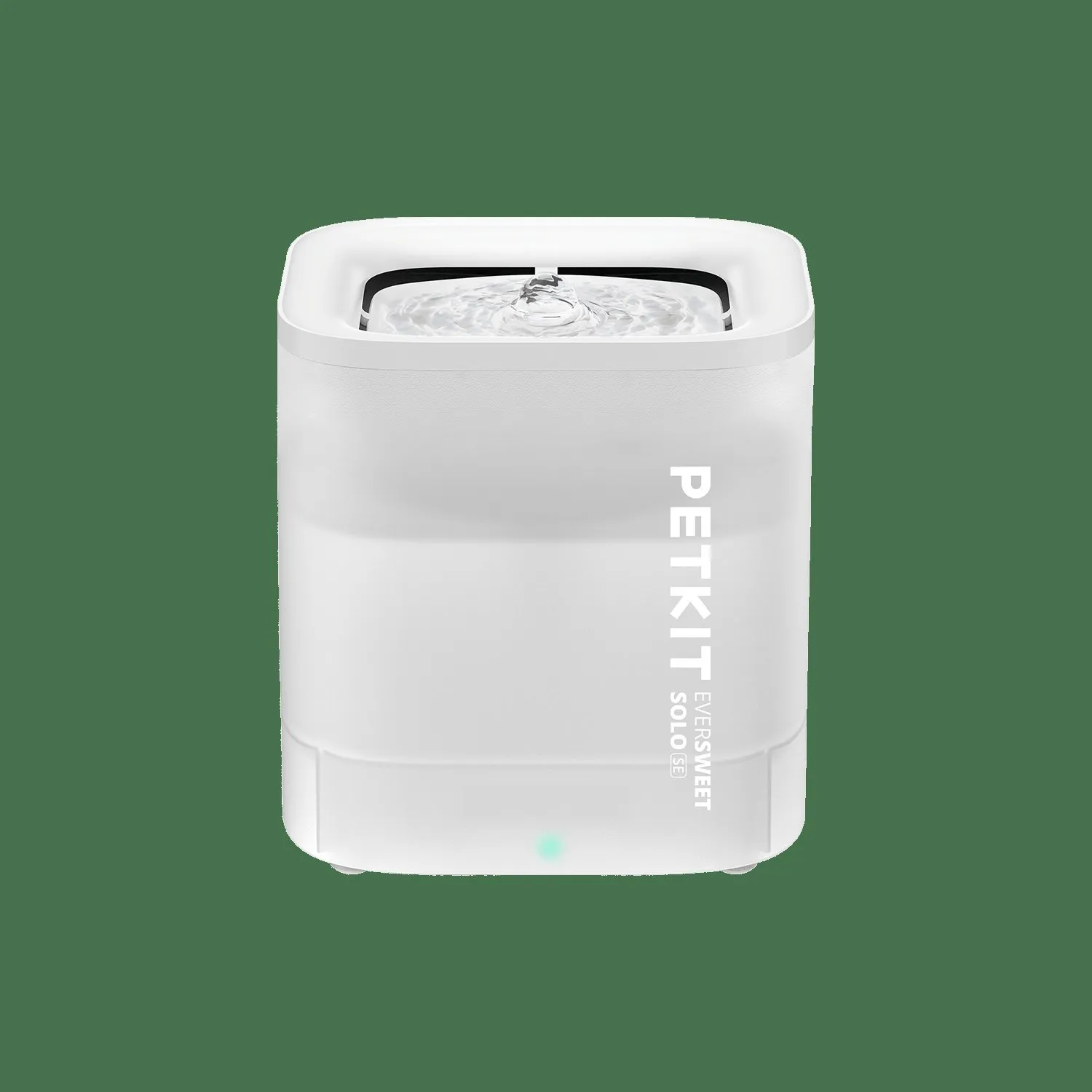
The short answer: smart pet fountain pumps die around month 12-14 in most brands because mineral scale builds up on the impeller until the motor stalls, and most pumps have no low-water sensor, so running dry accelerates the death. The category sits at 3.5/5 on Trustpilot with about 35% of reviews at one star, and the pump is the complaint in nearly every one. A replacement is a standard submersible unit at $15-30, a 20-minute no-tools swap when you match the flow rate and voltage stamped on the body. Budget $30-55 a year for branded filters on top, which puts a $40-80 fountain at $160-305 over three years. The one model that protects against the failure is the PETKIT Eversweet 3 Pro: its pump is wireless, its dry-run protection shuts the motor off before an empty tank burns it out, and the official replacement has its own Amazon listing (B0B2DM5Q7N).
I spent a slow afternoon on Trustpilot last week, reading reviews for the three biggest smart fountain brands, PETKIT, PETLIBRO, and Dockstream, plus the cheap-fountain budget shelf. The category sits at 3.5/5, with about 35% of reviews at one star. Read the 1-star reviews and one pattern repeats until it’s boring: the pump dies somewhere around month 12 to 14, suspiciously close to the warranty line. The fountain body is almost never the complaint.
What surprised me is where the trail led. The same dataset that buries budget fountains at month 4 points back at one model I’d have walked past on price alone, the PETKIT Eversweet 3 Pro. It’s not the cheapest fountain at $62.99, and it still runs $30-55 a year in branded filters. But it’s the one fountain in this category that treats the pump as the product, and the pump is the whole failure story. The PETKIT Trustpilot profile holds that dataset; the recommendation at the end is where it lands.
Why does the pump die at month 12?
The short answer: mineral scale builds on the impeller until the motor stalls, and sealed pumps hide the impeller so the whole unit gets binned instead of descaled.
The mechanism is boring, which is why nobody warns you. Mineral scale from the water builds up on the impeller, the small spinning wheel inside the pump. The scale adds drag, the motor slows, and eventually it stalls. Sealed pumps hide the impeller, so the whole unit goes in the bin; pumps that come apart get a vinegar soak and another cycle.
The warranty timing is the tell. A Chewy verified buyer on the Eversweet put it exactly like this:
“it stopped working right after the warranty expired. The replacement stopped working at 13 months.”
Every brand has a version of that review, and it isn’t a conspiracy; nobody descales until the pump is already dead.
Why is the cheap pump a trap?
The short answer: budget pumps die at 3-6 months instead of 12 — one replacement “worked for four days” — so a cheap fountain that eats $15 pumps is a subscription with extra steps.
Then there’s the budget shelf, where the timeline gets really short. Veken fountains draw the same complaint at 3-6 months instead of 12. One owner’s replacement “worked for four days” before it died, and the second replacement died too. Their verdict:
“This is obviously a cheap pump.”
It is. Here’s the math nobody does at the register: a cheap fountain that eats a $15 pump every few months isn’t cheap. It’s a subscription with extra steps.
What does a fountain cost over three years?
The short answer: $160-305. That covers a $40-80 fountain, $30-60 in replacement pumps, and $90-165 in branded filters over three years.
The numbers add up worse than the price tag suggests. A $40 fountain needing a $15 pump every 12-14 months, plus $30-55 a year in branded filters, lands here over three years:
| Item | Price (est.) | Over 3 years |
|---|---|---|
| Fountain | $40-80 | $40-80 |
| Replacement pumps | $15-30 each | $30-60 (one per 12-14 months) |
| Branded filters | $30-55/year | $90-165 |
| Total | $160-305 |
A plain water bowl costs $10. Whether $160-305 over three years is worth it depends on your cat’s water intake and urinary history: cheap if your cat won’t touch a bowl, a maintenance hobby if it drinks fine from one.
Can running dry kill the pump?
Yes, when the level drops below the intake the motor overheats, and most fountains give no warning. The Eversweet 3 Pro’s dry-run protection shuts it off before it burns out.
Scale is the slow killer; running dry is the fast one. When the level drops below the intake, the pump keeps spinning and the motor overheats, and most fountains give you zero warning. One owner of the PETKIT wireless fountain found out the hard way:
“was empty TWICE but no alert or notification was shown on the APP. I spent 5 days going back and forth with their customer service over 13 emails and still got nowhere.”
That quote is the most common misunderstanding about the wireless PETKIT fountains. Standalone, it pairs over Bluetooth only; phone alerts about water level need a PETKIT main device like the PuraX over Wi-Fi. Nobody tells you that until you find out like this owner did. A PETKIT SOLO SE owner on the official forum watched the light flash blue when the water ran low, refilled, and the pump never came back: “And now it does not work.”
This is where the Eversweet 3 Pro stops being just another name in the dataset. Its pump has dry-run protection: when the water level drops too low, it shuts the motor off before it can burn out. Every other pump here relies on you remembering to top up; this one fails safe. If you travel, top up before you leave or skip the fountain and leave extra bowls. Don’t trust an app to tell you, and don’t buy a pump with no hardware backup.
Your pump just died. Now what?
The short answer: take it apart and check for white crust first. A 30-minute vinegar soak often revives it; if the motor is dead, match flow rate and voltage and swap in a $15-30 pump.
Before you order anything, take the pump out and look at it. Most pumps come apart into 3-5 pieces; if the impeller is crusted white, that’s scale, not death. A 30-minute vinegar soak, a rinse, and a reassembly buys another cycle.
If the motor is genuinely gone, no sound, no spin, it’s a replacement. Pumps are standard submersible units at $15-30, stamped with flow rate and voltage on the body; match those two numbers to your fountain, and the swap takes about 20 minutes with no tools. The smart pet device DIY repair guide walks through the full teardown, including the cord entry point where PETLIBRO’s Dockstream dies.
My rule now: buy a spare pump in the same order as the fountain. $15-25 turns a month-13 failure into a 20-minute fix instead of a dead-fountain weekend.
Where do other fountains break?
The short answer: the PETLIBRO Dockstream dies at the power port from water ingress, and one wireless Dockstream leaked and overflowed, the same cord-entry weakness.
PETLIBRO Dockstream. This one breaks at the power port, not the pump. A Reddit owner’s unit “just quit due to water damage to the cord (where it plugs into base).” The replacement did the same thing: “Petlibro already sent a second one, but this one developed the same problem.” PETLIBRO’s troubleshooting page warns third-party foam filters can stop water flow, which is how the brand enforces original filters.
Dockstream wireless. Same base-still-plugs-in deal as the Eversweet line; one owner’s power port failed after water ingress. Hannah Z (US) paid $60 for hers and called it not worth it:
“constantly leaks… overflows.”
Which fountain would I actually buy?
The short answer: the PETKIT Eversweet 3 Pro, with a stainless tank, wireless pump, dry-run protection, a replaceable pump with its own listing, and durability reports nearing two years.
The Eversweet 3 Pro earns its spot on four things, all about the pump and the tank, none about the app.
The tank is SUS 304 stainless steel, the same grade as human cookware. Plastic stains and scratches, bacteria set up inside those scratches, and steel doesn’t. Per Dr. Allona Jackson, DVM, feline chin acne typically clears within 2-4 weeks after switching from plastic to stainless, no ointments and no antibiotics. A vet visit for a chin infection usually clears $63, so the $62.99 fountain is the cheaper option by the second flare-up.
The pump is wireless, so no electrical wire sits in the water. The cable entry point is a grime trap on every conventional fountain. Trustpilot reviewer Jose Hernandez (August 10, 2026) spelled out the payoff:
“having the motor be wireless makes refilling even easier.”
A pump you can lift out without unplugging is a pump that gets cleaned, and cleaning is the entire maintenance story in this category.
The dry-run protection above handles this dataset’s number one failure mode in hardware. When the pump does wear out, it’s a normal consumable: the official replacement has its own Amazon listing (B0B2DM5Q7N), and Trustpilot user Dennis (August 7, 2026) reported the parts pipeline working:
“Had my new pump in less than a week, always keep an extra on hand, ordered the new pump with UV protection.”
Durability shows up too. DStar (August 6, 2026):
“The water bowl I have is perfect, and has been going strong for almost 2 years!”
It runs under 25dB, quieter than library ambient noise at around 40dB. The 1.6L tank gives one cat 5-7 days per fill and two cats 3-4 days.
None of this makes it perfect. The adapter is sold separately, the branded filter doesn’t accept generics, and there’s no water-level gauge on the tank. Walmart reviewers note “there is no way of knowing how much water is left in the tank,” and the app “shows as disconnected very often.” Those are conveniences, not durability; the tank and the pump are the product. The full Eversweet 3 Pro review covers parts and ecosystem, including the cross-line loyalty: JORGE GOMEZ (August 10, 2026) is adding the fountain to his PETKIT feeder and litter box, “All of them PETKIT,” the pattern our pet feeder reputation comparison documents.
How much cleaning does a fountain need?
The short answer: rinse the body and pump weekly, vinegar-soak monthly, and descale every 2-3 weeks in hard-water areas. Wide-mouth, fully removable designs cut the job in half.
All three brands’ pumps disassemble into 3-5 parts that trap hair and scale, and “hard to clean” shows up across the review pools. Amy (US) on a PETLIBRO:
“gets slimy fast and is hard to clean.”
Andy (JP) on the same complaint: the pump “gets dirty easily… hard to clean.” The body is heavy when full, which quietly discourages the weekly clean everyone knows they should do.
The cadence that works: rinse body and pump weekly, vinegar-soak the pump monthly, and descale every 2-3 weeks in hard-water areas. Narrow-neck fountains make this miserable; wide-mouth models with fully removable tops cut the job in half. On the 3 Pro, the wireless pump makes the weekly lift-out a two-second job.
How much do filters cost per year?
The short answer: $30-55 a year for branded filters, with generic carbon filters about half that where dimensions match, except Dockstream and the Eversweet 3 Pro, which are proprietary-only.
Branded filters run $30-55 a year, and some fountains accept generic carbon filters at about half the price if the dimensions match. Two exceptions: Dockstream, where third-party foam stops water flow, and the Eversweet 3 Pro, which is proprietary-only.
What do 4-star reviews agree on?
The short answer: cats drink more, with visible intake increases and fewer urinary issues. Nobody disputes the core value; the complaints are maintenance and durability.
Roughly 40% of reviews at 4-5 stars center on one thing: cats drink more, with visible intake increases and fewer urinary issues. Nobody disputes the core value; the complaints are all maintenance and durability, which is why the category still earns a “buy” rating from me, and why our what pet owners loved in 2026 roundup picked this same stainless model at 4.1 stars across 2,495 Amazon ratings.
Who should still buy a fountain?
The short answer: multi-cat households and senior cats with a urinary history. Moving water encourages drinking; skip one if you won’t keep the cleaning schedule.
A multi-cat household: a 2-3L fountain empties fast with multiple drinkers, so size up to a 3L+ reservoir. For three or more cats, step up to the Eversweet Max (5L, 10-14 days per fill).
A senior cat with a urinary history: the maintenance is clearly worth it here. Moving water is more attractive to cats, veterinary guidance supports it, and it’s the strongest argument in the category.
Skip one if you won’t keep the cleaning schedule. Hard water kills pumps at 8-10 months; soft water stretches the same pump to 18-24. A water softener or filtered refill water extends pump life, making the $30-55 filter spend look smaller than the pump replacement it prevents. Some pumps hum louder as they scale; a clean pump is a quiet pump. The category guide ranks the whole category on owner data.
What should you check before you buy?
The short answer: a replaceable $15-25 pump, a wide-mouth or wireless design, filter costs, what “wireless” means, a spare pump in the same order, and dry-run protection.
- Check that the pump is replaceable and cheap ($15-25) before you check anything else. A sealed unit you can’t service is a disposable fountain.
- Prefer wide-mouth, fully disassembleable designs, or a wireless pump. Narrow fountains trap hair; the 3 Pro’s cordless pump skips the unplugging.
- Budget for filters ($30-55 a year), and check whether generics fit your model. The Eversweet 3 Pro and Dockstream are the two exceptions.
- Ask what “wireless” means. The 3 Pro’s pump is cordless, but the base still plugs in and the adapter is sold separately.
- Buy the spare pump in the same order as the fountain. $15-25 turns a month-13 failure into a 20-minute swap.
- Check for dry-run protection. Most pumps have no sensor at all; the 3 Pro shuts itself off before an empty tank can kill it.
The whole category is a pump with a bowl around it. Plan for the pump and the fountain is fine; ignore it and you’ll write the same 1-star review as everyone else, right around month 13, on schedule. Some pumps fail safe while you’re learning the schedule; that’s the spec I’d pay extra for. It’s why the stainless PETKIT ends up in the cart instead of the skip pile.
What should you buy?
The short answer: the PETKIT Eversweet 3 Pro at $62.99 with a spare pump, or the PetSafe Drinkwell stainless and a universal two-pack pump for a tighter budget.
PETKIT Eversweet 3 Pro (~$62.99). The stainless tank ends the chin-acne cycle, the wireless pump has dry-run protection, and the replacement pump is a normal $15-30 consumable with its own listing. It carries 4.1 stars across 2,495 Amazon ratings, and PETKIT’s Trustpilot profile shows 50% five-star reviews out of 191 total (source). Order the official filter and a spare pump in the same cart for the first year. See it on Amazon. Spare pump: B0B2DM5Q7N on Amazon.
- PetSafe Drinkwell stainless (~$40-80), if stainless is the goal and the budget is tighter. It checks the same two boxes: a stainless body and a standard replaceable pump, with a clean record in the review data this site collects and no subscription attached to the hardware. See it on Amazon. The pump will still scale eventually, because it’s a pump. The difference is you replace the pump, not the fountain.
- Universal replacement pump, two-pack (~$15-30), if you already own a fountain. Match the flow rate and voltage stamped on your current pump. A month-13 failure becomes a 20-minute swap instead of a dead-fountain weekend. See it on Amazon.
- Filter pitcher for refill water (~$25-35). The cheapest pump-life extension on this list. Filtered refill water is the difference between an 8-10 month pump and an 18-24 month one. See it on Amazon.
The three-year table decides the rest: a cat that drinks fine from a bowl needs none of this; a cat that needs the moving water gets the stainless fountain, the spare pump, and no dead-fountain weekend.
Disclosure: the links above are affiliate links. If you buy through them, we may earn a commission at no extra cost to you.
FAQ
Can I replace the pump myself? Yes, on most models. Pumps are standard submersible units ($15-30). Match the flow rate and voltage to your fountain before ordering. Take the pump out first and look at the impeller: if it is crusted white, a 30-minute vinegar soak usually buys another cycle. If the motor is dead, the swap takes about 20 minutes with no tools.
Do I have to use branded filters? No, but generic filters must match the dimensions. Owners report generic carbon filters work fine at about half the price. Branded filters run $30-55 a year, so the generics save real money. Two exceptions: Dockstream enforces originals by blocking third-party foam, and the Eversweet 3 Pro is proprietary-only.
How often should I clean the fountain? Weekly for the body and pump, monthly for a vinegar descale. Hard water areas need descaling every 2-3 weeks. The pump comes apart into 3-5 pieces that trap hair and scale, so clean each part. Wide-mouth models with fully removable tops cut the job in half, while narrow-neck fountains make it miserable.
Do cats really drink more from fountains? Owners report yes, and veterinary guidance supports it. Moving water is more attractive to cats, which helps prevent urinary issues. Roughly 40% of 4-5 star reviews center on visible intake increases and fewer urinary problems. That is the core reason the category earns a “buy” rating despite the maintenance, and a senior cat with a urinary history is the clearest case for it.
Why did my pump die with no warning? Scale stalls the impeller gradually, then the motor stops. Most pumps have no low-water sensor, so empty-tank runs accelerate the failure. The Eversweet 3 Pro is the exception: its dry-run protection shuts the pump off before an empty tank can burn it out.
How long should a fountain pump last? With monthly descaling, 18-24 months is realistic. Without it, expect 12-14 months, which matches the dominant review complaint across brands. Hard water kills pumps at 8-10 months, so a filter pitcher for refill water or a softener is the cheapest pump-life extension available.
Are stainless steel fountains worth the extra cost? Plastic bodies stain and scratch, which gives bacteria a grip; stainless resists that. Per Dr. Allona Jackson, DVM, feline chin acne typically clears within 2-4 weeks after switching to stainless. A vet visit for a chin infection usually clears $63, so the steel fountain pays for itself by the second flare-up.
Updated: August 10, 2026. Trustpilot data collected August 2026. Quotes from verified reviews. Prices change; verify before purchase.