Two Tabbies, One $150 Feeder: Who Decides Which Cat Ate?
The short answer: three devices name a cat in three different ways, and only two of those ways leave evidence an owner can check. PETLIBRO’s One RFID feeder opens for a dedicated collar tag, not a microchip, one tag per feeder. PETKIT’s YumShare Solo 2 sells facial recognition for up to 15 pets at $129.99. PETLIBRO’s Luma litter box claims up to 10 cats from a camera. On November 3, 2026, an owner of two tabby cats wrote that Luma could not tell the two apart, and that correcting the label leaves the earlier weight data wrong. A missed read on a collar is a fault you can see. A misread face is a number that looks fine and is not.
I spent one evening reading four owner threads with a kitchen scale on the desk, because in a two-cat house the scale is the only instrument that answers the question honestly. Both cats weigh something. The app weighs a guess.
petiqlab earns a commission from the Amazon links on this page. Everything below comes from PETLIBRO’s Luma and One RFID pages and PETKIT’s YumShare Solo 2 page read on November 12, 2026, from Sure Petcare’s microchip feeder page read the same day, from owner reports held in this site’s material library, and from a Trustpilot reading taken that morning. Prices are list prices as of November 12, 2026, and sales move them. petiqlab has not run any of these units through a deliberate identity test, and the reports below belong to the people who wrote them.
What does each device actually read to name a cat?
Only three things are being read in 2026, and the difference between them decides what a household can prove later.
A collar tag is an object. PETLIBRO’s One RFID feeder reads a dedicated tag on a pad under the bowl, and PETLIBRO states the reader works with that tag and nothing else, not microchips and not another brand’s tag. One feeder syncs with one tag.
A microchip is an object too, but it sits under the skin and cannot fall off. Sure Petcare’s Microchip Pet Feeder reads any implanted chip worldwide or a SureFlap tag, holds 32 identities in memory, and keeps those identities stored when the batteries come out.
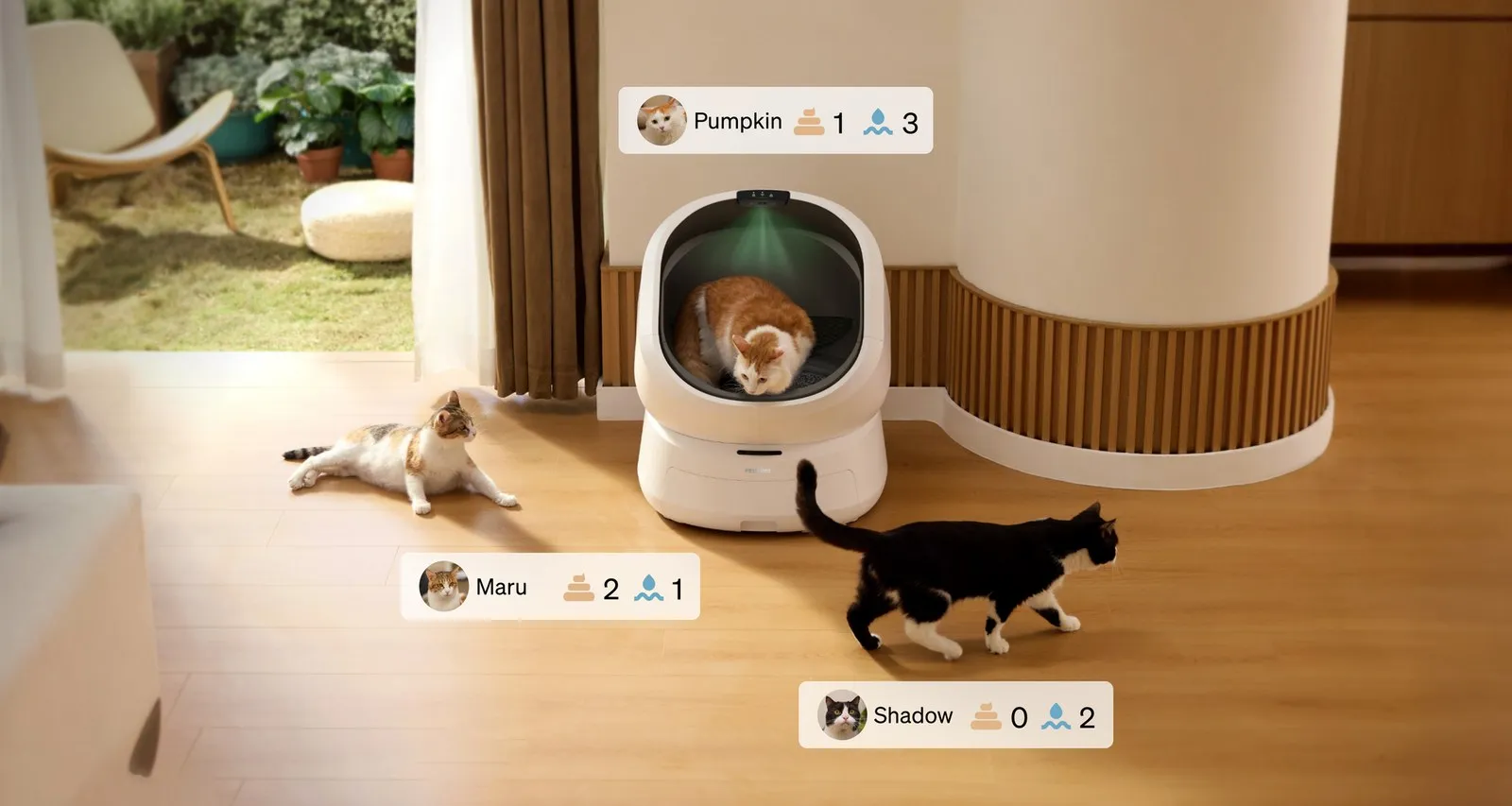
A camera reads a picture. Luma compares arrivals against photos in the app, and PETKIT’s YumShare Solo 2 compares faces at the bowl.
| What you are buying | Model and price | What decides identity | What it cannot do |
|---|---|---|---|
| Collar-tag feeder | PETLIBRO One RFID, $149.99 | Dedicated tag, one per feeder | Read a microchip; hold two tags |
| Microchip feeder | SureFeed, no app required | Implanted chip or SureFlap tag, 32 identities | Dispense scheduled meals |
| Camera feeder | PETKIT YumShare Solo 2, $129.99 sale | Face match in app | Prove the match was right |
| Camera litter box | PETLIBRO Luma, $599.99 | Face match, up to 10 cats | Recalculate history after a fix |
The first two answer a yes-or-no question. Is this the registered animal? The third answers a similarity question, and similarity has a threshold that nobody publishes.
Why does correcting a wrong cat never fix the data already saved?
Because the correction edits a label, and the label was the input for numbers already written down.
The November 3 report on r/Petlibro is the clearest version of the problem I have read. The owner has two tabby cats. Luma could not separate them at all. Then comes the sentence that matters: correcting a misclassified cat leaves all of the health data forever incorrect, weight included. The same post says there is no way to purge blurry or irrelevant photos from the recognition pool, so the pool that produced the bad match keeps feeding the model.
Read that as a data problem rather than a hardware problem. A litter box that logs 4.9 kg at 07:20 has made a measurement. The name attached to that measurement came from an image classifier. If the classifier was wrong, the row is wrong, and the trend line for both cats now contains one animal’s weight filed under another’s name. Two cats at 4.5 and 5.2 kg look like one cat gaining and losing weight, which is the pattern a vet would treat as illness.
The audit gap is worse than the error. Nothing in the app shows how a label was produced, so an owner cannot go back and ask which visit was the guess. The same shape appears in the disconnection case, where an owner of two $599.99 Luma units set up a router script to timestamp every drop, and reported that support spent days reading logs from the wrong box before conceding the mistake. When the log is the only evidence, a log pulled from the wrong device is not a small error. It is the whole case.
What does “up to 10 cats” look like in a two-tabby house?
PETLIBRO lists Luma at $599.99 with a 9-gallon drawer rated for seven days of waste from two cats, a 24-month warranty and a 90-day in-home trial. The product page promises recognition of up to 10 cats from multiple angles, even from behind, and sets a suitability floor at adult cats over 2. On November 3, 2026, an owner of two tabby cats posted that Luma could not separate the pair at all, and added that correcting a misread cat leaves the earlier health records wrong, weight included. A second owner spent $1,200 on two Luma units and reported that support pulled logs from the working box for days before admitting the mistake. The camera label is the input for every metric Luma reports, so a wrong label is a wrong dataset, and the app offers no screen for reviewing how that label was produced.
Ten cats is a memory specification. It says how many profiles fit. It does not say how similar two profiles may be before the classifier flips them, and no vendor in this category publishes that number.
The other Luma report worth reading is the phantom one, from October 23. The box displayed a warning that a weight sensor detected a pet continuously, with no cat in the room. The owner reset the unit, and in other cases the only way out was to scoop manually, which is the exact work the $599.99 purchase was meant to remove. A sensor that reports an animal that is not there and a classifier that reports the wrong animal are the same failure from two doors.
Where does facial recognition on a feeder break down?
PETKIT sells the YumShare Solo 2 at $129.99 on sale against a $149.99 list, with 24 reviews on the product page and a promise of scheduled meals for up to 15 pets plus facial recognition that distinguishes every face in the family. On October 30, 2026, an owner tested the bowl sensor and wrote that monitoring amounts to a before and after photo, that nothing converts the pair into a food measurement, and that a very full bowl still received the next full serving. PETKIT’s reply pointed to a Surplus Food Control setting inside a section called AI Lab. The owner answered that no such option exists in the iOS app. A reviewer named JOHN K. on the same page counted $7 per month for each feeder to unlock features the listing calls in-app purchases. Two of three advertised jobs depend on software a buyer cannot inspect before paying.
The pattern repeats across the category, and it is not a knock on one brand. A camera pointed at a bowl can answer a question about pixels. Someone ate, roughly. Turning pixels into grams requires calibration data per bowl, per food shape and per lighting, and none of these listings publish a tolerance.
PETLIBRO’s Scout camera shows the same gap from the other side. An owner wrote on November 8 that the camera detects humans but not cats, with a cat sitting in front of the lens, after rebinding the device, reinstalling the app and pushing every sensitivity setting to maximum. A device can be excellent at faces in general and useless at the two animals in your kitchen.
What does one collar tag per feeder cost a three-cat home?
Three feeders, or two cats sharing one bowl. PETLIBRO states one feeder syncs with one collar tag, so a third cat means a third unit at $149.99, plus a replacement tag at $14.99 when a tag is lost. The same page asks for 10 inches (25 cm) of clearance between units to avoid interference, which is easy in a kitchen and awkward in a hallway.
The tag is the weak physical link. It is splashproof only, it rides on a collar, and collars come off. When a tag stops being read, the lid stays shut and that cat eats nothing, which at least announces the fault. Compare that with a camera that credits the wrong cat, where the failure produces a normal-looking number.
The lid has its own reported failure, documented on November 8 by an owner whose feeder closed on a cat mid-meal. A second unit produced the same behaviour, and the household ended up sitting beside the bowl so the other cats could not steal the food. That case is covered in the One RFID collar article, and the mechanism sits in the same read zone covered in the lid closing piece.
Why does a microchip feeder need no app at all?
Because the identity lives in the animal, not in an account. The SureFeed reads an implanted chip or a SureFlap collar tag, remembers 32 identities with the batteries removed, and opens the lid when a registered pet approaches. The bowl takes 400 ml or two pouches of wet food, four C cells run about 6 months, the eating area measures 8 1/4 by 6 1/8 inches, and the warranty runs 3 years.
There is no router, no cloud, no subscription and no photo pool. A chip is not a picture, so a tabby and a tabby are two different numbers. The trade is real and worth stating plainly. A microchip feeder does not dispense scheduled meals, it does not log grams eaten, and it cannot tell you at noon whether the cat ate at 6 AM.
The limit that owners report most often is the lid itself. A smaller cat can have the lid close while still eating, which Sure Petcare addresses with a training mode that introduces lid movement gradually. Sure Petcare’s Trustpilot page read 4.7 out of 5 from 4,049 reviews on November 12, 2026, with replies to 75% of negative reviews within 48 hours. For comparison, petlibro.com read 3.2 from 1,124 reviews with a 76% reply rate inside two weeks, and petkit.com read 3.8 from 399 reviews with 92% inside one week. A reply rate measures a company’s queue. It says nothing about whether the identity layer works.
What can you check in ten minutes before trusting per-cat data?
Four checks, all of them free, all of them before the first meal is logged.
- Weigh both cats on a scale that resolves 10 grams and write the numbers on paper. That baseline is the only figure you will be able to audit in a month.
- Put the device where the two similar cats pass in a known order, feed them one at a time on camera, and compare the app timestamps to the footage.
- Open the app and look for a way to delete a stored photo or reassign a recorded visit. If the answer is no, the device is a black box by design.
- Count identities in the specification against cats in the house. Ten profiles for two cats is headroom. One profile per unit for three cats is a shopping list.
A device that fails check two is producing numbers you cannot defend at a vet appointment. A device that fails check three cannot be corrected after the fact, which is the whole complaint in the November 3 tabby report.
Which setup fits two cats, three cats, and one cat on a diet?
Name the cat first, then schedule the meal. Almost nobody sells both in one box at $150, and the ones that claim to are the ones argued about above.
For per-cat separation, the microchip feeder route is the shortest chain: a chip, a lid, a warranty. The SureFeed Microchip Pet Feeder stores 32 identities, needs no account, and carries a 3-year warranty. Disclose the known limit with it. Small cats sometimes eat while the lid comes down, and the training mode exists for that reason.
For scheduled meals in a one-cat or two-room house, a plain dispenser beats a smart one, because there is no identity layer to fail. The PetSafe Smart Feed is the model this site keeps recommending for offline scheduling, and the reason is the absence of a cloud dependency rather than a brand score.
If a subscription is already involved on the health side, read the subscription wall breakdown before paying for a year of per-cat charts. Data behind a paywall and data with a wrong label behind a paywall are both worse than a paper note on the fridge.
Sources
- PETLIBRO Luma Smart Litter Box product page (read November 12, 2026)
- PETLIBRO One RFID Pet Feeder product page (read November 12, 2026)
- PETKIT YumShare Solo 2 product page (read November 12, 2026)
- Sure Petcare Microchip Pet Feeder specifications (read November 12, 2026)
- Trustpilot, petlibro.com, petkit.com and surepetcare.com (read November 12, 2026)
- r/Petlibro, November 3, 2026, two tabbies and the health data
- r/Petlibro, October 20, 2026, two Luma units and the wrong log
- r/Petlibro, October 23, 2026, phantom weight sensor
- r/PETKIT, October 30, 2026, bowl monitoring tested
- r/Petlibro, November 8, 2026, lid closing mid-meal
- r/Petlibro, November 8, 2026, Scout detects humans not cats
FAQ
How does a feeder know which cat is eating?
Three channels ship in 2026. A dedicated collar tag read by a pad under the bowl, as on PETLIBRO’s One RFID feeder. An implanted microchip read at close range, as on the SureFeed Microchip Pet Feeder. A camera comparing the animal to photos stored in an app, as on PETKIT’s YumShare Solo 2 and PETLIBRO’s Luma litter box. The first two identify an object the cat carries. The third identifies an image, and an image of two tabby cats is two sets of similar stripes.
Can the One RFID feeder read a microchip instead of the collar tag?
No. PETLIBRO states on the product page that the reader works only with the dedicated collar tag, not microchips or tags from other brands, and that one feeder syncs with one collar tag. A three-cat house therefore buys three feeders at $149.99 each, or accepts that two cats share the wrong meal. The tag itself is splashproof only, so a collar is the weakest part of the chain.
Why can’t I fix wrong weight data after correcting a cat?
A correction changes the label on future visits. The history already recorded keeps the old label, and the app offers no view of which visit was misread, so a weight trend for both cats now mixes two animals. An owner on November 3, 2026 described exactly this on Luma, saying the health data stays wrong including weight, and that there is no way to purge blurry photos from the recognition pool.
Is facial recognition on a pet feeder accurate enough to trust?
Treat the published claims and the owner reports as two different tests. PETKIT advertises meals for up to 15 pets with facial recognition that distinguishes every face in the family. An owner testing the same feeder on October 30, 2026 found that bowl monitoring produced a before and after photo, that nothing converted the pair into a measurement, and that a full bowl still received the next serving. Recognition that works on a demo clip and recognition that works behind a closed lid at 6 AM are not the same claim.
Which feeder separates two cats without an app or a subscription?
The SureFeed Microchip Pet Feeder. Sure Petcare lists 32 identities in memory, a 400 ml bowl or two pouches of wet food, about 6 months on 4 C cells and a 3-year warranty, with no account, router or cloud in the chain. The lid opens for a registered chip and stays shut for other animals. The trade is portion control, because the unit does not dispense scheduled meals and cannot tell you how many grams were eaten.
What should I check before trusting per-cat data?
Weigh both cats on a kitchen scale and write the numbers down, because that baseline is the only figure you can audit later. Then watch the app for one week and compare a logged visit against your own video from the same minute. Check whether the device lets you delete a stored photo or a wrong label, and check how many identities the unit holds against how many cats live in the house. A device that cannot pass those four checks is producing a trend you cannot defend at the vet.
Do cheaper devices without identity tracking make sense instead?
For a single cat, yes. A plain scheduled feeder with no recognition has no identity layer to get wrong, and a camera focused on the bowl answers the only question that matters when you travel. The identity layer earns its price in a multi-cat house where two animals share one room, one diet or one illness. In a one-cat home the same money buys a better bowl and a cheaper mistake.