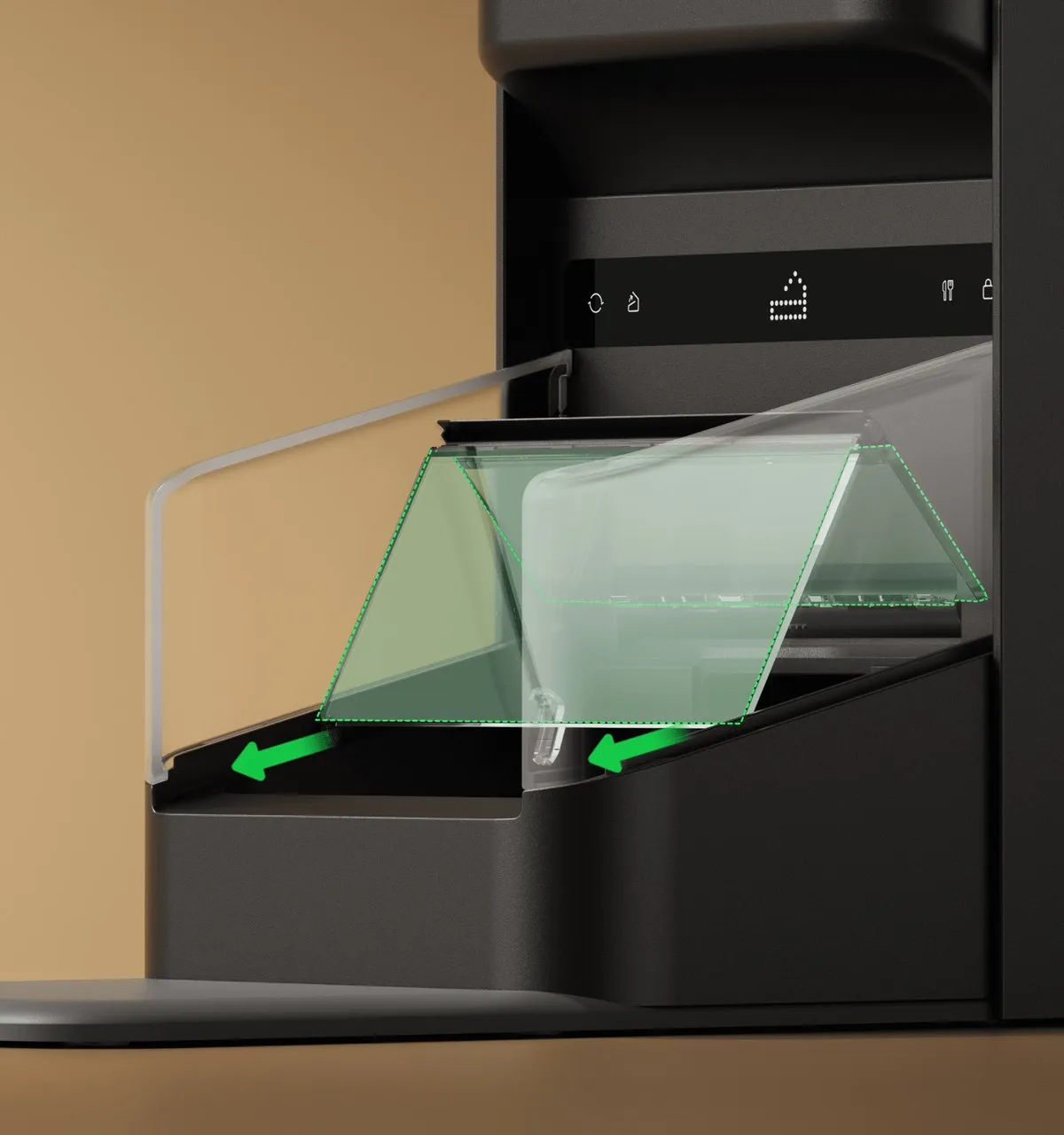
Feeder Lid Closed on My Cat Mid-Meal: 3 Fixes to Try
The short answer: a powered feeder lid closes when the collar tag leaves the RFID read zone, and a cat with its head buried in the bowl is the position where that happens. PETLIBRO publishes a support page for the exact case where the tag cannot be recognized when it is close to the reader, and its pre-sale FAQ warns that pets which are too tall get “poor or no recognition” of the tag. The One RFID feeder sells for $149.99 with a 24-month warranty, and the app controls lid closing speed and time. PETLIBRO also says the lid briefly reopens if something blocks it. One owner wrote on October 25, 2026 that the lid “pinched my cat.”
I read the lid threads in r/Petlibro on a Sunday night with the product page open in a second tab, expecting to find a broken sensor. What I found instead was a geometry problem that the company documents in three separate help pages without ever describing it as a risk.
The feeder is not watching your cat. It is watching a plastic tag hanging from a collar, and the reader lives in the mat under the bowl.
The lid is a motor with a tag check
The One RFID Smart Feeder is model PLAF301, and the hardware explains most of what follows. PETLIBRO’s product page lists a 3 liter tank (about 13 cups), a net weight of 2.80 kg (98.56 oz), and a body measuring 442 x 196 x 320 mm. The collar tag, model TG001, weighs 4.2 g and measures 23 x 23 x 14.18 mm.
The mechanism is described on the same page in one sentence: the reader verifies the collar tag “before allowing the lid to unlock and food to be served.” That single line carries the whole design. The lid does not open because a cat is present. It opens because a tag has been authenticated within range, and it goes back down when that authentication stops.
Three details on that page matter more than the marketing copy around them:
- The mat is the reader. PETLIBRO’s FAQ says the feeder’s pet recognition “relies on RFID technology, of which the mat functions as the RFID reader,” and warns that recognition fails if the mat is not properly installed.
- One feeder holds one tag. The reader works only with the dedicated collar tag, not a microchip, and “the feeder can only sync with one collar tag.”
- The portion is volume, not weight. PETLIBRO’s portion table lists the PLAF301 at roughly 20 ml per portion, about 1/12 cup, with up to 10 meals or snacks a day.
None of that is a defect. It is the same approach Sure Petcare takes with the SureFeed Microchip Pet Feeder, whose lid “opens when a registered pet approaches” and stays closed for everyone else. The difference is what happens when the tag and the bowl occupy the same small piece of floor.
Why the head-down position is the problem
The reader is underneath, the tag hangs from a collar, and the bowl sits between them. Lower the head and the tag travels away from the mat and toward the rim of the read zone.
PETLIBRO’s own help center describes the failure mode without naming a cat. One page is titled What Can I Do If the Collar Tag Can’t be Recognized When the Tag is Close to the RFID Reader of the One RFID Feeder? The troubleshooting steps are about the reader’s prongs, the jack at the base, whether the base clicked into place, metal objects and other electronics nearby, and keeping multiple RFID feeders at least 10 inches (25 cm) apart. Another page, on a lid that closes slowly, repeats the interference advice and adds a change of location.
The pre-sale FAQ is blunter. Asked whether the feeder suits all pets, the company answers: “The feeder fits most cats and small dogs. Pets that are too tall will have poor or no recognition of the collar tag.”
Read those pages next to each other and the pattern is not mysterious. Recognition depends on where the tag sits in space, and eating is the moment when a cat’s tag is furthest from where it was when the lid opened.
An owner in r/Petlibro reached the same conclusion in a thread titled “One RFID feeder lid keeps closing on my car.” The reply that explains it: “the rfid chip is going just out of the ‘fence’ of the pad. he’s likely sticking his head too far into the bowl and making the chip to ‘out of bounds’.”
That is a hardware read-zone boundary, not a mood. The cat did nothing wrong.
The company says the lid backs off. One owner says it pinched.
Here is the uncomfortable part, and it deserves both halves.
PETLIBRO’s pre-sale Q&A answers a question about another pet blocking the lid, and the answer describes a deliberate anti-injury behavior:
When the pet wearing the matching collar leaves, the bowl lid will close. You can adjust the lid closing speed and time using the Petlibro app. If another pet tries to access the food and prevents the lid from fully closing, the lid will briefly open to prevent injury and then attempt to close again.
The same answer says that after a third failed attempt the feeder enters a failed-to-close state and sends a notification. On paper, that is an obstruction response built for exactly the scenario in the previous section.
Then there is October 25, 2026. In a comment in the r/Petlibro support thread that asked whether anyone had emailed five times without an answer, owner u/StreetAd8865 wrote:
the lid on my RFID feeder started opening and closing at random and even pinched my cat, I tried reaching them on the chat and got an unhelpful AI bot, I tried emailing them and got no answers
I am not going to call that proof that the safety behavior failed. It is one report, with no video, in a thread about unanswered email. What it does establish is narrower and still worth writing down: a feeder that advertises a reopen-to-prevent-injury behavior has at least one owner describing a pinch, and the same owner describing no human reply from support.
A search of the CPSC recall database on October 26, 2026 returned no recall entries for pet feeders and none for PETLIBRO. That is an empty search result, not a clearance. Pet injuries land in that database only when someone files.
What three owners changed, and what happened
The practical fixes in the threads are all about buying the tag more time in the zone.
In the same r/Petlibro thread, one reply describes a working combination: “set the lid closing time to 10 seconds. i also changed the opening/closing to slow so it gives him a little more time to eat before it cuts.”
A second thread, on lid close delay, shows how unreliable the setting can feel. The owner reports the lid set to 1 second, “and it seems to be completely random. Sometimes it’s 1 second, sometimes it’s more like 5 or 6.” A reply says “a firmware update solved this for me for the most part,” while clarifying the fix applied to the feeding area and not the food silo lid.
A third thread is the most useful warning about app settings. An owner complains that the lid closing time is slow, and the reply reads: “There’s a setting in the app that lets you make the lid close faster, but it’s just a change from ‘really slow’ to ‘moderately slow’.”
So the app helps, and the app is not a fix for a cat that eats with its face against the kibble. If the movement itself is rough, PETLIBRO’s own troubleshooting points elsewhere: in a thread on a lid closing issue, the quoted fix is “replacing the lid and bowl shield,” with a stuttering or lagging shaft treated as mechanical.
Older hardware adds one more failure. A three-year-old thread from an owner whose kitten defeated the feeder lists four design complaints, and two are about the lid: it should “latch when closed,” and “the lid should sit flush within the plastic and no so there is an exposed edge where grubby kitten mits can push back against.” The update at the bottom of that post says a replacement lid changed nothing.
The same physics shows up on the other brand. In r/SurePetcare, an owner of two microchip feeders describes a smaller cat whose “lid closes in her face, while she’s still eating,” guessing that the cat moves too close and “the feeder can’t detect her chip anymore.” A reply describes the same lid landing on a cat and adds that “she shrugs it off.”
That last detail is not comfort. It is the reason this problem stays invisible. Cats do not file tickets.
Three ways a feeder can keep a cat out of another cat’s bowl
| Design | What opens it | What the lid does when the tag drops out | Price read October 26, 2026 |
|---|---|---|---|
| PETLIBRO One RFID (PLAF301) | RFID collar tag read by the mat, one tag per feeder | Motorized bowl lid closes; PETLIBRO says it reopens briefly if blocked, then retries twice | $149.99, 24-month warranty, 30-day money-back |
| SureFeed Microchip Pet Feeder | Microchip or SureFlap RFID tag, up to 32 identities stored | Motorized lid closes when the registered pet leaves; training mode introduces the movement gradually | 400 ml bowl, 3-year warranty, 6 months on 4 x C cells |
| PetSafe Smart Feed, 2nd generation | Nothing. Food moves down a conveyor on a schedule | No pet-sensing door exists; the lid is the dishwasher-safe hopper cover | $134.99, 24 cups, 12 meals a day, 45-day return |
The third row is why the choice exists at all. If your only goal is portion control and two cats eat at the same bowl without guarding it, a conveyor feeder has no lid to close on anyone. The moment you need per-cat access, you are back to a motor next to a food bowl.
Two placement checks that cost nothing
Before spending on hardware, PETLIBRO’s help pages give two checks that decide a lot of cases.
The first is the mat. The reader sits in it, and the feeder base has to seat properly on it. PETLIBRO’s troubleshooting says to confirm the base is correctly installed, and that “if you hear a ‘click’ sound, it means the device is installed correctly.” A mat that is slightly out of position, or one with kibble dust along the prongs, produces exactly the symptom in this article.
The second is distance and interference. Keep multiple RFID feeders at least 10 inches (25 cm) apart, keep Dockstream fountains at least 5.9 inches from a One RFID feeder, and move metal objects and electronics a few feet away. A stainless bowl stand, a metal litter enclosure or a router on the same shelf can all sit inside the range the feeder is trying to read.
One more check comes from the app rather than the manual. If your cat is a face-in-the-bowl eater, raise the feeder. A tilted stand keeps the chest higher and the tag closer to the mat, which is the opposite of what a low bowl does.
If a lid has already caught your cat
Unplug the feeder before anything else, then look at the cat rather than the machine. A pinch that leaves the cat squinting, pawing at its face, or guarding a front paw is a vet visit, not a wait-and-see. Whiskers grow back; a corneal scratch does not fix itself.
Then document it in the order that matters for a claim:
- Photograph the lid position and the cat on the same day, with the timestamp visible.
- Film the feeder with the cat eating, so the closing sequence is on record.
- Open a ticket and put the case number in every follow-up, because PETLIBRO’s support reply rate on Trustpilot is 74% of negative reviews inside two weeks, and the pattern owners describe is a reply that asks for video and then goes quiet.
- File with the CPSC as well. One report changes nothing; the database is the only place where a pattern becomes visible to anyone outside the brand.
The refund routes and the seller list are covered separately, because a lid that hurts a cat and a warranty claim that goes nowhere are two different problems.
What to buy instead
If you need per-cat feeding and a motorized lid closing on a cat is the thing you cannot live with, the microchip feeder route is the honest alternative, with one caveat I will not hide.
The SureFeed Microchip Pet Feeder is the pick here, and the reasons are boring and checkable: it reads an implanted microchip or a SureFlap collar tag, stores up to 32 identities, and the official spec page lists a 400 ml bowl (or two pouches of wet food), about 6 months on 4 x C cells, and a 3-year warranty. It also ships a training mode that “helps pets get used to the feeder in their own time,” which is the only lid behavior in this article that is designed around a nervous cat.
The caveat: the r/SurePetcare thread above is about a SureFeed, and its lid closed on a smaller cat mid-meal. The same geometry applies, because the same reader-and-tag arrangement is underneath. What differs is the published response, a gradual introduction mode, and a brand whose Trustpilot profile reads 4.7 from 3,983 reviews with 75% of negative reviews answered inside 48 hours as of October 26, 2026.
If you do not need per-cat access at all, buy the boring one. The PetSafe Smart Feed runs 24 cups, 12 meals a day at 1/8 to 4 cups, a conveyor instead of a swinging door, low and empty food sensors, a dishwasher-safe lid and hopper, and 4 D-cell backup. No tag, no read zone, no lid to close on a cat. The current listing is the 2nd generation unit.
I would not buy the One RFID expecting the app to fix a face-in-the-bowl eater. PETLIBRO’s support record is the reason: Trustpilot reads 3.3 from 1,074 reviews, 74% of negative reviews answered within two weeks, and the company’s own support account has written in public threads that a high volume of inquiries caused delays in follow-ups. The lid is a $149.99 feeder with a 24-month warranty. Its weakest part is not the plastic.
If you already own one, the portion unit confusion and the jam-without-a-warning pattern are worth reading next, because a feeder that stops logging and a feeder that closes early fail in the same silence.
FAQ
Why does the feeder lid close while my cat is still eating?
The lid is not watching the cat. It is watching a collar tag, and the One RFID feeder only opens while that tag is inside the reader’s range. When a cat pushes its head deep into the bowl, the tag can slip past the edge of the read zone, the feeder reads that as an empty feeding station, and the lid starts to close. PETLIBRO publishes a support page for the case where the collar tag cannot be recognized when it is close to the RFID reader, and its pre-sale FAQ says pets that are too tall get poor or no recognition. Retraining the cat is usually the wrong fix. Slowing the lid and raising the feeder are the cheap ones.
Can I make the lid close slower on a PETLIBRO One RFID feeder?
Yes, and it is the first thing to change. PETLIBRO’s pre-sale Q&A states that lid closing speed and time are adjustable in the Petlibro app. Owners describe the range differently: one thread reports the app only moving the lid from really slow to moderately slow, and another reports a closing time set to 1 second behaving like 5 or 6 seconds. Set the longest closing time the app allows and the slowest travel, then watch a full meal before deciding it worked. If the shaft stutters or the lid lags instead of moving smoothly, the mechanical fault sits in the lid or bowl shield rather than the setting.
Does the lid reopen if a cat is in the way?
PETLIBRO says it does. Its pre-sale Q&A describes the sequence in plain words: if another pet blocks the lid from closing, the lid briefly opens to prevent injury and then tries to close again. After a third failed attempt the feeder enters a failed-to-close state and sends a notification. That is a designed obstruction response, not a sensor that counts paws. Owners still report the lid closing on a cat’s head mid-meal, and one report from October 25, 2026 says the lid pinched a cat. Both can be true. A guarantee in a FAQ is not the same as a clean run in a kitchen.
Is there a recall for the PETLIBRO One RFID feeder or a pet feeder lid?
A search of the CPSC recall database on October 26, 2026 returned no recall results for PETLIBRO and none for pet feeders as a product category. That is an absence of a recall, not a certificate of safety. Pet product injuries are under-reported because owners often do not file anything and because a pinch that scares a cat rarely gets a report. If your cat was hurt, keep the photos, the order number and the date, and file with the CPSC as well as the brand. A single report does not trigger anything, but the database is how patterns eventually become visible.
Will a taller feeder stop the lid from closing on my cat?
It can help, and the reason is in the design. The reader sits in the mat under the bowl, so a cat that has to reach down into a low bowl pushes its collar tag further from the reader and closer to the edge of the read zone. Owners in the PETLIBRO threads describe the tag going just out of the fence of the pad. A raised or tilted stand keeps the chest higher and the head less buried. It is not a guarantee, because a determined cat will still put its face in the bowl. Test the height change with a full meal and a camera before you decide it is fixed.
Which automatic feeders do not use a motorized lid at all?
Two shapes avoid the problem. The first is a microchip feeder with a lid that only opens for a registered chip or tag, like the SureFeed Microchip Pet Feeder, which pairs the lid with a training mode that introduces the movement gradually. The second is a plain scheduled feeder with no pet detection at all, like the PetSafe Smart Feed, where food travels down a conveyor into an open bowl and the only lid is the cover on the hopper. Neither design stops a determined thief. Both remove the specific failure where a motor closes on a cat that is still eating.
Should I return the feeder over a lid that keeps closing?
Return it inside the return window if the lid closes on a cat that is simply eating, because that is not a training problem. PETLIBRO sells the One RFID feeder for $149.99 with a 30-day money-back guarantee and a 24-month warranty, and the return path depends on where you bought it: the company’s policy sends third-party purchases back to the retailer and names its authorized sellers in the US without naming Amazon. Document the fault on video before you open a ticket, because a video of the lid closing on a cat is the one piece of evidence that cannot be argued with.