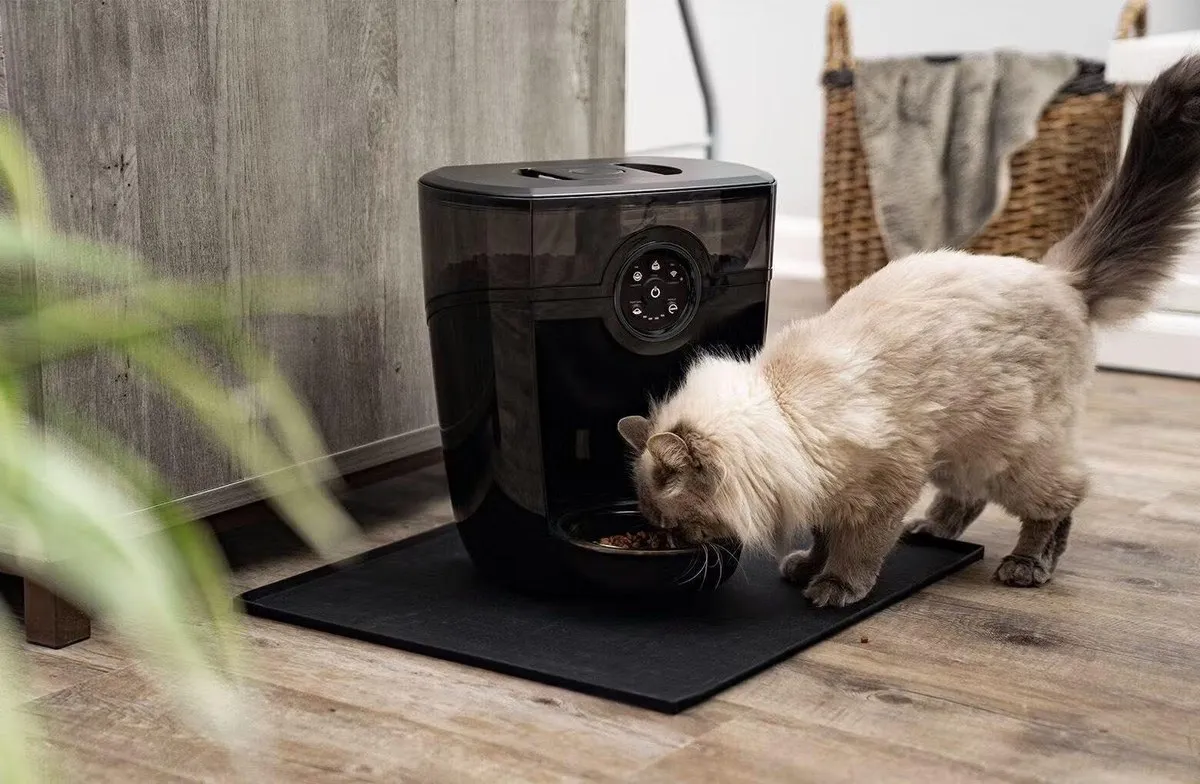
'1 Portion' Is 10g on One Feeder, 1/8 Cup on Another
The short answer: a feeder’s “portion” is a unit the maker invents, and four makers define it differently. PETKIT’s Fresh Element Solo page puts one portion at “about 10g ≈ 1/12 cup” with 1 to 5 portions a meal, and its YumShare Dual-hopper 2 lists 1 to 10 portions per hopper at 10 to 100g. PetSafe’s Smart Feed counts from 1/8 cup to 4 cups per meal, up to 12 meals a day. Whisker’s Feeder-Robot dispenses “up to 1/2 cup of pet food in 1/8-cup increments, 1 to 8 times per day.” The same word means four different volumes, and the smallest step your app allows decides whether you can hit your cat’s daily target at all. When the count goes wrong, the failure runs toward overfeeding rather than starvation. Owners of PETLIBRO RFID feeders reported machines set to one portion dispensing until the bowl was full.
I opened four maker pages side by side this week and put the numbers in a row, because the same word sits on every box. Then I went back through the feeding complaints this site has collected since August, and the sentence that ties the two halves together came from an owner with a kidney-diet cat and three RFID feeders, who wrote that his machines “dispense until the bowls are full and it jams the hopper.”
petiqlab earns a commission from the Amazon links on this page. Everything below comes from manufacturer pages read on October 15, 2026, plus complaint records held in this site’s material library, and every quote is the owner’s or the maker’s own. petiqlab has not tested these feeders, and nothing here is veterinary advice.
Why Do Four Makers Count a Portion in Four Different Units?
Most of the confusion is units. Line the published numbers up and read across. None of these figures is hidden. They sit in the specs tabs and FAQ blocks of pages that sell the machines.
| Feeder | What the page counts in | Per-meal setting | Hopper | Listed price |
|---|---|---|---|---|
| PETKIT Fresh Element Solo (P570) | “Each portion is about 10g ≈ 1/12 cup” | 1 to 5 portions | 12 cups (3L) | $69.99 |
| PETKIT YumShare Dual-hopper 2 (P592) | 10 portions per hopper at “10-100g” | 1 to 10 portions in each hopper | 21 cups (5L) | $169.99 |
| PetSafe Smart Feed (2nd generation) | 1/8-cup steps | 1/8 cup to 4 cups, up to 12 meals a day | 24 cups | $134.99 |
| Whisker Feeder-Robot | 1/8-cup increments | “up to 1/2 cup”, 1 to 8 times per day | 32 cups, 25 with the insert | $299 as low as |
Read that table as a conversion chart and the daily plan most owners build falls apart. A cat eating 10g of kibble per meal gets one PETKIT portion and two PetSafe steps. The same cat on 30g gets three PETKIT portions and roughly four PetSafe steps, except PetSafe counts in eighths of a cup while PETKIT converts its 10g into 1/12 cup on the spec sheet. Cups measure volume, grams measure mass, and kibble density changes with shape, coating and brand.
Only one of the four pages converts its own unit into grams. PETKIT does it twice, once on the Fresh Element Solo spec sheet and once in the YumShare Dual-hopper 2 comparison table, where the same 10g step reappears as “10 portions (10-100g) in each hopper.”
The one that surprised me was the ceiling. PetSafe allows a single meal of 4 cups and up to 12 meals a day, which is built for large dogs and free-feeding cats, while Whisker stops at half a cup per serving. If you are portioning for a 4kg cat, the practical range you care about sits in the first two steps of every one of these machines.
Look at the price column and the picture gets stranger, because the machine that counts in the smallest steps is not the cheapest one. PETLIBRO’s Granary and RFID lines sit in the middle of the range, PETKIT lists the Fresh Element Solo at $69.99 and the YumShare Dual-hopper 2 at $169.99, PetSafe lists the Smart Feed at $134.99, and Whisker lists the Feeder-Robot at $299 as low as, with $100 off a reconditioned unit. None of those numbers tells you what a portion weighs.
Four maker pages read on October 15, 2026 give the same word four different volumes. PETKIT’s Fresh Element Solo (P570) at $69.99 defines each portion as about 10g, roughly 1/12 cup, with 1 to 5 portions a meal and a 12-cup hopper. The YumShare Dual-hopper 2 (P592) at $169.99 counts 1 to 10 portions per hopper across 10-100g in a 21-cup hopper. PetSafe’s Smart Feed (PFD00-16828) at $134.99 steps in 1/8 cups from 1/8 cup to 4 cups per meal, up to 12 meals a day, with 24 cups of capacity. Whisker’s Feeder-Robot at $299 dispenses up to 1/2 cup in 1/8-cup increments, 1 to 8 times a day, from 32 cups or 25 with the insert. Only PETKIT converts its unit into grams, and only PETKIT prints a 10g figure beside a cup figure. A cat eating 10g per meal gets one PETKIT portion and two PetSafe steps, and 30g gets three PETKIT portions and roughly four PetSafe steps.
The spec sheets carry other details worth knowing before the count becomes the only number you look at. PETKIT’s Fresh Element Solo runs on a USB power cable with five AAA cells as backup over a 2.4GHz radio, and its bowl is listed as 304 stainless steel. The YumShare Dual-hopper 2 carries the model name P592, a 5L hopper, a desiccant pouch on top and a camera that switches itself off when the feeder is running on batteries alone. Whisker’s Feeder-Robot page covers HSA and FSA purchases and ships free outside Alaska, Hawaii and Puerto Rico. PetSafe’s Smart Feed page, listed as the 2nd generation model PFD00-16828, adds D-cell backup and four dishwasher-safe parts to its 24-cup hopper.
Why Does the Same Page Give Two Different Portions?
PETKIT’s Fresh Element Solo page manages to disagree with itself, and the disagreement is instructive. The spec sheet and FAQ say a portion is about 10g, which the page converts to 1/12 cup. A reviewer further down the same page, describing the app, writes that she is “trying to feed my cat a quarter cup per day so it’s not optimal that the smallest increment is 1/10 of a cup.”
A twelfth of a cup and a tenth of a cup are not the same setting, and this site has documented what happens when a portion count is off by a step before, in the meal-skipping analysis. One owner measured the machine she owns and got one answer, the manufacturer’s own spec sheet prints another, and nothing on the page reconciles them. The gap is small enough to look like pedantry until you do the arithmetic on a 12-step daily plan, at which point the two definitions put your cat a few grams apart every single day.
There is a second layer to this, and it is the one that decides what the app recommends. Reviewers on the PETKIT page describe how the app sets a target in the first place. One notes that “you can upload information about the pets food that they are eating so it can properly determine portion sizes,” and another that the app suggests amounts “based on my cats age and weight.” Both statements are true of a system that is only as good as its inputs. If the food you select is not the food in the hopper, or if the calorie figure attached to it is wrong, the app’s target is wrong in exactly the same proportion, and the Fresh Element Solo will hold that error to the gram for a year.
This is worth stating plainly. A feeder does not know how much your cat should eat. It knows how many of its own portions you told it to drop.
What Does a Wrong Portion Count Do to a Cat?
The failure that frightened owners after PETLIBRO’s August 2026 outage was not a missed meal. It ran the other way, and it is the mirror image of the silent jams collected in this site’s feeder jam report. One owner of three RFID feeders, feeding a cat on a kidney diet and describing the machine as mandatory because a second cat is a “voracious food thief,” wrote that since the outage his feeders “occasionally just… infinitely dispense food.” His machines were set to dispense 1 portion a couple of times a day. Instead, he wrote, they “dispense until the bowls are full and it jams the hopper.”
He was not alone in the direction of the failure. A second owner, recovering from surgery, described the same shape of bug in blunter terms: “the feeder wouldn’t stop. It just kept pushing dry food out until I did a manual feed from the app.” A third, replying in the same r/Petlibro thread with five Granary feeders in the house, wrote “overfeeding on almost all of my granary feeders and then having errors bc its jammed.”
Anyone who has fed a cat on a prescription diet knows why this matters more than a jam does. A portion-controlled feeder exists to hold a daily ceiling. When the ceiling fails upward, the machine keeps doing what it was told, and nobody finds out until the bowl is empty and the cat has eaten two days of food.
All three reports come from Reddit’s r/Petlibro community, the forum this site has been reading since August, and the first was collected on September 18, 2026. The same class of complaint reaches the filing side too. A complaint filed with the Better Business Bureau, or BBB, on August 31, 2026 describes a feeder bought directly from PETLIBRO on August 14, 2026 for $136.43, returned inside the 30-day window because, in the buyer’s words, “the portion sizes were not suitable for my needs,” and because “the feeder takes an excessively long time to dispense food.” That is a different complaint from an overflowing hopper, and it points at the same design truth. The portion you can select may not be the portion your cat needs, and the machine has no way to tell you so.
Against all of that, it is worth remembering why people buy these boxes. A widely upvoted comment in the feeding threads this site collects puts the case in one line. Automatic feeders are “recommended for portion control to keep your cat a healthy weight.” That is the promise. The eight sentences above are what it looks like when the counting breaks.
Why Is the Part That Measures the Part Nobody Covers?
Something odd appears when you read a feeder warranty next to a feeder spec sheet. The component doing the measuring is excluded from coverage.
PETLIBRO’s warranty lists normal wear and tear with examples, and one of them is the feeder rotor, alongside batteries, desiccant bags, fountain filters and placemats. The rotor is the mechanism that meters kibble out of the hopper. It sits outside the 24-month term that the brand confirms in public replies to reviewers, which means the part that decides your cat’s daily intake is classified the same way as a filter you are expected to replace.
PETKIT’s page carries a matching complaint from the other direction, about maintenance rather than money. One reviewer’s single criticism of the Fresh Element Solo is that “the impeller that portions out the food cannot be disassembled for cleaning.” An impeller you cannot take apart is an impeller whose accuracy you cannot verify or restore, and food residue in a measuring channel is exactly the condition that produces an inconsistent portion.
Kibble size sits under the same heading, because the count only means something if the food passes through at a predictable rate. All three makers publish a limit, and they do not agree on it either. PETLIBRO’s jam guide asks for dry kibble between 2 and 15 mm and rules out large square, crescent-shaped and irregular pieces. PetSafe’s guidance for the same problem, published for the FlexFeed feeder, gives 1/4 inch to 1/2 inch, which is 5mm to 12mm. PETKIT’s spec sheet for the Fresh Element Solo states that kibble must not exceed 0.35in. Buy food outside the stated band and the machine still counts portions, still logs meals, and still gets the weight wrong.
3 makers publish a kibble limit and none of the numbers agrees. A portion count only means something if the food passes through at a predictable rate. PETLIBRO’s jam guide asks for dry kibble between 2 and 15 mm and rules out large square, crescent-shaped and irregular pieces. PetSafe’s guidance, published for the FlexFeed feeder, gives 1/4 inch to 1/2 inch, which is 5mm to 12mm. PETKIT’s spec sheet for the Fresh Element Solo states that kibble must not exceed 0.35in. Buy food outside the stated band and the machine still counts portions, still logs meals, and still gets the weight wrong.
What Do the Four Spec Pages Leave Out?
One absence runs across all of them. None of the four pages read for this article, PETKIT’s Fresh Element Solo (P570) and YumShare Dual-hopper 2 (P592), PetSafe’s Smart Feed (2nd generation, PFD00-16828) and Whisker’s Feeder-Robot, publishes a tolerance in grams, a calibration procedure, or a drift figure for a machine that has been running for a year. PETKIT’s 10g conversion is the closest any of them comes to a physical unit, and it is printed as an approximation rather than a specification. Whisker and PetSafe describe their steps in cups, which is a volume measure that moves with the food. That gap is why the kitchen scale belongs next to the feeder, and why the first week matters more than the warranty card.
PETLIBRO’s 24-month warranty treats the metering part as a wear item. The policy’s examples of normal wear and tear include the feeder rotor, alongside batteries, desiccant bags, fountain filters and placemats, so the mechanism metering kibble out of the hopper sits outside the 24-month term that the brand confirms in public replies. PETKIT’s Fresh Element Solo page carries the maintenance version of the same problem: one reviewer writes that the impeller portioning out food cannot be disassembled for cleaning, and an impeller nobody can open is an accuracy nobody can restore. Neither page prints a tolerance in grams, a calibration procedure or a drift figure for a machine a year old, and PETKIT’s 10g conversion is an approximation rather than a specification. Whisker’s Feeder-Robot page shows 4.3 out of 5 from 394 reviews and a 90-day in-home trial.
Which Five Checks Should You Run in the First Week?
These are the tests that separate a working portion plan from a confident app screen. None of them takes more than twenty minutes.
- Weigh one portion, five times. Put a kitchen scale under the bowl, dispense a single portion, write down the grams, and repeat five times in a row. Then compare the spread with the number the app reported. A scale is the only instrument here that speaks the same language as the food bag.
- Find the smallest step and compare it with your daily target. If your cat eats a quarter cup a day and the machine moves in tenths of a cup, you have two clean steps and a rounding error. Either split the day into more meals or accept that the schedule is approximate.
- Run the ceiling once, on purpose. PETKIT allows 10 portions per hopper on the YumShare Dual-hopper 2, PetSafe allows a 4-cup meal on the Smart Feed, and Whisker caps the Feeder-Robot at half a cup. Set the largest meal the app permits, watch the bowl, and listen for the chute. A machine that struggles at the top of its range tells you something before a sitter finds out.
- Test it after a power cut and after an outage. The overfeeding reports above followed a server outage rather than a hardware fault. Pull the power, restore it, and check that the counter and the schedule come back where you left them. Whisker’s page makes a specific promise here that is worth testing rather than assuming, since its Feeder-Robot “will continue to feed on that specific schedule until it is updated” whether or not it is online.
- Check the log against the bowl. If your feeder keeps a feeding log or before-and-after bowl images, use them, then verify one day against the scale. A PETLIBRO owner reported that all three of her One RFID feeders “stopped recording in the feeding log when the cats actually eat,” which is the failure mode where the app looks calm while the bowl does not.
What Does Good Portioning Look Like?
Two counterweights keep this from being a story about broken machines, and both are documented on the same pages that carry the complaints.
On PETKIT’s Fresh Element Solo page, the portion machinery draws praise in the same review block where the self-contradiction appears. “The feeding portions are pretty accurate and I have not had any issues with this,” one owner writes, and another notes that “the portion sizes increase in very small increments, so it makes personalizing meals very easy,” adding that she dislikes feeders with “four portion size settings because it’s harder to get it just right.” A third calls it “perfect portioning.” Fine granularity is a real feature, and 10g steps are finer than most.
Whisker’s Feeder-Robot page carries its own numbers, and they are the most legible of the four. The page claims up to 32 cups of capacity without the hopper insert and 25 with it, anti-jam technology, a schedule that survives an outage, and a status light that runs blue when the machine is following a program. The page displays a 4.3 out of 5 rating from 394 reviews, a 90-day in-home trial, and eligibility for HSA and FSA funds.
PetSafe’s Smart Feed keeps the widest meal range of the group at 1/8 cup to 4 cups across 12 meals, ships with dishwasher-safe parts and D-cell battery backup, and its 45-day return window is the longest on this page. Its brand-level Trustpilot profile sits at 2.1 out of 5, read on October 15, 2026, across 231 reviews counted in this site’s October 5 read of the same page, and the profile is unclaimed with no reply badge. Both facts belong in the same paragraph, which is why they are here.
Which Two Feeders Have Counting You Can Check?
Two of the machines this site recommends put the measurement problem in a place you can inspect, and both keep their parts on the market.
PetSafe Smart Feed lists at $134.99 under ASIN B07NR47N2Q. It counts in 1/8-cup steps from 1/8 cup to 4 cups, schedules up to 12 meals a day, and holds 24 cups in the hopper, with D-cell batteries as backup and lid, hopper, bowl and bowl holder going into the dishwasher. The catch is the step size, which is coarse for a small cat, and the brand profile above.
SureFeed Microchip Pet Feeder, ASIN B00O0UIPTY, comes from Sure Petcare and solves a different half of the problem, the multi-cat half, and this site’s microchip feeder guide covers which model fits which household. It opens for the microchipped cat registered to it, has no app, no account and no cloud, and cannot be knocked sideways by a server outage. If two cats eat at different rates and one is a “food thief” in his owner’s words, separating them by identity beats counting portions into one bowl. It is not a portioning scale. It is a door.
And one tool that carries no commission and no product name. A kitchen scale costs less than a bag of prescription food. Pair it with the machine’s own log for one week, because the ruler that matters is the one both you and your vet can read.
Buying through a retailer such as Chewy moves the return clock to that retailer’s policy rather than the maker’s, which this site’s return-fee report covers in detail. That matters more on a feeder than on most devices, because the window you get is the window in which you can still weigh a portion and hand the machine back.
A note on what is not linked here. Whisker’s Feeder-Robot publishes the finest counting detail of the four machines, and this site rates the broader Whisker line neutral at best, with several of its machines doing badly in the reports collected here. Its page is quoted above as a source. No link to it appears on this page.
FAQ
What is one portion on an automatic pet feeder?
It depends on the maker, which is the whole problem. PETKIT’s Fresh Element Solo page states that each portion is about 10g, roughly 1/12 cup, and its YumShare Dual-hopper 2 lists 1 to 10 portions per hopper at 10 to 100g, the same 10g step. PetSafe counts in 1/8-cup steps between 1/8 cup and 4 cups per meal. Whisker’s Feeder-Robot dispenses up to 1/2 cup in 1/8-cup increments.
Why can’t I hit my cat’s daily target with the app?
Because the app moves in whole steps of its own unit. One reviewer on PETKIT’s own product page feeds a quarter cup a day and notes that the smallest increment is 1/10 of a cup, which leaves two steps and a fraction. When the step is wider than the gap between your target and your setting, the schedule rounds. More meals a day, or a machine with a finer step, is the fix.
How do I measure what my feeder actually dispenses?
Weigh it. A kitchen scale under the bowl, one portion at a time, five times in a row, with the grams written down. Then compare that with the figure the app reported. Volume and mass are not interchangeable here, because two kibbles with different density fill the same cup at different weights. The number you write down is the only one your vet can use.
Why did my feeder empty the hopper overnight?
The documented failures after PETLIBRO’s August 2026 outage ran toward overfeeding. One owner of three RFID feeders described machines set to 1 portion a couple of times a day dispensing until the bowls were full and jamming the hopper. Another wrote that the feeder would not stop until a manual feed from the app. A third, with five Granary feeders, described overfeeding on almost all of them. Run the test after any outage or power cut.
Does the warranty cover the part that measures the food?
Not on PETLIBRO, whose policy lists normal wear as batteries, feeder rotor, desiccant bags, fountain filters and placemats. The rotor is the piece that meters kibble, so it sits outside the 24-month term. PETKIT’s Fresh Element Solo page carries a reviewer note that the impeller which portions the food cannot be disassembled for cleaning. The measuring part is both the wear item and, on that model, the part you cannot wash properly.
Does kibble size change the count?
Yes, and each maker publishes a limit. PETLIBRO’s jam guide asks for dry kibble between 2 and 15 mm and rules out large square, crescent-shaped and irregular pieces. PetSafe’s guidance gives 1/4 inch to 1/2 inch, or 5mm to 12mm. PETKIT’s Fresh Element Solo spec sheet caps kibble at 0.35in. Food outside the band still gets counted, and the weight comes out wrong.
Which feeder counts in the smallest steps?
Among the pages read here, Whisker’s Feeder-Robot is the most explicit, with 1/8-cup increments up to a 1/2 cup serving across 1 to 8 meals, and PETKIT’s Fresh Element Solo moves in roughly 10g steps across 1 to 5 portions per meal. PetSafe’s Smart Feed covers the widest range, 1/8 cup to 4 cups across up to 12 meals, which suits big dogs better than a small cat on a diet.
Do camera feeders make the check easier?
They can, if the log is honest. PETKIT’s YumShare Dual-hopper 2 page promises replayable videos in the logs and before-and-after bowl images after each meal. The counterexample is a PETLIBRO owner whose three One RFID feeders stopped recording feeding events in the log while the cats kept eating. Use the log as a hint and the scale as the record.
Updated: October 15, 2026. Prices and terms as of that date. Sources: the PETKIT Fresh Element Solo page (12 cups or 3L, 1 to 5 portions per meal, “Each portion is about 10g ≈ 1/12 cup,” kibble not exceeding 0.35in, five AAA cells not included, $69.99, plus the customer reviews quoted above including the quarter-cup and 1/10-cup note, the accuracy comment and the impeller complaint), the PETKIT YumShare Dual-hopper 2 page (P592, 21 cups or 5L, 1 to 10 portions per hopper, “10 portions (10-100g) in each hopper,” $169.99, 38 reviews, before-and-after bowl images, camera off in battery mode), the Whisker Feeder-Robot page (up to 1/2 cup in 1/8-cup increments 1 to 8 times a day, 32 cups or 25 with the insert, offline scheduling, blue status light, 4.3 from 394 reviews, $299 as low as, 90-day in-home trial, $100 off a reconditioned unit), the PetSafe Smart Feed page ($134.99, 24 cups, up to 12 meals a day at 1/8 cup to 4 cups, D-cell backup, dishwasher-safe parts, 45-day returns), PETLIBRO’s warranty policy and jam guide (24 months, feeder rotor named among wear parts, kibble 2 to 15 mm), the PetSafe FlexFeed kibble guidance of 1/4 inch to 1/2 inch, and Trustpilot profile scores read on October 15, 2026 (petlibro.com 3.3, petkit.com 3.7, Whisker 3.2, petsafe.net 2.1, furbo.com 3.3, petcube.com 3.2, surepetcare.com 4.7, with review counts and reply badges unavailable that day because the profile pages returned a verification challenge). Owner reports: r/Petlibro thread 1wj7pk2 on the three RFID feeders and the kidney-diet cat, thread 1wkbkk3 on the feeder that would not stop, thread 1i5xjrt on feeding logs that stopped recording, a Better Business Bureau complaint filed August 31, 2026, and an upvoted comment in this site’s collected threads describing feeders as portion control for weight. Review text is quoted as owners published it. Prices, terms and availability change, so verify them before you buy.