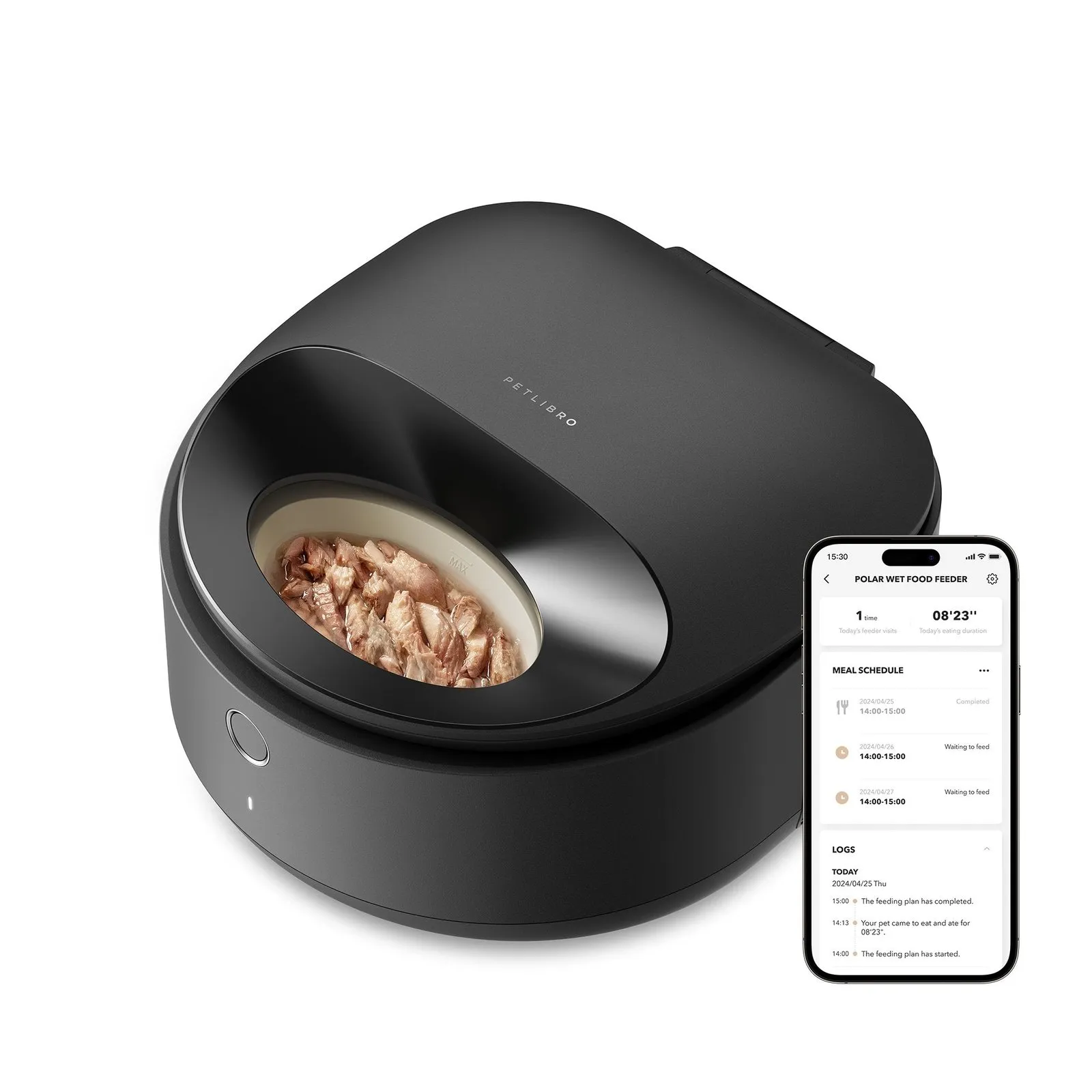
PETLIBRO Feeder Review 2026: Why Units Die in 6 Months
PETLIBRO feeders get worse with age. Firmware updates remove features owners paid for, and units die at 6-7 months. That verdict rests on 841 Trustpilot reviews (3.8/5, 28% one-star) and the Amazon listing for the camera feeder (4.2/5, 11,694 ratings), collected August 2026.
I spent an evening on PETLIBRO’s Trustpilot page, then another night on the Amazon listing for the camera feeder and the support forums. The scoreboard: 3.8/5 across 841 reviews, 28% of them one star. The camera feeder (B0B5ZGGWBQ) looks healthier on Amazon, 4.2/5 across 11,694 ratings with 11% at one star. On paper that’s a decent product with a loud minority attached.
Then you read what the loud minority says, and the pattern is unlike anything else in this category. The hardware works. And then a firmware update quietly takes a feature away, one by one, over years of ownership. Amazon’s machine-generated “Customers say” summary of the camera feeder lands on the same four things: inconsistent portion control, durability, units breaking after about a year, and frequent Wi-Fi disconnects. The algorithm and the handwritten one-star reviews agree.
Why did a firmware update take a feeder apart?
The short answer: updates shipped without regression testing stripped features one by one. A four-year owner lost the recorded voice, sound alerts, low-food notices, and motion activation in sequence.
The most complete account belongs to Dilek Mir Tekin, a verified purchaser who ran her feeder for four years. The first update killed the recorded voice. The next one killed the sound alerts. Then the feeder stopped telling her when food ran out or the device went offline, and her cat went without food three times in four years because she had no way to know. Motion activation went last, and a factory reset didn’t bring it back. Support told her the device was out of warranty and offered a discount on a new unit, “which i found it insulting.” Her closing line: “Never trust a brand that doesnt stand for their products.”
That review is the most distinctive thing in PETLIBRO’s profile, and it isn’t one unlucky customer. The same sequence shows up across reviews: updates ship without regression testing, and owners lose functions they paid for. If you already own one, turn off auto-update if the app allows it, and check the support forum before installing any major release.
Why do PETLIBRO feeders die in six months?
The short answer: the failure reports read like a maintenance log. Polar units break every two to three months at an average lifespan of six to seven months, which works out to roughly $25 a month per feeder.
The lifespan complaints read like a maintenance log. Stefano Barboro in Italy ran Polar feeders in rotation, one breaking every two or three months, average lifespan six to seven months. He ordered over ten. Amy in the US lost the vacuum-seal function in under a year. A Reddit owner on r/CatAdvice put it plainly: “it works great when it works… but it doesn’t work after less than a year.” The BBB record for Petlibro (Santa Clara) shows a wet-food feeder that stopped refrigerating, a warranty replacement, and a replacement that failed the same way. Another Reddit owner called the Polar “the only one refrigerated on the market” and still returned it because the design and programming were too faulty to trust.
Do the math on that. At $150+ per unit, a six-to-seven-month lifespan works out to roughly $25 a month per feeder. Owners rotating multiple units are paying a subscription they never signed up for.
Why does support stall inside the warranty?
The short answer: support demands videos, fan tests, and temperature readings — “creating barriers not resolving” — and the 12-month warranty barely covers the six-to-twelve-month failure pattern.
The device fails, support stalls, the owner gives up or pays. That sequence shows up in the one-star reviews more consistently than any hardware defect, and it starts inside the warranty period. Tony Knight in the UK, still under warranty, had support repeatedly demand videos, fan tests, and temperature readings, “creating barriers not resolving.” Amy’s support stopped responding entirely. Andy in Japan watched filter quality decline and reported a pump that gets dirty easily, with no clean path offered. Sam in the Netherlands canceled his subscription in the app, Google Play kept charging, and support passed him between departments. A YouTube reviewer, @bradleybennett, summed up the escalation channel: “They have a Hotline but they dont monitor it.”
BBB lists active complaints for Petlibro as of July 2026. The 12-month warranty most models carry barely covers the failure pattern at six to twelve months, which makes the support experience the real test of the purchase.
Why doesn’t the food come out right?
The short answer: even undersized kibble comes out slowly and sometimes breaks, the feeder stops below roughly 50% hopper, and portion size takes about six feedings to stabilize.
Ana, a verified US purchaser, found that even with kibble smaller than the recommended size, “the machine doesn’t release food very smoothly… Sometimes it even breaks the kibble pieces slightly.” DIY Smart Home Hub’s fault roundup adds the mechanics: the feeder stops dispensing when the hopper drops below roughly 50%, kibble has to stay within 2-10mm, the outlet tube clogs, and portion size takes about six feedings to stabilize.
For most cats, six feedings of settling in is nothing. For a diabetic cat, it’s a problem. A diabetic-cat owner on YouTube, @suuske, tested the camera model and called it not accurate at all. That combination of words shows up more than once in the medical-feeding reviews, and I’d treat it as the deciding factor if your cat’s health depends on exact portions.
Veterinary guidance from the AVMA notes that diabetic and prescription-fed cats need consistent, accurate portions, so a feeder that drifts or stalls is a medical risk, not just a portion-size annoyance.
The same failure class runs across brands. A PETKIT Fresh Element 3 owner’s weight sensor stopped the feeding when the cat touched the bowl while the app still reported 50g dispensed, and his cats couldn’t eat enough for days. If you feed a prescription or diabetic cat, weigh portions manually at least weekly and keep a manual backup feeder.
Why does the camera feeder lose Wi-Fi and night vision?
The short answer: Wi-Fi drops away from the router and in battery mode by design, the app can lag or freeze, and multiple owners report the camera’s night vision does not work.
Robert S. in the US lost Wi-Fi unless the feeder sat close to the router. On battery power the feeder disconnects from Wi-Fi entirely, probably by design, and D-cell batteries add recurring cost. Ana found the app can occasionally lag or take a little while to connect. @RJT629 on YouTube reports the app freezing constantly. The camera model has its own catch: multiple owners report the night vision does not work. Simon in Australia: “The machine is great, but night vision doesn’t work.”
None of this is PETLIBRO-specific. PetSafe Smart Feed, at $120.99 with 4.0/5 on Amazon, has official troubleshooting pages for offline units and wrong dispensing amounts, and a Reddit owner’s cats went unfed from Thursday because the app failed. In this category, an offline feeder is a missed meal. Plan for the power cord and the router before you plan for the app. I broke down the hardware differences in the PETLIBRO vs PetSafe comparison.
What do the numbers say?
The short answer: 3.8/5 on Trustpilot with 28% one-star, 4.2/5 on Amazon with 11% one-star, and the same four failure classes repeated across Reddit, Trustpilot, and Amazon.
The data behind this review. Four sources collected August 2026: PETLIBRO’s Trustpilot profile (3.8/5 across 841 reviews, 28% one-star), the Amazon listing for the camera feeder B0B5ZGGWBQ (4.2/5 across 11,694 ratings, 11% one-star), the BBB file for Petlibro Santa Clara, and owner posts on Reddit’s r/CatAdvice. The failure pattern repeats across all four. Firmware updates remove features owners paid for: one four-year owner lost the recorded voice, sound alerts, low-food notices, and motion activation in sequence. Units fail at 6-12 months, and support stalls inside the 12-month warranty window. At $122.99-180 per unit, a six-to-seven-month lifespan works out to roughly $25 per month per feeder. Amazon’s machine-generated summary of the camera feeder lands on the same four complaints as the handwritten one-star reviews: inconsistent portion control, durability, units breaking after about a year, and frequent Wi-Fi disconnects. The 28% one-star share on Trustpilot and the 11% on Amazon both concentrate on these failure classes rather than on the app’s day-to-day use.
| Metric | Value |
|---|---|
| Trustpilot score | 3.8 / 5 (841 reviews) |
| 1-star share (Trustpilot) | 28% |
| Amazon rating (camera feeder) | 4.2 / 5 (11,694 ratings) |
| Amazon 1-star share | 11% |
| Amazon 3-star or below | 21% |
| Camera feeder price | $122.99 (list $139.99) |
| Polar wet-food feeder | ~$150-180 |
| Model | Price | Notes |
|---|---|---|
| Camera feeder (B0B5ZGGWBQ) | $122.99 (list $139.99) | 4L hopper per listing; night vision reported broken |
| Polar wet-food feeder | ~$150-180 | Cooling fails; tray stops spinning (Best Buy reviews) |
| Dockstream fountain | varies by listing | Pump failures; cord water damage |
| PetSafe Smart Feed (competitor) | $120.99 | 4.0/5 (2.1K ratings); app failure reports |
Prices from Amazon listings as of August 2026. Verify before you buy.
What do the good reviews praise?
The short answer: a straightforward app, portion control that works for most kibble, and solid camera video. Owners with working units are satisfied, but the failure rate drags the score down.
The four- and five-star share centers on three things: the app is straightforward, portion control works for most kibble sizes, and the camera model’s video quality is solid. Several positive reviewers mention the 2-10mm kibble requirement and that calibration takes patience. Owners with working units tend to be satisfied, which matches what our roundup of what pet owners love in 2026 found: the products people praise are the ones that keep running. The failure rate is what drags the score down, and the failure rate is the story. The same four failure modes repeat across Reddit, Trustpilot, and Amazon, a pattern the pet feeder reputation comparison maps brand by brand.
Where does it work, and where doesn’t it?
The short answer: it works for a single cat with standard kibble and reliable Wi-Fi; it doesn’t for diabetic or prescription feeding, wet food, multi-cat homes, or travel without a backup.
Travel. A Best Buy reviewer’s Polar stopped cycling on the second day of a trip and served an empty bowl: “This thing is going to get a cat killed.” Run a full week of schedules before you leave, and keep someone on standby who can feed manually.
Diabetic or prescription-fed cats. Portion precision is the whole point, and “not accurate at all” is the recurring risk. Weigh portions manually and keep a backup feeder.
Multi-cat households. More feeders means more failure points and more of the $25-a-month-per-unit lifespan math. Stefano ordered over ten units. Budget for replacements.
Wet-food households. The Polar is one of the only refrigerated feeders on the market, and the cooling failure reports from BBB, Trustpilot, and Best Buy hit exactly that feature.
Apartments and small spaces. The feeder is compact, but it needs reliable Wi-Fi near the router. Battery mode cuts Wi-Fi and with it the notifications. Keep it plugged in.
What checklist would have caught these failures?
The short answer: turn off auto-update, measure your kibble, plan for the power cord, weigh portions manually, keep a gravity backup, and read the 12-month warranty terms.
- Turn off auto-update if the app allows it. The firmware is where features go to die. Check the support forum before installing major releases.
- Measure your kibble before ordering. PETLIBRO feeders accept 2-10mm dry kibble. Smaller pieces jam and get crushed mid-dispense, and the wrong size produces the “not dispensing” complaints.
- Plan for the power cord. Keep it plugged in and near the router. Battery mode disconnects Wi-Fi, which kills notifications.
- Weigh portions manually if your cat’s health depends on them. The app’s portion report isn’t a medical instrument.
- Buy a $20 gravity feeder as backup. It covers the gap when the app fails or the schedule resets.
- Read the warranty terms. Twelve months is standard on most models. Given the failure pattern at six to twelve months, the warranty barely covers the expected lifespan. Keep your receipt.
Who should buy it, and who shouldn’t?
The short answer: consider it for a single cat, standard kibble, and reliable Wi-Fi; skip it for medical feeding, wet food, night-vision needs, or travel without a backup plan.
Consider it if you have a single cat, standard 2-10mm kibble, and reliable Wi-Fi near where the feeder will sit; if you’ll keep it plugged in; and if you accept the update risk or will disable auto-updates.
Skip it if your cat needs exact portions for a medical condition, if you feed wet food (the Polar’s cooling is exactly where the failures hit), if you’re buying the camera model for night vision, or if you travel without a backup plan. Skip the water fountain bundle unless you budget for original filters, about $30-55 a year, and weekly pump cleaning. Owners flag slime buildup and hard-to-clean pumps, and one reviewer called her $60 fountain a constant leaker that overflowed.
The 3.8/5 is a hardware score with a software problem stapled to it. The feeder feeds. Everything around the feeding is where the value leaks out: the updates, the support queue, the warranty that expires right as the unit does. Buy it with your eyes open, keep a gravity feeder in the cupboard, and never let the app update itself. Your cat doesn’t care about the ecosystem. Your cat cares about dinner.
What should you buy instead?
The short answer: the PetSafe Smart Feed, with no firmware updates quietly deleting features, a schedule kept on backup batteries when Wi-Fi drops, and no mandatory subscription.
If the update-and-failure pattern above has you looking elsewhere, the alternative I keep coming back to is the PetSafe Smart Feed, a 6L/24-cup feeder with 4.0/5 across 2,100+ Amazon ratings, currently around $120.99.
PetSafe is the opposite of PETLIBRO on the two things that matter most here. First, there are no firmware updates quietly deleting features you paid for. The Smart Feed is a mature platform, and the app is a remote control, not a subscription gate. Second, it keeps its schedule on backup batteries when the Wi-Fi drops, which is exactly the failure mode that left PETLIBRO owners with a silent feeder and a hungry cat. No mandatory subscription either, so there’s no $25-a-month-in-disguise math hiding in the lifespan.
It’s not flawless. The app has its own offline reports, and any feeder in this category can miss a meal if the network goes down. But those are the ordinary risks of owning an automatic feeder, not a product that gets worse on purpose over time. For the full landscape, the smart pet devices category guide shows where feeders sit against cameras, fountains, and litter boxes, and which brands this site actually recommends.
Disclosure: the link above is an affiliate link. If you buy through it, we may earn a commission at no extra cost to you.
Updated: August 12, 2026. Review data from Trustpilot’s petlibro.com profile and Amazon (ASIN B0B5ZGGWBQ), collected August 2026. Quotes are from verified reviews. Prices change; verify before purchase.
FAQ
My PETLIBRO lost a feature after an update. Can I fix it? Factory reset sometimes restores functions, but multiple owners report it does not. Check the official forum for your model, and report the regression to support so it gets logged. Consider disabling auto-update until a release has been out for a few weeks.
Is PETLIBRO portion control accurate? For standard 2-10mm kibble, mostly yes after the first few feedings settle the mechanism. For precise medical feeding, the reviews split: diabetic-cat owners report the camera model is ‘not accurate at all.’ Weigh portions manually at least weekly if your cat’s health depends on exact amounts, and keep a manual backup feeder.
Should I buy the PETLIBRO water fountain? The fountain works but needs frequent cleaning and original filters, which run about $30-55/year. Reviews flag pump failures at 12-14 months, slime buildup inside the basin, and one case of a cord that failed from water damage at the base. Budget weekly pump cleaning if you bundle it with a feeder, and check whether replacement pumps are sold separately.
What warranty does PETLIBRO offer? Standard is 12 months on most models, and owners report support demanding videos and diagnostics inside that window. Given the failure pattern at 6-12 months, the warranty barely covers the expected lifespan; the BBB file for Petlibro Santa Clara lists active complaints as of July 2026. Read the terms before buying, and keep your receipt.
Will PETLIBRO work with my cat food? PETLIBRO feeders accept 2-10mm dry kibble. Smaller pieces jam and get crushed mid-dispense, and wet food requires the Polar model, whose cooling is where the BBB and Best Buy complaints concentrate. Measure your kibble before ordering; the wrong size produces the ‘not dispensing’ complaints, and the hopper stops dispensing below roughly 50% full per the DIY Smart Home Hub fault roundup.
Does PETLIBRO work on battery or offline? On battery power the feeder disconnects from Wi-Fi entirely, which kills notifications, and owners report D-cell batteries add recurring cost. Keep it plugged in and near the router if you need alerts; Robert S. lost Wi-Fi unless the feeder sat close to the router. For travel, run a full week of schedules and keep a $20 gravity feeder as backup.
Is the camera model worth the extra cost? The camera adds live video and two-way audio, and reviewers praise the video quality. Night vision is the catch: multiple owners report it does not work. Buy it for the video, not the night vision, and check current reviews of the app version.
Additional sources: FDA Center for Veterinary Medicine — pet food, Cornell Feline Health Center.