Cat Won't Use Your Automatic Litter Box? 5 Real Reasons
The biggest failure of an automatic litter box is rarely the machine. It is the cat. Owners on Reddit and Bilibili report cats that refuse the box for weeks, kittens that step in their own waste inside a rotating drum, and $400+ machines that say “full” right after being emptied. The gap between the advertising and the owner reports is wide enough to drive a truck through.
I spent an evening inside a Bilibili video about a 2,000-yuan Catlink box that turned into a “祖宗” (an ancestor you serve), plus the Reddit threads under PETKIT and Litter-Robot keywords. The pattern repeats in both languages: the marketing shows a clean white box and a happy cat; the owners describe a cat that treats the machine like furniture, a drawer that lies about being full, and litter that smells worse than the manual box it replaced.
That gap matters more than any spec sheet. A litter box you scoop by hand still works. A $600 automatic box your cat refuses is a $600 sculpture with a power cord.
The ad-to-reality gap is the real first review
The short answer: the gap is real and it is the first thing to price in — the marketing shows a happy cat and a clean box, while owners report cats that refuse the machine and boxes that lie about being full.
Start with the Bilibili video from August 8, 2026, where the uploader documents a Catlink 胖宝 series box that faulted repeatedly, got replaced, faulted again, and ended with them back to manual scooping. Their line: “什么叫花钱买罪受?这就叫花钱买罪受” — roughly, “this is what buying misery looks like.”
The top comment, 8 upvotes, captures the buyer experience better than any marketing page:
终于有吐槽的,网上搜了半天一堆广告夸的天花乱坠 — “Finally someone complains. I searched all over and every ad praised it to the skies.”
A second commenter calls themselves a Catlink “产品受害者” (product victim) and says they will blacklist the brand. These are not isolated meltdowns. They are the noise floor of a category where ad spend outruns product maturity, and our smart litter box guide shows the same split in the data: 1,263 Trustpilot reviews, one-star shares from 22% to 69% depending on brand.
Reason 1: The cat decides, and the cat often says no
The short answer: the cat, not the machine, decides — and some cats never accept an enclosed automatic box, no matter how long or how patiently you train them.
The most expensive failure mode has nothing to do with motors. On r/PETKIT, August 5, 2026, an owner wrote:
At first, my cat completely ignored my new PetKit Purobot for Max 2. She treated it as a piece of furniture and simply couldn’t grasp that it was for doing her business. I tried every method, but none of them worked.
Every method. Weeks of training, no result. The box was not broken; the cat simply decided the machine was not a toilet. That is the failure no warranty covers and no firmware update fixes.
Slow introduction works for some owners: leave the box off for days, feed near it, keep the old box available. The honest version of that advice is that some cats never accept it. If you have a cat with strong box preferences, an automatic box is a gamble, not an upgrade.
Veterinary guidance from the Cornell Feline Health Center on litter-box issues notes that cats can reject a box for many reasons — location, litter, noise, and change — and recommends gradual transitions, which matches the refusal reports above rather than any single brand defect.
Reason 2: Kittens and enclosed drums do not mix
The short answer: enclosed rotating drums do not match kitten behavior — a 5-month-old Ragdoll stepped in her own waste inside a Purobot Max Pro.
On r/Pets, August 7, 2026, a 5-month-old Ragdoll inside a PETKIT Purobot Max Pro kept digging, turning around in the enclosed space, and stepping in her own waste. The closed barrel plus rotating mechanism did not match kitten behavior.
That is the design tension nobody puts on the box: enclosure controls odor and tracking, and it also traps a kitten inside with her mess. Brands mostly advise waiting until the cat is grown. From the owner reports, the practical rule is that kittens under roughly 6 months belong in an open tray you can watch.
Reason 3: Sensors lie, and the box argues with you
The short answer: dust and cat hair coat the optical sensors, so the box reports a full drawer right after you empty it and keeps arguing through resets.
The machines that do work still argue with their owners. On r/litterrobot, an LR4 owner wrote:
LR4 saying drawer is full when it isn’t… now it says it’s full even after I just emptied it. We’ve tried to press the reset button, unplug & plug it back in again…
A follow-up owner: “I recalibrate the sensor, switched to the clear liner… Everything. I give up! Should have kept my old one instead of buying a new one.” Another LR4 thread documents constant WiFi drops, the app deleting the device during reconnection attempts, and an infinite loading screen that survives factory resets.
Why this is structural: optical and weight sensors sit inside a box full of dust, hair, and litter. The dust coats the beam, the reading drifts, and the box misjudges. Sealed sensors force a repair call; removable, cleanable ones fail least. Our Neakasa M1 review documents the same sensor-drift pattern plus a warranty that ends at month 12, and the Litter-Robot 5 Pro review covers the $1,000 version’s overloaded-globe false alarms.
Reason 4: Litter compatibility and odor control overpromise
The short answer: most automatic boxes restrict litter types and deliver only partial odor control — tofu litter is widely incompatible, and clay does not cover 100% of the smell.
On r/Catownerhacks, August 4, 2026, an owner who tried both PETKIT and Neakasa boxes:
It’s great not having to scoop poop every single day, but the clay litter doesn’t cover 100% of the smell, and it’s sooo frustrating. I tried switching to tofu litter, but it seems like none of the automatic litter boxes on the market can work with it.
Two real costs hide here. First, most automatic boxes restrict litter types, so the tofu or crystal litter you already use may be disallowed. Second, odor control is advertised as solved and delivered as partial, which matters in a small apartment where the whole point was fewer smells.
Reason 5: The box should not depend on a server
The short answer: a litter box that needs an app, an account, or a server to clean is a liability — buy boxes with physical buttons and offline cycles.
A BuyItForLife thread from August 13, 2026 (58 upvotes) says it plainly:
I don’t want my litter box to become useless because an app stops working… I’m fine with an app being optional, but I don’t want basic cleaning to depend on a phone, an account, a server, or whatever software still exists years from now.
That fear is not hypothetical. The PETLIBRO outage in August 2026 took feeders offline globally for days, and our subscription wall analysis shows where the industry is heading. A litter box that refuses to clean without cloud approval is a liability wearing a convenience costume. Buy boxes with physical buttons and offline cycles, or treat “app required” as a red flag.
Who should still buy one: the owners who got it right
The short answer: easygoing cats, compatible litter, and disciplined sensor cleaning separate the owners who get years of trouble-free use from the ones who don’t.
The honest counterweight is that plenty of owners report years of trouble-free use. On r/homeassistant, August 8, 2026, a household running 21 cats on automatic PETKIT boxes says “the litter boxes work great” (their complaint is litter tracked out of the box, solved with a robot vacuum). On the Bilibili thread, one owner’s PETKIT box is “still in use, no problems,” another praises the 萝卜 C40 as “huge and stable,” and a third switched to 糯雪’s semi-enclosed design because their cat likes to dig litter outward.
The line between those owners and the ones above is not brand luck. It is cat temperament, litter choice, and maintenance habit. The owners who succeed tend to have easygoing cats, compatible litter, and the discipline to clean sensors on schedule. The owners who fail tend to have opinionated cats and no test period. So the buying question is not “which brand” first. It is “will my cat accept an enclosed machine.”
A pre-purchase checklist that would have saved the 2,000 yuan
The short answer: test before you unbox fully, read the litter list, count the consumables, match the warranty to the failure window, check offline modes, and skip mandatory subscriptions.
- Run a test period without unboxing fully. Keep the box off for 3-4 days with the old tray beside it, then switch on. If the cat stops using the old tray but ignores the new box, return it while you still can.
- Read the litter-type list before checkout. If your current litter is disallowed, budget for the brand’s litter, which is usually pricier.
- Count the consumables. Bags, filters, and odor cartridges run $30-55 a year on most boxes, on top of the machine.
- Match the warranty to the failure window. Our litter box guide data says one-year warranties expire right before the failure curve; two years is the baseline for a $400+ appliance.
- Check for offline modes. A physical button that cycles the box without the app is the difference between a broken box and a working one during an outage.
- Skip models with mandatory subscriptions. Litter box history and health data are increasingly paywalled, as our health data analysis documents.
What to buy instead
The short answer: the PETKIT Purobot Max Pro 2 for cats that accept enclosed machines, or a plain open tray and a daily scoop if your cat refuses them.
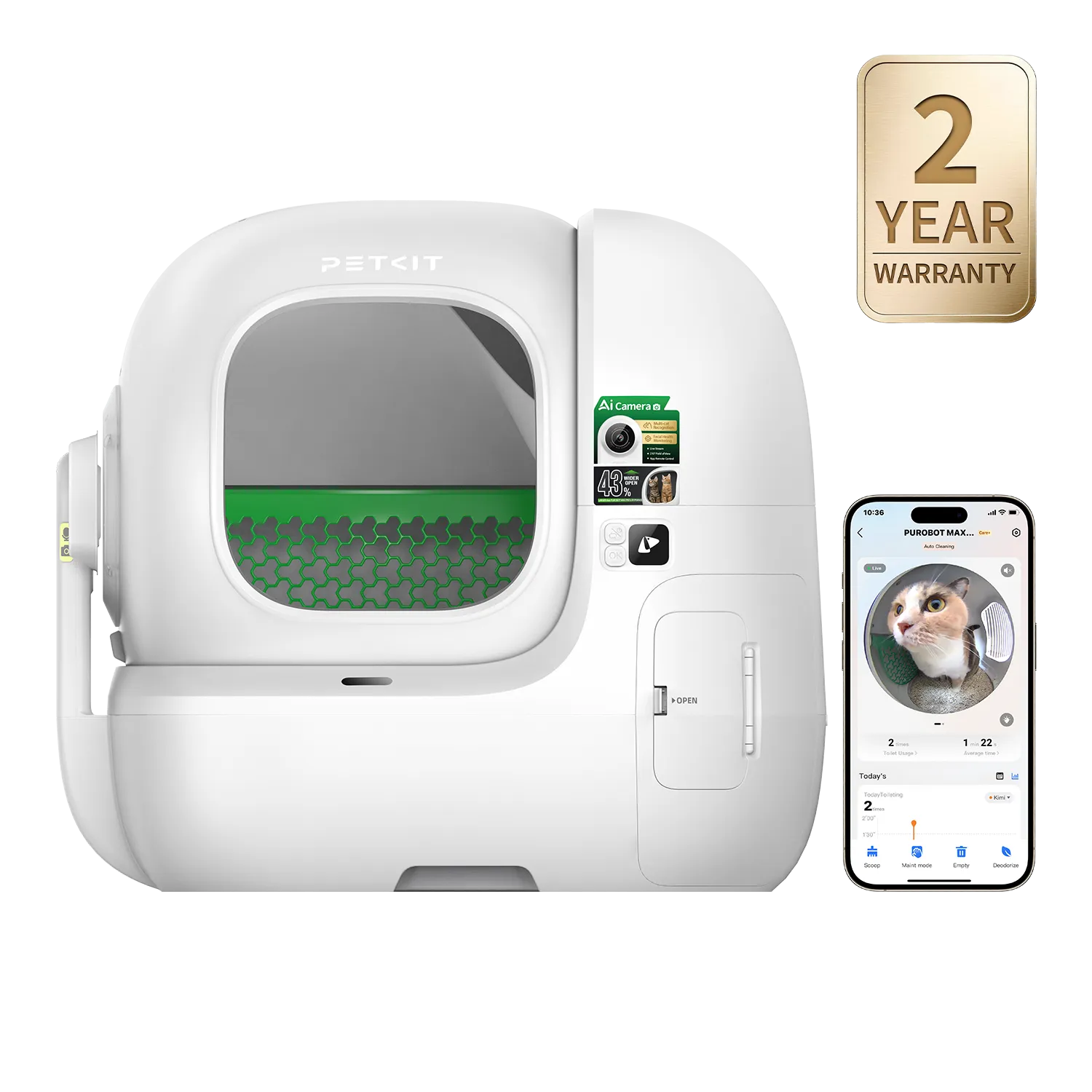
The PETKIT Purobot Max Pro 2 (on Amazon) is our pick at $499.99, and the reasons are the four specs above: a 43% larger entry for bigger cats, an 8L sealed waste bin with contactless drawstring packing and up to 17 days hands-free, AI health tracking with multi-cat recognition, and a 2-year warranty. It runs without a paid subscription, and the app is a dashboard rather than a toll booth. PETKIT’s brand record in our data stays positive, with the documented caveat that enclosed automatic boxes carry an adaptation risk, so pair the purchase with the test period above.
If your cat flat-out refuses enclosed machines, the honest recommendation is a plain open tray and a 10-minute daily scoop. A manual box cannot break, cannot lie about being full, and never needs a firmware update. Plenty of the owners in this research ended up exactly there, including the one who spent 2,000 yuan to learn it.
The automatic litter box is a good product for the right cat and a terrible one for the wrong cat, and the difference is almost never in the advertising. Listen to the owners who tried, test before you commit, and buy the machine that cleans without an app, a server, or a subscription standing between you and a clean box.
Updated: August 20, 2026. Owner reports from Reddit (r/PETKIT, r/Pets, r/litterrobot, r/Catownerhacks, r/BuyItForLife, r/homeassistant, August 2026), Bilibili comment threads (BV1a4uG61Eox, August 8, 2026), and PETKIT product page specs. Prices and warranty terms change; verify before purchase.
FAQ
Why won’t my cat use the automatic litter box? The most common owner-documented reasons are unfamiliar motion and noise, a closed barrel design the cat finds cramped, and litter texture changes. One Reddit owner trained a cat for weeks with zero success before giving up. Some cats accept an automatic box in days; others never do, and no amount of treats changes that.
Are automatic litter boxes safe for kittens? Kittens under a few months old are the documented risk group. One owner’s 5-month-old Ragdoll stepped in her own waste inside a Purobot Max Pro because the enclosed space plus rotating design did not match kitten digging behavior. Most brands recommend waiting until the cat is large and coordinated enough to use the box comfortably.
Why does my automatic litter box say full when it isn’t? Sensor false readings are a category-wide problem. Litter-Robot 4 owners report the drawer showing full right after emptying it, with recalibration and unplugging failing to fix it. Dust and cat hair coat the optical sensors over time, which is why removable, cleanable sensors fail less than sealed ones.
Can automatic litter boxes work with tofu litter? Most cannot. An owner who tested PETKIT and Neakasa boxes found tofu litter incompatible with both and clay litter only partially controlling odor. Check the brand’s litter-type list before buying, because the litter you already use may not be allowed.
Do automatic litter boxes need WiFi or a subscription? No, and you should avoid ones that make you depend on it. A 58-upvote BuyItForLife thread argues the box should not become useless when an app stops working. Look for boxes with physical buttons and offline cleaning cycles; PETKIT Purobot models run without a paid plan.
Which automatic litter box do you recommend? The PETKIT Purobot Max Pro 2 at $499.99: 43% larger entry for bigger cats, AI camera, an 8L sealed waste bin with contactless drawstring packing, up to 17 days hands-free, and a 2-year warranty. Note the documented adaptation risk: some cats refuse enclosed automatic boxes, so test your cat’s acceptance before committing.