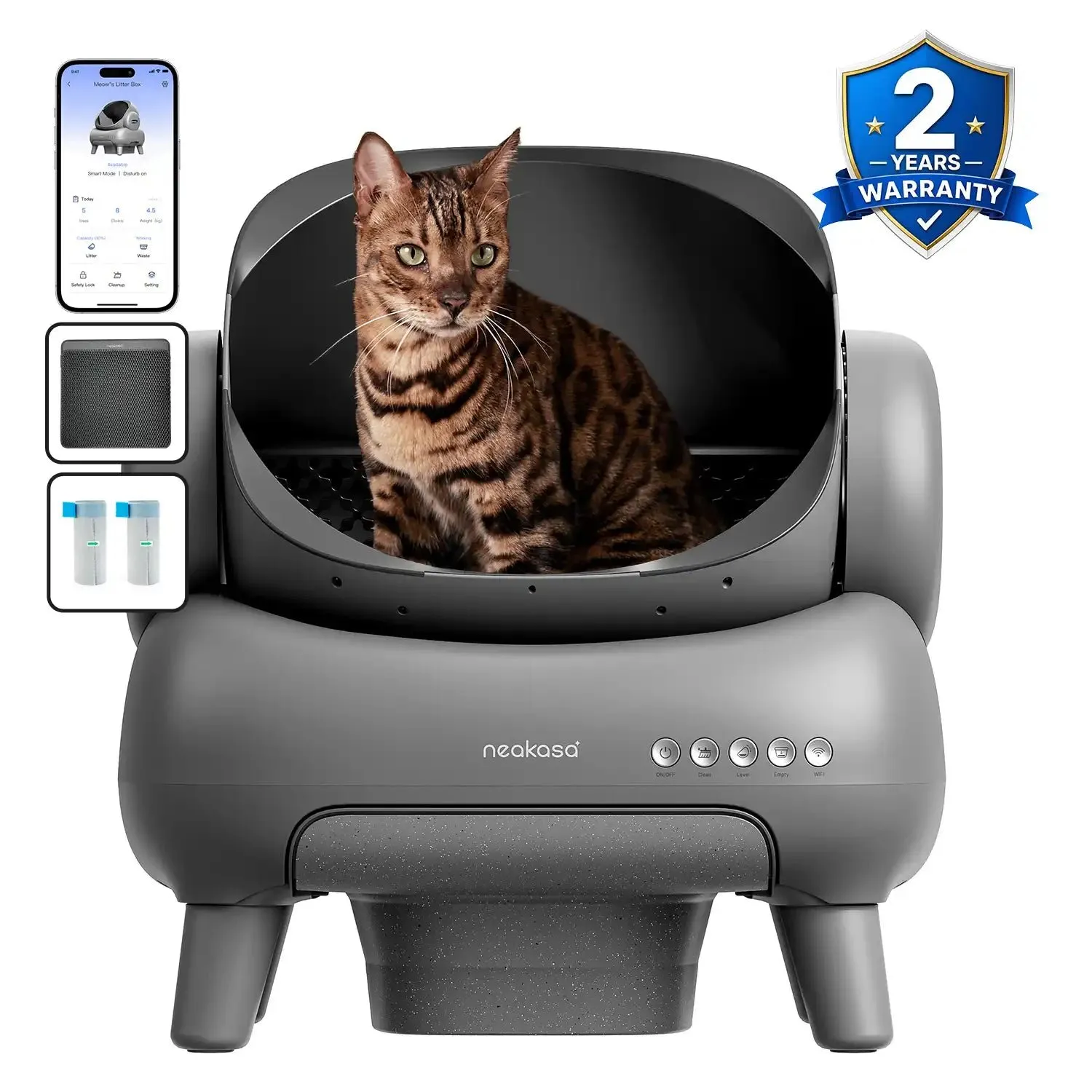
Neakasa M1 Review: Safety Incidents, 12-Month Warranty
The Neakasa M1 has the strongest Trustpilot score in the smart litter box category (4.2/5, 125 reviews) and a documented safety record. It includes one verified injury case, one verified death case, and units that flip over when the entry-pad magnet loosens. The 22% one-star share carries the failures, including a cat injured mid-cycle.
I spent an evening with the Neakasa M1’s review pile: every one-star review on Trustpilot, the forum warning threads, a year-long teardown, and the support complaints that trail through all of it. The math is the weird part. The M1 holds a 4.2/5 Trustpilot score across 125 reviews, the strongest in the smart litter box category. Then you hit the 22% that are one star, and the average stops carrying much weight. The positive reviews describe a box that works. The negative ones describe a cat injured mid-cycle, a second cat that died, units that died right after the warranty expired, and a support team that hands owners a screwdriver.
The M1 lists at $599.99, with 2026 spring promos around $376 (PetsRadar and MSN deal coverage) and the M1 Plus Lite variant as low as $332.99 at the official store. The warranty runs 12 months. Hold those two numbers together, because the failure reports cluster right around months 12 to 18.
The M1’s risk profile, in numbers. The Neakasa M1 holds a 4.2/5 Trustpilot score across 125 reviews, with 22% at one star, and lists at $599.99 with 2026 spring promos around $376. The 12-month warranty expires exactly where the failure reports cluster, months 12-18. Mark’s Tech Blogs’ one-year long-term review (September 2025) documented one verified injury case and one verified death case in Neakasa’s official community, plus a unit that flipped over when the entry-pad magnet loosened at the end of a cleaning cycle. Neakasa responded with a firmware update and a revised cog; the reviewer still advises waiting until every retail unit ships with the revised cog. A Chinese market test of 25 smart litter boxes found only 7 met safety standards, with concerns centered on sensor reliability during cycling. Truthful Paws’ roundup of 500+ Amazon reviews and 48 Reddit threads titled the M1 ‘Best Open-Top Box, Sensor Problems.’
Are the accidents real?
The most detailed account comes from Mark’s Tech Blogs, a one-year long-term review published in September 2025 that ends with the line “No one should buy this machine!” The reviewer documented one verified injury case in Neakasa’s official community: a cat was injured when the unit did not stop mid-cycle. A second verified death case exists, which Neakasa attributed to multiple failures compounding. The same review reports that the entry-pad magnet loosened, which let the whole unit flip over at the end of a cleaning cycle.
Neakasa’s response was a firmware update plus a revised cog. The Sphynxlair forum picked up the same warning: “there was a pet injured due to a physical malfunction of the Neakasa M1 litterbox,” with advice to update the firmware and install the add-on Neakasa released to stop the litter basin from inverting fully. The reviewer ends the piece with “Until all retail units include the revised cog and (ideally) improved sensing, I cannot recommend buying.”
Outside the individual cases, the category itself came up short. A Chinese market test of 25 smart litter boxes found only 7 met safety standards, with the concerns centered on sensor reliability during cycling. Neakasa’s own support FAQ lists 360-degree rotation and tipping among its troubleshooting topics, alongside app connection failures, sticky buttons, interrupted cleaning cycles, and drifting weight readings.
These are worst-case outcomes, and they cluster in this brand family. The whole point of an automatic box is that you leave it running unattended. If you’re doing that with a small cat in the house, the incident history matters more than the average score.
Veterinary guidance from the Cornell Feline Health Center notes that cats can be injured by equipment that moves unexpectedly, and that owners should supervise early use of any automated litter box — which makes the M1’s cycling and tipping reports a reason for caution, not a rounding error.
Why does the warranty run out when failures start?
Alex in Canada owned an M1 for 1 year 4 months. It “died completely with no warning.” The 12-month warranty had expired, so his only option was full-price replacement. He moved to the PETKIT Purobot Max Pro 2 specifically for its 2-year warranty.
John in the UK spent £2000 on four units. Problems started within five weeks. He emailed support for 17 months while they “asked for serial numbers over and over” and never honored the warranty.
A Facebook support-group owner reported odd noises and flashing buttons at five months. That one was in warranty, and Neakasa shipped replacement parts after he sent serial numbers and diagnostics. So the coverage exists. The problem is timing: the parts that fail most, the sensors, the motor, the cog, fail around or after month 12.
A $500-700 machine carries a 12-month warranty, and the failures arrive at months 12 to 18. The warranty barely covers the expected lifespan. That’s not bad luck. It’s a design decision.
Why does support hand owners a screwdriver?
Patricia Ingram put the support experience in one sentence: “make me work on this box like I’m a Neakasa employee technician.”
John’s case is the extreme, but the shape repeats everywhere: serial number requests, video requests, stalled replies. When support does act, it ships parts and expects the owner to install them, which is exactly where Patricia’s complaint comes from. Alex, out of warranty, was offered a discount on a new unit instead of a repair.
This isn’t unique to Neakasa. Warranty fights are common across the category: support demands documentation for in-warranty failures, then offers a discount on a replacement once the warranty expires. Neither path fixes the machine you already own. When a brand does ship parts, the install is on you, and my DIY repair guide covers which of those fixes are actually worth doing at home.
What do the positive reviews describe?
Most M1 reviews are positive, and the positive ones describe the same box: it genuinely works, the app is clean, the waste drawer holds several days of litter for a single cat, and setup takes minutes. Truthful Paws, which aggregated 500+ Amazon reviews and 48 Reddit threads, titled its verdict “Best Open-Top Box, Sensor Problems.” That title is the whole review in six words.
The open-top design is the real selling point. No dome means skittish cats walk in without hesitation, which is the exact group that dome boxes scare off. And “Sensor Problems” is the defining issue: hair and dust block the IR sensors on every brand, so plan to wipe them down every 2-4 weeks.
The split is genuine. The product works when it works, and the failure cases are severe but in the minority. Both of those statements are true at once, and the star rating only captures one of them. The same split shows up across the category in our roundup of what pet owners actually love in 2026.
Who should skip the M1?
- Small cats, kittens, and skittish cats. The documented incidents involve a unit that kept cycling and a unit that flipped. A panicking small cat inside a moving drum is the worst possible match for that failure mode.
- Multi-cat households relying on per-cat weight tracking. Owners report weight attribution errors, and Neakasa’s own FAQ lists inaccurate weighing as a known issue.
- Owners who travel for days at a time. Notifications are unreliable per the long-term review. A missed alert plus a stuck cycle means a full drawer and a stressed cat.
- Anyone buying without checking the hardware revision. Older stock may still ship without the revised cog. The reviewer who documented the incidents says to wait until every retail unit includes it.
Where do the alternatives sit?
| Model | Trustpilot | Warranty | What owners complain about |
|---|---|---|---|
| Neakasa M1 | 4.2/5, 22% 1-star (125 reviews) | 12 months | Safety incidents, unit death, support loop |
| PETKIT Purobot Max Pro 2 | N/A | 2 years | Connectivity, consumables |
| Litter-Robot 4 | 3.1/5, 47% 1-star (567 reviews) | N/A | 20-25% fault rate within 18-24 months |
| els pet | 1.8/5, 69% 1-star | N/A | Units dead at 4 months, support refuses remedies |
| CATLINK | N/A | N/A | Viral review: creates more work than it saves |
Alex moved to the PETKIT Purobot Max Pro 2, and its owner complaints focus on connectivity and consumables rather than safety incidents. Litter-Robot 4 has a larger review base but a worse failure rate: roughly $699, with a complaint roundup estimating 20-25% of owners hit sensor, cycling, or mechanical faults within 18-24 months. els pet sits at 1.8/5 with 69% one-star; buyers report units dead at four months and support that refuses remedies even when owners cite the UK Consumer Rights Act 2015. CATLINK is popular in China, but a viral Bilibili review with 163,000 views is titled “spent 2000 yuan and got an ancestor to serve,” a machine that creates more work than it saves.
No option is incident-free. Check the model’s history before buying, and our smart pet devices category guide breaks down where each brand’s complaints concentrate.
What would I buy instead?
If the incidents and the 12-month warranty have you looking for a different box, the one Alex moved to is the one I’d start with: the PETKIT Purobot Max Pro 2 (see it on Amazon). It carries a 2-year standard warranty, double the M1’s, which is the difference between the failure window and the coverage window, not a rounding error. Its owner complaints center on connectivity and consumables, not cycling incidents or support loops, and it’s the same pick the owner communities point at when the M1’s incident record comes up.
It isn’t a free pass. The same sensors need wiping every 2-4 weeks, and “no option is incident-free” still applies. But the two problems that define the M1’s review pile, safety incidents around cycling and a warranty that expires right as the failures start, are not the ones PETKIT owners are reporting.
Disclosure: the link above is an affiliate link. If you buy through it, we may earn a commission at no extra cost to you.
What should you check before buying?
If you’re still shopping after all this, run through these before checkout:
- Warranty length. 2 years minimum. A 12-month warranty on a $500+ machine is a red flag.
- Incident history. Search the model name plus “injury,” “incident,” or “death” before purchase. One search beats a refund fight later.
- Sensor design. Removable, cleanable sensors beat sealed units. Cat hair and dust block sensors on every brand.
- Replacement part availability. Check whether motors, sensors, and waste drawers are sold separately and at what price.
- Hardware revision. Ask whether the unit ships with the revised cog and current firmware. Older stock may lack the safety fix.
- Drawer size vs. cat count. Match the drawer to how many cats will use it. A full drawer that goes unnoticed is how “always full” errors become real problems.
The full smart litter box buying guide walks through the same checklist with prices and per-brand failure histories.
FAQ
Is the Neakasa M1 safe? The majority of owners have no incidents, but documented injury and death cases exist, and a market test found safety shortfalls in the category. If you have a small cat, a kitten, or a skittish cat that panics in enclosed spaces, weigh the risk carefully.
What does the Neakasa warranty actually cover? 12 months on the unit, and failure reports cluster at months 12-18, so coverage expires as failures start. Support requests videos, serial numbers, and diagnostics before authorizing anything, and owners report slow or stalled resolution: John in the UK emailed for 17 months and never got a four-unit warranty honored. Read the full terms before buying, and keep your receipt.
Why does the M1 have few but severe complaints? The positive-to-negative ratio is good because the product works for most owners: the app is clean, setup takes minutes, and the waste drawer holds several days of litter for a single cat. The severity of the failure cases is what makes the negative reviews heavier than the numbers suggest: safety incidents, total unit death, and support loops that run for months. Star ratings capture frequency, not severity.
What is a safer alternative? PETKIT’s Purobot Max Pro 2 offers a 2-year standard warranty, and its owner complaints focus on connectivity and consumables rather than safety incidents. Litter-Robot 4 has a larger review base but a worse failure rate. No option is incident-free; check the model’s history before buying.
Has Neakasa fixed the tipping problem? The company shipped a firmware update, a revised cog, and an add-on to stop the litter basin from inverting fully, per the Sphynxlair warning thread. Mark’s Tech Blogs still advises waiting until every retail unit ships with the revised cog. Check your unit’s revision before trusting it.
How often do the sensors fail? Truthful Paws named ‘Sensor Problems’ the defining issue in its 500+ review roundup, and in-warranty IR sensor failures exist, with Neakasa shipping replacement parts after owners send serial numbers and diagnostics. Hair and dust block sensors on every brand, so plan to wipe them every 2-4 weeks; Neakasa’s own support FAQ lists drifting weight readings among its troubleshooting topics.
Is the M1 okay for kittens or small cats? The open-top design reduces the enclosed-space panic that plagues dome boxes, which is why skittish cats take to it. The incident history involves cycling and tipping, so supervise the first weeks and keep early cleaning cycles short while you watch how your cat reacts.
The M1 works for most owners. I believe that. But it’s a $500+ machine with documented failure modes around small animals and a 12-month warranty that expires right around when the failures show up. Check the revision before you trust it, check the warranty before you buy it, and if you’ve got a small or skittish cat, ask yourself whether the convenience is worth that specific risk. For my money, it isn’t.
Updated: August 12, 2026. Trustpilot data collected August 2026 from neakasa.com and related profiles. Quotes are from verified reviews. Prices and warranty terms change; verify before purchase.