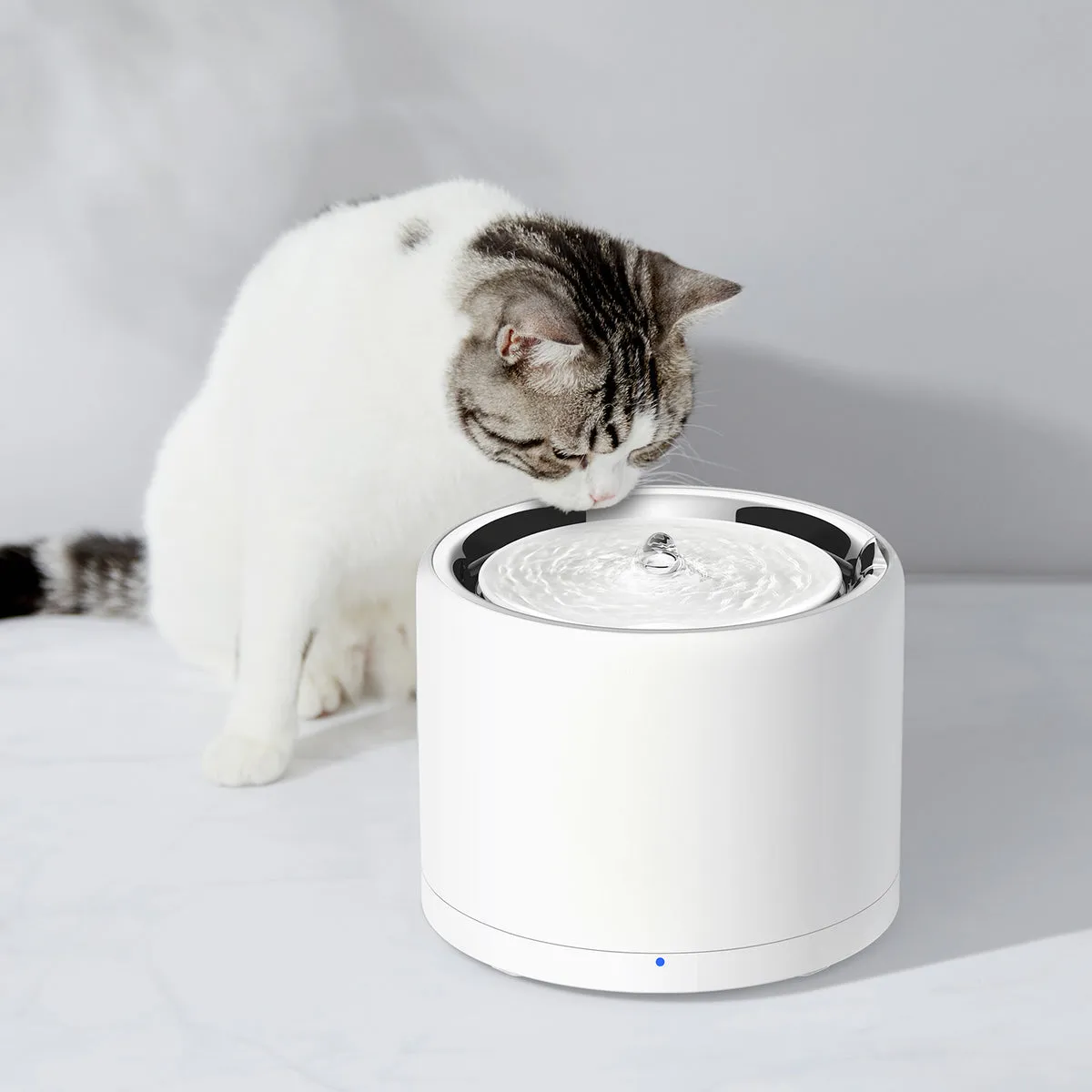
Cat Won't Drink From the Water Fountain? 5 Causes to Check
The short answer: a cat that ignores a water fountain is almost never rejecting water. It is rejecting something about the machine, and the five most common culprits cost nothing to test. The owner who solved this for her household did not buy a bigger tank or try a different water source. She realized the pump noise was the problem, swapped to a silent ceramic fountain, and her cats started drinking more of it.
I read three months of threads on this question this week, plus a Chinese-language roundup of 18 fountain models, and the same order of operations shows up in almost every case. Rule out sound. Check the mode the pump is running in. Then look at what the tank surface and the filter do to taste between cleanings. Then watch what your cat does with the machine when it thinks nobody is looking.
petiqlab earns a commission from the Amazon links on this page. Everything below comes from owner posts, PETKIT’s official product page, and Trustpilot profiles read on September 17, 2026, with links in the sources.
Why does my cat drink from the shower puddle and not the fountain?
Start with the behavior, because it is normal and it is not a defect in your cat.
The most upvoted version of this question in the past month is a thread in r/cats with 1,530 upvotes, where the owner asks whether it is normal that her cat prefers tap water to the fountain. The thread turned into a joke within an hour, but two comments explain the mechanism. A reply with 35 upvotes sets out the two-part answer owners keep rediscovering: moving water reads as fresh, and cats do not trust still water, because in the wild still water is where a predator can be waiting.
The second comment, at 48 upvotes, is the cautionary tale. This owner thought it would be fun to teach her cat to drink from the bathroom tap. She now lifts her cat onto the sink and opens the tap three to five times a day, or listens to it scream. Cats generalise that lesson fast, and a fountain is supposed to be the version of the tap that runs without human labour.
So the instinct is correct and the diagnosis is usually wrong. What follows is the order petiqlab would run, cheapest check first.
Cause 1: is it the pump noise you stopped hearing?
The clearest case in the last month came from a household running three fountains. The cats ignored all of them and drank puddles on the tile after showers. The owner assumed her cats were strange.
A reply with 7 upvotes gave the actual diagnosis, and it is the single most useful comment I found in this batch:
“My cat ‘didn’t like fountains’ either, until I realized it was the mechanical sound the fountains made that she didn’t like. I got a really nice, SILENT ceramic fountain, and, voila! She loved drinking from it and got much more water intake as a result as well.”
She names the model she bought, a PetSafe Creekside Ceramic fountain. This site has not tested that unit and does not recommend it, and the same brand’s Outlast line is one of the worst fountains petiqlab has reviewed. What matters is the mechanism, not the logo: the pump, not the water, was the objection.
There is a related clue worth knowing if the rejection started recently rather than on day one. In a separate thread, a CatAdvice owner describes her Petlibro fountain being knocked over two or three times a day, and a reply with 4 upvotes points out that a new noise or an inconsistent flow is often what pulls a cat’s attention to the machine in the first place. A pump that has started whining is both a noise problem and a warning that a vinegar soak is overdue.
Free test. Unplug the pump for a day and leave the tray or bowl section filled, changing the water twice. Watch what happens to drinking. Then, on a second day, run the fountain in another room to separate sound from location. If intake rises when the motor is off, you have your answer without buying anything.
For context on how much noise is even possible here, PETKIT’s official EverSweet 3 Pro product page, read on September 17, 2026, states that the sound of water flow on that unit is below 25 dB. That number is the one to compare against when a fountain’s own listing will not state it.
Cause 2: is the fountain set to a mode that leaves the water still?
An 18-upvote thread covers the second mistake, and it is a setting rather than a defect. The fountain had three modes, and the owner had it in the one that only activates when motion is detected.
The reply worth reading explains why that defeats the purpose:
“Would recommend changing to run constantly. Biggest purpose of a fountain is to keep water circulating (often through a filter). The constant agitation and motion discourages insects and reduces bacterial growth. Suddenly starting and stopping based on approaching/moving may also not be a stimulus that makes the fountain approachable to the cat.”
Two arguments are stacked there. Circulation is what keeps the filter doing anything, and a pump that starts when the cat approaches turns drinking into an event the cat has to trigger. Most cats drink in small, frequent visits, and a fountain that sits silent between visits is a still water bowl with a motor attached.
PETKIT’s page for the EverSweet 3 Pro lists exactly three flow modes, which is a useful vocabulary for reading any fountain listing: Smart, where the water flows intermittently; Normal, where it flows continuously; and Do Not Disturb, where the pump stops for a configured sleep window. On a cat that ignores the machine, run Normal through the day and leave Do Not Disturb for the hours you are asleep.
One review on that same page shows why this is a dial rather than a rule. An owner writes that she uses the Smart setting because some of her cats prefer moving water and others prefer it still, so intermittent flow keeps both groups served. That is a reasonable compromise in a multi-cat house. It is the wrong starting point when the problem you are solving is one cat who will not drink.
Cause 3: does the tank taste wrong between cleanings?
The longest, most technical thread in this batch is also the one with the clearest buying standards. A 13-comment thread in r/PetAdvice opens with an owner who says she cannot find a fountain she trusts, listing the failures she keeps hitting: steel that is not steel, tiny crevices everywhere, filter material of unclear origin, and a suspicion that motors that small cannot last.
One reply has the standards in a single sentence:
“The secret to safety and sanity is not finding a mythical everlasting motor, but choosing a reputable brand with a seamless unibody design, certified 304 food-grade stainless steel, and no tiny internal tubes or crevices. Slime isn’t just a filter issue, it’s a cat saliva issue. No matter how good the fountain is, cat saliva creates a biological film within days.”
That last line reframes the whole cleaning question. The film people clean off weekly is partly their own cat’s saliva, deposited on every visit. A fountain cleaned on the app’s two-week reminder is a fountain whose water tastes wrong for twelve of those fourteen days. petiqlab’s pink slime protocol and mold cleaning guide cover the removal side; the design side is 304 steel, no seams, and parts that come fully apart.
The pump is the other half, and it is a consumable rather than a repair. A reply with 2 upvotes puts the expectation in plain numbers: small fountain pumps last “a year or so running 24/7,” stainless beats plastic, and mineral deposits come off with a vinegar soak. A long-lived owner in the same thread reports running stainless Pioneer Pet fountains for decades by buying replacement motors rather than new fountains. petiqlab’s own pump guide works through the same math, and on the model recommended at the end of this article the official spare pump lists at $15.99.
Filters are the recurring bill, and the honest number is worse than the marketing. A Dockstream 2 owner measured 7 to 9 days of filter life against a two-week cadence, and a second commenter running two of the same fountains for one dog and one cat reports barely getting two weeks out of each filter. The same owner returned an earlier unit because it stopped logging how much the cats drank, and adds the advice that matters for anyone buying into this category: buy from a retailer with a long return window.
Durability complaints cross languages without changing shape. In a Chinese-language fountain comparison, one Mijia fountain owner left a comment that the unit broke twice in eighteen months, came back from a warranty repair, then failed again six months later. Small pumps die on a schedule, and the design decision that matters is whether the pump can be bought separately.
Cause 4: is the fountain actually a toy?
This one is not a fault at all, and it is the reason some fountains end up on the floor. In the same CatAdvice thread, the owner of the knocked-over Petlibro fountain had already surrounded it with a plastic storage bin, and the cat still toppled it. A reply with 4 upvotes describes the moment it becomes permanent:
“Once they figure out that pushing a thing makes water move, it’s game over for the next few months. Some cats treat it like a puzzle feeder but for splashing.”
Another reply, with 3 upvotes, is blunter about the same cat: “My cat doesn’t care about drinking water, his fountain was 95% a toy.”
The Chinese-language side has a structural version of the same complaint. In a roundup of 18 fountain models with 4,980 views, a commenter with 3 likes describes his cat pulling the water tank off the base until the two separated, spilling water across the floor and killing the machine, then adds the advice that follows from it: if your cat takes things apart, do not buy a design where the tank lifts off a separate base.
Three practical responses, in order of cost. Put it where it cannot be tipped onto a hard floor edge, since a fountain that has already been knocked over once will be knocked over again. Prefer a body with a low centre of gravity and anti-slip feet, the kind of detail PETKIT lists on its own product page as anti-slip pads. And if the cat has a history of dismantling appliances, treat the base-separated style as a category you skip, whatever the price.
Cause 5: is your cat simply a bowl cat?
The most useful reply in the whole batch for this problem is also the least commercial. In the same r/cats thread where the noise fix appears, a comment with 30 upvotes reads:
“Just give them a bowl if they don’t like the fountain. I have 3 cats, 1 fountain, 1 bowl. 2 cats prefer the fountain, one prefers the bowl.”
That household stopped arguing with its cats and stopped losing water intake, which is the actual goal. Two other routes appear in the same thread for cats that dislike moving water. One owner reports her cat ignored every fountain she tried and drinks heavily from a heated bowl with two stainless bowls in it, from K&H, and says she wishes she had bought that instead of the fountains. Another switched to a gravity bowl, sized for a dog so the drinking pan is roomier, and reported that fixing the pan size mattered more than the water’s motion.
The measurement that matters is how much your cat drinks per day, not whether the machine earns its counter space. If a stainless bowl gets more water into the cat, the bowl wins.
Five causes, five free checks
| What you see | Most likely cause | Free check | What fixes it |
|---|---|---|---|
| Cat drinks taps and puddles, ignores the fountain | Pump noise | Unplug the pump for a day, keep the tray filled and refresh the water twice | A quieter unit, or a bowl, or both |
| Cat visits only when the water is visibly moving | Motion or intermittent mode | Read the mode list in the app or listing | Switch to continuous flow, keep the sleep window for night |
| Drinking dropped off after months of use | Biofilm, scale, or a fouled filter | Rinse the tank and inspect the impeller for white crust | Vinegar soak, clean on a 2 to 3 day cycle, replace the filter |
| Fountain ends up on the floor, water everywhere | The machine is a toy | Watch one full visit from across the room | Low centre of gravity, anti-slip feet, avoid base-separated designs |
| Cat ignores every fountain ever bought | Preference | Put out a bowl for a week and count the visits | Keep the bowl, and stop buying fountains |
The two-week protocol petiqlab would run
This is the sequence for anyone who has already bought a fountain and is deciding whether to keep it.
- Rinse daily for two weeks, not fortnightly. Biofilm is largely cat saliva, and taste is the one variable the cat can detect and you cannot.
- Run the pump continuously unless your cat has already shown it dislikes moving water. Put the sleep window on the hours you are asleep.
- Set out a plain bowl beside the fountain, in a different spot, far from the litter box and the food.
- Unplug the pump for one full day and refill the tray twice. If visits to the still water jump, sound is your bottleneck.
- Put the fountain in a different room for a day. If the cat follows the water, the problem was never location. If it stops drinking entirely, the problem is the machine.
- Watch one full visit without moving. You will learn more in ten minutes about tipping, batting and approach angle than a week of app notifications.
If intake is up by the end of that and nothing has been knocked over, the fountain has earned its place. If the bowl keeps winning, the bowl is cheaper and no less healthy.
One thing worth separating from all of this: a sudden increase in how much your cat drinks is a veterinary question, not a fountain question. Increased thirst shows up in a long list of conditions, and the plumbing on the counter is not the first suspect.
What petiqlab recommends if the checks all pass
For a household that has ruled out noise, mode, cleaning and toy duty, and still wants a circulating fountain, the pick on this site stays the PETKIT EverSweet 3 Pro (UVC). It lines up with the checks above rather than with a marketing page: a 304 stainless steel container, which is the material standard owners in these threads ask for, a fully detachable build that includes the wireless pump, three flow modes including continuous, and a below-25 dB rating stated on PETKIT’s own product page as read on September 17, 2026. Capacity is 1.6 L, or 54 oz, with 60 ml held in the water tray during a power cut, and the filter runs on PETKIT’s 3.0 cartridge, a monthly consumable. PETKIT’s own store lists the unit at $79.99 as of September 17, 2026; Amazon pricing moves around that figure.
Four things belong in the same paragraph as that recommendation. The pump is a wear item, and the official spare lists at $15.99, which is the single best indicator of whether a fountain is repairable. Filters are a recurring cost, and a cat with strong preferences may ignore this unit for the same reasons it ignored the last one; one review on the product page reads “my cat hasn’t touched it yet.” And PETKIT is not a spotless brand. Its Trustpilot profile sat at 3.6 out of 5 across 292 reviews on September 17, 2026, with replies to 77% of negative reviews inside a week, and the negative side of that record clusters on its litter boxes rather than its fountains.
If the two-week protocol says the cat wants a bowl, buy the bowl. A stainless bowl costs a fraction of any fountain and delivers the same water without a motor, a filter or an app, which is also the honest answer for the last remaining cause on the list. Look at seals and edges before that purchase too, since fountain hardware has caused real injuries during ordinary cleaning on at least one model this year.
FAQ
Why won’t my cat drink from the water fountain? The water is rarely the reason. The causes that survive inspection in owner threads are pump noise the human stopped hearing, a flow mode that leaves the water standing most of the day, biofilm and mineral scale on a tank cleaned on a two-week reminder, and cats that treat the machine as a toy rather than a water source. A minority of cats simply prefer a still bowl.
How do I test whether the fountain noise is the problem? Unplug the pump for a day and keep the tray filled, refreshing the water twice. If visits go up, sound is a suspect. A second test separates sound from location by running the fountain in a different room and watching whether the cat follows the water or the spot. One owner in a 26-comment r/cats thread solved this for two cats by moving to a silent ceramic fountain and reported intake rose after the swap.
Should a cat fountain run continuously or on a smart mode? Continuous flow is the default for a cat that ignores the machine. Circulation through the filter is the point of owning it, and owners argue in a September 2026 thread that constant movement discourages insects and slows bacterial growth. PETKIT’s page lists three modes on the EverSweet 3 Pro: Smart for intermittent flow, Normal for continuous flow, and Do Not Disturb for a sleep window. Keep Do Not Disturb for the night and Normal for the day.
How often does a fountain pump need replacing? Treat it as an annual wear item rather than a fault. Owners in a September 2026 thread report small submersible pumps lasting about a year when they run 24 hours a day and note that swapping one is cheap and tool-free. A crusted impeller usually responds to a vinegar soak, which buys another run. The spare pump for the model recommended above lists at $15.99.
Should I keep a water bowl next to the fountain? Yes, and it costs nothing. A three-cat household in a September 2026 thread reported running one fountain and one bowl, with two cats preferring the fountain and one preferring the bowl. The number that matters is total water intake, not which vessel wins. Keep the bowl away from the litter box and the food station.
How long should I give a new fountain before deciding? Two weeks of honest testing, with the water changed and the tank rinsed every second or third day. If a cat has not used it after that, the machine is not the answer. Owners in these threads also warn that removing the old water source overnight can backfire, so keep both available while the cat decides.
Updated: 2026-09-17. Sources: r/cats post 1w97s76 (three fountains ignored in favour of shower puddles, the 7-upvote reply identifying mechanical sound and reporting a switch to a silent ceramic fountain, the heated bowl route from K&H with two stainless bowls, and the 30-upvote reply running one fountain and one bowl for three cats, September 7, 2026, 26 comments), r/cats post 1wg52rf (1,530 upvotes, the 35-upvote explanation that moving water reads as fresh and that cats distrust still water, and the 48-upvote account of tap training turning into three to five demands a day, September 14, 2026, 106 comments, mechanism comments only, the original image was deleted by the poster), r/cats post 1wdnvj3 (three modes including a motion-triggered one, the recommendation to run a fountain continuously for circulation, insect and bacterial reasons, September 12, 2026, 6 comments), r/PetAdvice post 1whkvwn (an owner unable to find a fountain she trusts, the seamless unibody and 304 stainless standard with the saliva biofilm explanation, replaceable motors on stainless Pioneer Pet fountains used for decades, pumps lasting about a year running 24/7 with stainless preferred over plastic and vinegar for mineral scale, PETKIT pump crevices that fully disassemble with a brush supplied, and the gravity bowl route sized for a dog, September 16, 2026, 13 comments), r/CatAdvice post 1wbcw1g (a Petlibro fountain knocked over two or three times a day despite a storage bin enclosure, the 4-upvote note that a new pump noise or inconsistent flow draws a cat’s attention, and the 3-upvote “95% a toy” summary, September 9, 2026, 6 comments), r/Petlibro post 1wes3p1 (Dockstream 2 filters lasting 7 to 9 days, two units for one dog and one cat barely reaching two weeks per filter, a return because drinking was not logged, and the advice to buy where the return window is long, September 13, 2026), bilibili video BV1nZN26mEyH (roundup of 18 fountain models, 4,980 views, a 3-like comment describing a base-separated unit dismantled by the cat until it spilled and failed, with the warning not to buy that design in a household that takes things apart), bilibili video BV1NDEg69Enr (Mijia fountain owner reporting two failures in eighteen months, a warranty repair and another failure six months later), PETKIT EverSweet 3 Pro official product page at petkit.com, read September 17, 2026 (304 stainless steel container, fully detachable components including the wireless pump, water flow sound below 25 dB, 1.6 L or 54 oz capacity with 60 ml retained in the tray during a power cut, Smart, Normal and Do Not Disturb flow modes, PETKIT Filter 3.0 four-stage filtration, UVC disinfection claim of 99.96%, anti-slip pads, listed at $79.99 with 111 site reviews of which 85 are five-star and 4 are one or two-star, plus the owner review using Smart mode for a mixed group and the review stating the cat has not used it), Trustpilot profiles for petkit.com (3.6/5 across 292 reviews, replies to 77% of negative reviews within a week), petlibro.com (3.4/5 across 967 reviews, 58% replied within two weeks) and petsafe.net (2.2/5 across 228 reviews, no reply badge), all read September 17, 2026.