Cat Water Fountain Mold: 4 Traps and What to Buy Instead
The short answer: cat water fountains go moldy when the design gives bacteria a place to hide. Four traps do most of the damage: parts that do not come apart, plastic bodies, a filter that collects food, and too many tiny pieces. Material and disassembly decide how long a fountain stays clean, not the app and not the filter count.
I spent an evening reading fountain complaint threads across r/cats and r/CatAdvice. The pattern repeats too precisely to be bad luck. A fountain works fine for the first month. Then the spout holder goes grey, the pump housing picks up a film, and the water starts tasting like a sponge smells.
The owners posting about it are not lazy. One cleans every Sunday and still watched a non-detachable part go moldy within a year. Another is a laboratory scientist on her third fountain who deep-cleans on schedule and still gets black gunk. Nobody blames themselves. They blame the design. They are right.
Why do cat water fountains get moldy so fast?
The short answer: fountains recycle water past food debris and warm motor parts all day, and any surface bacteria can cling to becomes a colony.
Biofilm is the technical name for the slime. Bacteria settle on a surface, excrete a protective film, and the film feeds on whatever the water carries past it. A fountain recirculates constantly, which means food particles, saliva, and dust get pushed past every internal surface on a loop. Warm pump housings speed the growth up. The question is not whether bacteria will find a surface. It is which surfaces you can scrub off.
That is where design enters. Plastic scratches. Steel does not. A part that does not detach cannot be scrubbed. A filter that sits in the water flow collects debris and then decomposes it. Each of those is a separate trap, and most fountains contain more than one.
Trap 1: Parts that don’t come apart
The short answer: if a fountain has a piece you cannot remove, that piece will mold, because no brush can reach inside it.
The clearest case comes from an r/cats thread posted August 16, 2026 by the owner of a kidney-disease cat. She cleans every Sunday and changes filters monthly. That did not save her:
“They all have this grey spout holder that does not disassemble and within a year, they have gotten moldy because this specific piece does not come apart to clean thoroughly.”
Nineteen upvotes, 58 comments, most describing the same part on their own fountains. The kidney-disease detail matters. For a cat on renal care, water intake is a medical intervention, and a moldy fountain is the opposite of the point. The thread’s top recommendation was a fountain whose parts all separate.
The test: if you cannot take a fountain apart into every piece that touches water in under a minute, skip it.
Trap 2: Plastic bodies
The short answer: plastic fountain bodies scratch with normal washing, bacteria multiply inside the scratches, and stainless steel or ceramic do not have that problem.
Plastic is porous at the microscopic level. Every scrub adds fine scratches, and bacteria settle into them where no cleaning reaches. A buyer thread on r/CatAdvice from August 2, 2026 sums up the consensus. The Petlibro Dockstream was praised for its multi-layer filters, then came the catch: “complaints that the plastic develops a biofilm pretty quick.” The same thread notes that buyers assume stainless steel beats plastic as a default. The material is the meal, not the garnish.
Chinese owners reached the same conclusion independently. In the comments of a Bilibili video about automatic pet products, one viewer said the fountain she bought on impulse was a disappointment. Another answered with four characters: 陶瓷碗干净些. Ceramic bowls are cleaner. Different platform, same rule.
The pattern in our water fountain pump guide notes matches: pump housings are the first part to slime in every material except steel.
Trap 3: The filter as a food trap
The short answer: the filter catches food debris and then holds it in the water flow, where it decomposes. How much that matters depends on your filter schedule, and whether the fountain circulates at all.
The most radical version of this argument is a r/cats thread titled “if you’re using a cat water fountain, STOP.” It drew 26 comments of genuine debate. The core claim:
“The filter is where the food is being caught but it’s just holding it as water flows over it, so it’s decomposing INTO the water and making it PRIME bacterial soup… activated carbon will continue to leach organic matter even after a water change AND will continue to host bacterial colonies that create biofilm.”
The measured take from both sides: the filter does trap debris, the debris does sit in the water path, and a filter changed late is worse than no filter at all. Manufacturers mostly set a monthly cadence, which only works if the owner actually remembers. That is a design flaw wearing a maintenance label.
The concern is pushing some owners toward non-circulating fountains, where water does not loop through a filter at all. A Japanese owner’s post about PETKIT’s EverSweet Ultra, a non-circulating model with a drinking-water record feature, is one of several demand signals for that direction. The circulating market is mature. The non-circulating side is where the bacterial soup crowd is looking.
Trap 4: Too many tiny parts
The short answer: every extra groove, valve, or floating piece is another surface for biofilm, and fountains with many small parts fail their owners even when cleaned on schedule.
An r/CatAdvice thread from January 4, 2026 is the most frustrated document I found. The poster is a laboratory scientist, which matters because she actually cleans properly:
“I’m on my third fountain and losing my damn mind lol… Even with this, there is some black gunk build up, and even a day or two with some minor error like an improperly installed filter leads to major mold. I’ve had to toss and repurchase plastic parts multiple times for this reason. Is there ANY fountain that doesn’t have so many tiny, mold-prone parts????”
Sixteen upvotes, 26 comments, and the question marks tell the whole story. The word to underline is tiny. Small parts are the ones you cannot see biofilm on and cannot scrub thoroughly. Fewer parts means fewer hiding places, full stop.
The comparison that matters: plastic vs stainless
The short answer: the same four traps map onto two material paths, and the owner threads vote overwhelmingly for steel.
What to check before you buy
The short answer: run every candidate through four questions, and reject it if it fails any of them.
- Can every part that touches water come apart? Including the spout, the pump housing, and the lid. If the answer is no, walk away.
- What is the tank made of? Stainless steel or ceramic only. Plastic is the mold substrate, not the discount.
- How many parts does disassembly involve? Five or fewer is comfortable. Ten-plus means a monthly ritual you will skip.
- Does the filter sit in the water flow? Yes is normal, but budget for on-time replacements, or look at a non-circulating design.
That checklist is the funnel I used to evaluate the fountain below.
The design owners land on
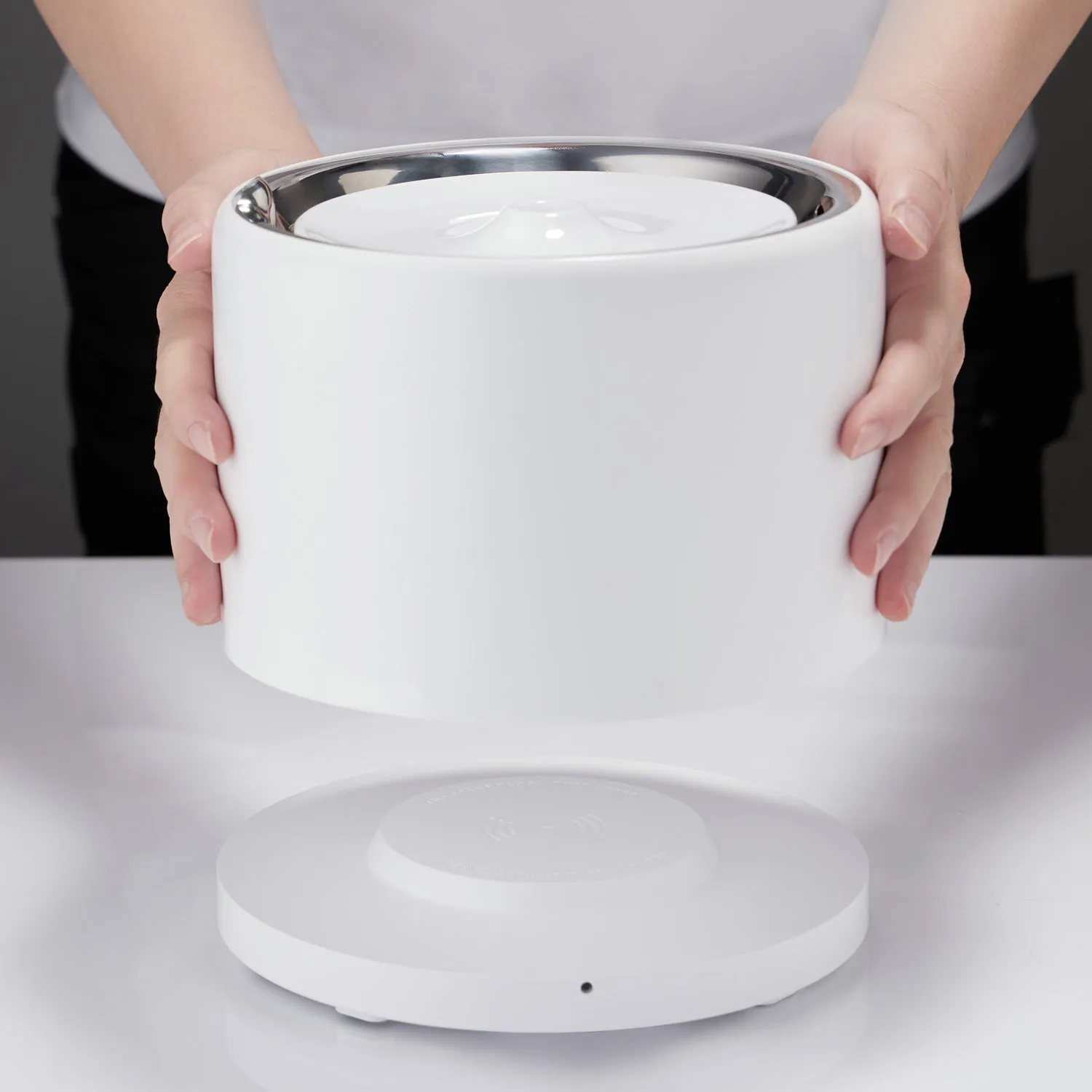
The short answer: the PETKIT Eversweet 3 Pro ($62.99, list $79.99) is the fountain our research points to: SUS 304 stainless steel tank, every part detaches, wireless pump, and a maintenance routine of a weekly 5-minute rinse plus a monthly 2-minute filter swap.
I went through the full review again before writing this, because the mold angle changes which features matter. The features that kill the four traps:
- The tank is SUS 304 stainless steel, the same grade as cookware. No scratches, no porous surface. Trap 2 is gone.
- Every part detaches for cleaning, including the pump. Trap 1 is gone.
- The pump is wireless with dry-run protection. No cable entry point sits in the water, and it shuts off before an empty tank burns it out. The cable entry is a classic grime trap on ordinary fountains.
- The filter is one large element on a monthly schedule, not a stack of tiny pieces. Trap 4 is gone, and Trap 3 shrinks to a calendar reminder.
The health argument is not theoretical. Dr. Allona Jackson, DVM, the veterinary reviewer for AvailPet’s Eversweet 3 Pro analysis, records feline chin acne clearing within 2-4 weeks after a switch from plastic to stainless, with no ointments and no antibiotics. Chin acne is the visible version of what mold does to water quality. One owner quoted in that review did the cost math out loud:
“The $63 is worth it to avoid recurring vet visits for chin infections.”
The numbers back the pick. Amazon shows 2,495 ratings at 4.1 stars, 200+ units sold last month, and a 1.6L tank covering 5-7 days for one cat, 3-4 days for two. Three or more cats means the EverSweet Max (5L). On a tight budget with no skin issues, the PETKIT Solo 2 at $26-45 is the compromise, but it is plastic, so the mold trade-off stays.
One honest caveat: no fountain is zero-maintenance, and stainless does not mean sterile. The difference is that cleaning a steel tank actually cleans it. Cleaning a scratched plastic tank is a ritual you perform while the bacteria stay.
What about the cat that won’t drink?
The short answer: the second-biggest fountain worry is that the cat ignores it, and the fix is usually flow style, placement, or a backup bowl, not a fancier fountain.
The 229-upvote “is a cat water fountain worth it” thread on r/CatAdvice shows the buyer’s real fear in its first line: “I don’t want to buy one and then she doesn’t use it.” The failure is real. An r/cats owner reported cleaning her Catit fountain twice a week while her cat ignored it and demanded shower-stream water instead.
The practical fixes from the threads: keep a plain bowl next to the fountain as a fallback, try a different flow height, and give the cat a transition week with the fountain off before switching it on. Cats accept still water they can see the surface of more readily than water they cannot. Stainless helps here too, because it has no plastic smell, and several owners in the mold threads reported their cats drinking more after the switch.
If you are weighing a fountain against other smart devices, our category guide ranks the field on owner data, and the injury safety piece covers the sharp-edge and electrical failure modes.
FAQ
Why does my cat water fountain get black slime so fast? The slime is biofilm: bacteria, a protective film they excrete, and food debris feeding the film. Fountains recirculate the same water past warm motor parts all day, so any surface bacteria can cling to becomes a colony. Plastic scratches and parts that do not detach make it worse. The fountain owner is rarely at fault. The design is.
How often should I clean a cat water fountain? Weekly is the minimum most owners report, plus a monthly filter swap. But cleaning frequency only matters if the design lets cleaning work. The laboratory scientist in our source threads cleaned on schedule and still got black gunk, because her fountain had tiny plastic parts that could not be scrubbed. Stainless, fully detachable designs hold up far better between cleanings.
Is a stainless steel fountain worth the extra money? The PETKIT Eversweet 3 Pro lists at $79.99 and sells around $62.99, against $26-45 for plastic models. The steel pays for itself the first time it prevents a problem: Dr. Allona Jackson, DVM records feline chin acne clearing within 2-4 weeks after switching from plastic to stainless. A single vet visit for a chin infection usually costs more than the fountain.
Do fountain filters cause bacteria? The debate is real. A filter catches food debris and then holds it in the water flow where it decomposes, which is the basis of the bacterial soup argument. Changed on schedule, the risk stays manageable. Changed late, a filter is worse than none. That is why some owners now look at non-circulating fountains that skip the filter loop entirely.
Which cat water fountain is easiest to clean? The pattern in owner threads is consistent: stainless steel or ceramic, every part detaches, few parts total. The PETKIT Eversweet 3 Pro fits that pattern with a weekly 5-minute rinse and a monthly filter swap. Non-detachable spout parts molded within a year in one widely shared r/cats thread, and the Petlibro Dockstream’s plastic drew biofilm complaints from buyers.
My cat won’t drink from the fountain. What should I do? Keep a plain water bowl next to it as a fallback and give the cat time. In owner threads, cats that refused one fountain accepted another with a different flow style, and some drank more from stainless because it has no plastic smell. Flow, placement, and material matter more than brand.
The four-question test above took me an evening to assemble and costs you two minutes in a product listing. A fountain that fails it will cost you a lot more than two minutes when you are scrubbing grey mold out of a part you cannot remove.
Updated: August 26, 2026. Owner reports from r/cats (August 16 2026, 19 upvotes; July 2026; November 2024), r/CatAdvice (August 2 2026; January 4 2026, 16 upvotes; March 19 2026, 229 upvotes), a Bilibili comment thread (BV1V7411v7Pi), an X post on non-circulating fountains (August 25 2026), and the PETKIT Eversweet 3 Pro official product page and Amazon listing (B09QRH6L3M, 2,495 ratings at 4.1 stars). Prices and availability change; verify before purchase.