Wet Food Feeder Bricked by an Update? 5 Checks First
The short answer: an automatic wet food feeder is the most fragile device in pet tech because it puts three jobs on one machine. It has to hold food at a safe temperature, serve it on a schedule, and give you a way to feed the cat when the software fails. Owner reports from the past three weeks show all three failing for different reasons: an update that left a tray spinning, a red light that skipped a feeding on a Sunday night, a cooling plate that stopped cooling at about a year, and a manual feed button that threw an error when it was needed most. Five of the checks below cost nothing, and two of them can be run before you pay.
I spent this week reading every thread I could find on refrigerated wet food feeders, in the owner forums where the failures actually get posted, and then read the manufacturer’s own product page line by line to see what it promises and what it warns about. The gap between the two is where the money goes.
petiqlab earns a commission from the Amazon links on this page. Everything below comes from owner posts, PETLIBRO’s official product page read on September 18, 2026, and Trustpilot data from September 17, 2026, with links in the sources.
What actually breaks on a refrigerated wet food feeder?
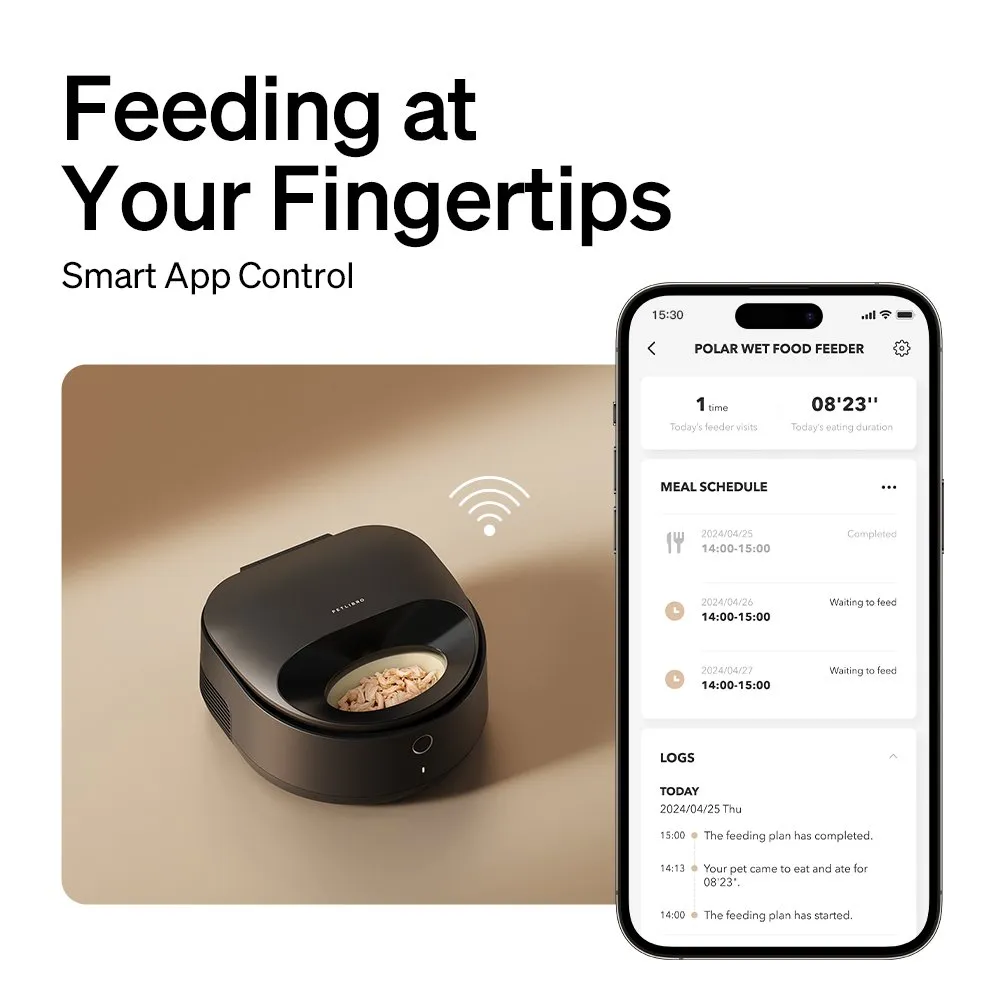
Start with the machine, because the failure types follow from how it is built. The Polar Smart Wet Food Feeder, model PLAF109, is listed at $169.99 on petlibro.com as of September 18, 2026, with 491 reviews on the page. Its job is narrow and hard: three meals, 6.76 oz (200 ml) per serving, cooled by a thermoelectric plate rather than ice packs, scheduled through a Wi-Fi app, and held open or closed by a motorised lid with an anti-pinch sensor.
That is four systems in one box, and each one can strand a cat:
- The cooling plate is a semiconductor element. It does not have a compressor to repair, and it can only pull temperature so far below the room it sits in.
- The rotation of the tray is driven by a motor and a sensor that has to know where the tray is. When it loses that reference, the tray parks sideways.
- The schedule lives in the app and travels over your Wi-Fi and the company’s servers, which is why an outage elsewhere can change your cat’s dinner.
- The lid is the only part the cat touches, and it has to open for the right cat’s meal and stay open while the cat eats.
The official number for the cooling side is on the product page, in the manufacturer’s own words. In lab tests at a room temperature of 77°F, the unit brings food to around 54°F, and the page adds that cooling pauses for about 30 minutes before serving so the food is not cold when the cat gets it. Preserved food is promised for up to 72 hours.
What did owners see after the September firmware update?
Three threads posted between September 13 and September 16, 2026 trace one firmware update and its aftermath. The first, in r/Petlibro on September 15, is an owner who accepted an in-app update and watched the machine come back wrong:
“my tray wont stop spinning, and the lid keeps opening halfway before closing again.”
In the same thread, another owner asks the question that matters to anyone with the app nagging them:
“Has anyone done the update and actually had their PetLibro feeder still work?”
The original poster’s answer is the reason this article exists: “so far, no.” A third commenter supplies the sequel, having already been through a previous firmware cycle.
“mine was doing this after the outtage, the most recent firmware made that action stop and it resumed working for two days before re-bricking itself with the red light of doom.”
That last phrase does the mechanical work better than any summary. The tray mechanism was fine. The lid mechanism was fine. The code driving both was not, and the recovery was temporary.
Two days earlier, in a separate thread, an owner described the same failure from the other end of the update. This one had received a firmware release specifically to stop the endless spinning:
“Tonight a red light appeared, the tray is ‘preparing’ in the wrong position and it did NOT initiate the feeding schedule tonight.”
The stakes in that thread are higher than a gadget complaint. One reply comes from a household with a cat on a prescription diet:
“The device use for me is crucial. My cat has IBD and I have to be at work. This is serious for me.”
In a third thread, posted on September 16, an owner with the same clinical constraint wrote that the unit failed with a constant red light, that boot calibration spins the tray blindly and gives up sideways, and that the overrides are gone too. Their sentence is the one to remember before relying on any of these machines:
“my cat has IBD and requires a strict wet food diet … he woke me up at 5 AM begging for food with the tray jammed halfway open.”
A weekend version of the same story appears in that thread from another owner, who came home to find the feeder had stopped while the house was empty and the cat had missed two days of wet food.
petiqlab has covered the mechanics of this class of failure before: pet devices receive one firmware image with no fallback partition, so a bad write is a one-way door. The firmware update guide walks through five rules for the moment the app offers you a new version, and the first one is to update when you are home.
Why did the feeding schedule change on its own?
This is the failure owners trust least, because nothing is visibly broken. In a September 13 thread with 15 upvotes, the owner came home to a cat that had been signalling all day:
“for some reason his schedule changed in the app ON ITS OWN for tomorrows schedule. My poor guy went a whole day without food”
The same day, a 24-comment thread tracked four units going offline together, flipping between online and offline, with a light alternating red and white. The cost of that evening is written plainly by another commenter:
“I can’t afford a new setup yet. I paid hundreds of dollars I saved up for these feeders.”
That thread also contains the sentence nobody wants to read after a replacement arrives:
“My replacement worked for an astonishing 48 hours before crapping out like the first.”
Balance belongs in the same section, and there is a real amount of it. In the migration thread quoted further down, one owner with two Polars wrote that both have worked perfectly for over a year and kept running on schedule through the outages. Another long-term owner in the 24-comment thread argues the loudest incidents are the ones that get posted, and that in five years with the brand, the recent outage was the only one.
Then there is the hardware lottery. In a September 13 thread about firmware versions, the maintainer of a local Home Assistant integration for Petlibro feeders reports what he sees across users: one hardware revision running firmware 2.0.47, a newer board running 3.0.72, the same product name on both. He adds that his own setup has been fully local for about a month without problems. When two buyers of the same feeder can be running different internal hardware and different firmware lines, “mine works fine” and “mine is bricked” are not contradictions.
Does the cooling plate still cool after a year?
The cooling side fails slowly, in silence, and one owner in a September 14 thread has the clearest account of it, written while describing a support process that asked him to photograph the machine next to a thermometer:
“It doesn’t work great when new, but after about a year it just stopped cooling.”
He had spent $200 on two units. Note what that means for a buyer of any brand: the element that makes this product different from a plastic bowl is the part you cannot check by looking at it, and it is not a part anyone replaces. There is no published degradation curve, no error code for “cooling weak”, and no way for you to measure the plate without buying a thermometer. Which is, ironically, why the support process ended up asking customers to photograph a thermometer in the first place.
Two design limits are worth reading before you buy any of these units. The same official page says the feeder performs optimally between 54°F and 86°F ambient, and that its bowl height of 7.7 inches may not suit small cats and kittens. The page also recommends against raw food. A feeder that cools to 54°F in a 77°F room is doing real work, and it is not a refrigerator.
What happens when you file a ticket?
The support loop is the part owners describe as most expensive in time. In the 12-upvote September 14 thread, an owner copies the request he was given:
“customer service asking you to take a picture of their product with a thermometer? what would that prove?”
Timelines in the same thread run long. One customer replied on August 26 and received a shipping confirmation for a replacement on September 14. Another reported waiting over a month after being told someone would reach out. A third, otherwise positive about the company, put the change in a single line: support was always great, and after the outage “it went to shit”.
The thread also contains the most useful practical detail for anyone stuck in it, from an owner who solved a subscription cancelation on a weekend:
“Did you try sending in a ticket through their website instead of sending an email? Funny enough I received a reply within 7 minutes on a Sunday.”
The manufacturer’s support account replied publicly in that thread, which is rare enough to quote. It said it would review “the reasonableness and effectiveness of our current troubleshooting process, including the temperature-verification steps”, and work toward more flexible support options. Promises of that kind are worth recording and not worth planning around.
Numbers from Trustpilot complicate the picture in both directions, and the bias runs by period. On September 17, 2026, petlibro.com held a TrustScore of 3.4 across 967 reviews, with replies to 58% of negative reviews inside two weeks. Trustpilot’s own AI summary on that page, generated from recent review text, says reviewers “frequently praise the helpful staff and highly responsive support team”. The threads above, all posted in the last three weeks, describe three-week silences. Trustpilot samples years of customers who chose to review; the forums sample the last two months of people who had a problem. Both can be true, and neither replaces the ticket you will open in year two.
One more line belongs here, from the product page. The same listing offers Petlibro Care plans at $47.99 a year for “free device replacement coverage”, on top of the 24-month warranty the listing already advertises. When a company sells replacement coverage as an add-on next to a two-year warranty, the failure interval the coverage is priced against is not a secret.
Is there a wet food feeder that works without the cloud?
Not one that also refrigerates, as far as petiqlab has tested or found. What exists is a set of routes that trade capability for predictability, and the trade is worth understanding before you spend $169.99 on a machine with a cooling plate and an app.
| Route | What it automates | What it gives up | What owners report |
|---|---|---|---|
| Refrigerated feeder with app (Polar and its peers) | Cooling to about 54°F, 3 meals, portion size, remote feeding | Local control, manual override, a cooling element you can check | Fast, accurate feeding when it works; spinning trays, red lights and silent schedule changes when it does not |
| Timed cooler with ice packs and a mechanical dial | Meal times, up to 5 or 6 trays, cold food in a power cut | No app, no remote feeding, no logging | Runs through an internet outage, food colder, inserts easier to clean; one tray always exposed to air, small bowls |
| Sealed microchip bowl (SureFeed) | Access control per cat, lid that seals after eating | No cooling, no schedule, no app | Wet food stays covered instead of sitting open; three-year warranty; needs an adaptation week |
| Manual setup plus a local camera | Proof of what happened | Automation itself | The camera answers the only question that matters when you are away, which is whether the cat ate |
Two owner comments from the migration thread are the reason the middle row is in that table at all. One owner who moved to PetSafe’s FreshFeed feeder after the August outage wrote that a storm took out their internet and the feeder still worked as planned, and listed the cost as the price and food served a little colder. Another said the simplicity is the point, and that not having to think about bowl numbers is worth more than the app. A third owner liked the same machine less for its small bowls.
To be clear about what that is and is not: petiqlab has not tested PetSafe’s wet food cooler, and the reports above come from three owners who left PetLibro, which is a biased sample by construction. It is not a recommendation. It is the route owners take when they want cold food without a server in the loop, and the honest summary is that nobody sells a cloud-free refrigerated feeder today.
Five checks before you buy a wet food feeder
- Ask where the schedule lives. A 12-hour battery backup, which is what the Polar offers, is not the same as a schedule stored on the device. Ask what happens on day two of an outage, and read petiqlab’s guide to devices that work without Wi-Fi before deciding your cat can afford the answer.
- Ask for the cooling specification and the ambient range. The credible number is a temperature at a stated room temperature, the way the Polar page states 54°F at 77°F. A listing that says “keeps food fresh” without a number is selling you the word.
- Test the manual override while you are still home. In one of the September threads the “Feed now” button threw an error on a unit whose lid had jammed. The override is the last line between a software fault and a hungry cat, and it deserves ten minutes of testing during the first week.
- Check the parts you will wash and the cat it has to fit. The bowl, tray and lid gaskets are the surfaces that see food daily, and the official bowl height of 7.7 inches may not suit a kitten. Run the size question the way petiqlab’s bowl fit guide runs it, with a tape measure rather than a product photo.
- Buy where the return window is long, and keep the receipt for the warranty clock. A 24-month warranty means nothing if the failure lands at month 26, and petiqlab’s reading of the 30-day clause in PETLIBRO’s refund policy explains which failures the coverage excludes. For a device whose central component fails quietly at about a year, the retailer’s window is the protection that actually pays.
If your cat eats dry food and simply needs the same meal every day, the wet food problem does not exist, and the cheaper category is also the more reliable one. petiqlab’s comparison of how long a cat can be left with an automatic feeder covers the dry side of that planning.
What petiqlab recommends instead
For a household that wants wet food covered without a cloud connection, the pick on this site is the SureFeed microchip feeder. It is not a cooler and it does not refrigerate anything, which is the point: a lid that closes on a sealed 400 ml bowl keeps wet food covered between meals, opens only for the registered cat, runs on four C-cells for about six months, and has no app, no account and no firmware to update. Sure Petcare lists a three-year warranty, and its brand-level Trustpilot profile sat at 4.5 across 3,760 reviews when petiqlab last read it. Two disclosures: it solves per-cat access and food coverage, not cooling, and a multi-cat introduction takes about a week. The microchip feeder guide covers that setup in full.
For the dry half of a cat’s day, or for a household that wants the schedule to survive an outage, the PetSafe Smart Feed keeps meals on a device-side schedule with a battery backup, and PetSafe lists it at $134.99. Judge it as a product rather than a badge: PetSafe’s brand-level Trustpilot score measured 2.2 across 228 reviews with no reply-rate badge on September 17, 2026, and the reason to buy this unit is that it schedules offline, not that the brand is loved.
If you keep a wet food feeder and want to know whether the cat actually ate, add a camera rather than another app notification. The TP-Link Tapo C210 records to a local microSD card with no subscription, so the footage survives the app that failed. Owners in other categories describe the same use for it, keeping a week of history to check when a sick pet last ate.
Finally, the boring recommendation that costs nothing: keep one plain dish of dry food available during any trip longer than a night. Every failure above ends the same way, which is a cat waiting by a machine that did not open.
FAQ
Why did my refrigerated wet food feeder stop working after an update? Owner reports from September 2026 describe the same sequence on the PETLIBRO Polar: an update installs, the tray spins without stopping, and the lid opens halfway and closes again. One thread then records a fix update that restored the unit for two days before a red light returned and the tray parked in the wrong position. The mechanical parts did not fail. The software driving them did, and there is no published rollback.
Should I install a firmware update on a wet food feeder? Treat it as a decision rather than a default. In a September 15, 2026 thread, one owner asked whether anyone had updated and kept a working feeder, and the original poster answered that as far as the thread knew, nobody had. Install updates when you are home and can watch a full feeding cycle, and never in the week before a trip.
How long can wet food stay in a feeder safely? PETLIBRO’s product page, read on September 18, 2026, states that the Polar preserves wet food for up to 72 hours and that cooling stays active after a plan ends. The same page gives the condition behind the claim: at a room temperature of 77°F the unit cools food to around 54°F, and it does not recommend raw food. Unplugged, the schedule is protected for 12 hours by a battery.
What do I do if a scheduled meal is skipped while I am away? Check the app first for a schedule that changed without your input, which is what one owner found after a day of missed food. Then check whether the tray is parked in the wrong position, which points at a stalled rotation rather than an empty hopper. Leave a second source of calories out for any trip beyond one night, and read petiqlab’s guide to leaving a cat with a feeder before you plan around the machine.
Does the backup battery keep a wet food feeder on schedule during a power cut? On the Polar, the stated figure is 12 hours on three AA cells, and that covers the schedule rather than the cooling, which draws far more power than the logic. Owners describe the practical failure as an outage that ends in a loop of online and offline states rather than a clean recovery, so unplug the unit for two hours and watch what happens before you trust it with a weekend.
How do I get PetLibro support to answer at all? Owners in a September 2026 thread report long email silences and one reply within 7 minutes through the website ticket form on a Sunday, so open a ticket inside the account instead of sending email. The same thread includes a public reply from the manufacturer’s support account promising to review its temperature-verification step. petiqlab’s support checks before buying cover the rest of the pattern.
Updated: 2026-09-18. Sources: r/Petlibro post 1wgpwqa (an in-app update that left the tray spinning and the lid half open, the “has anyone updated and kept a working feeder” question with the answer “so far, no”, and a second owner’s fix-then-rebreak timeline ending in the “red light of doom”, September 15, 2026, 7 comments), r/Petlibro post 1wewgkn (a firmware update meant to stop endless tray spinning followed two days later by a red light, a tray parked in the wrong position and a skipped feeding, a household with an IBD cat calling the device crucial, a third owner reporting the same spinning fault starting that day, and radio silence from support except one DM asking to confirm an email address, September 13, 2026, 7 comments), r/Petlibro post 1whqpfk (a Polar V2 with a constant red light, boot calibration spinning the tray blindly and stopping sideways, standard fixes already tried, the “Feed now” manual command throwing an error, an IBD cat waking the owner at 5 AM with the tray jammed halfway open, and an owner whose unit stopped during a weekend away with two days of missed wet food, September 16, 2026, 5 comments), r/Petlibro post 1wev8d7 (15 upvotes, the app schedule changing on its own and a cat going a day without food, an owner on a PetSafe FreshFeed reporting it kept working through a storm outage with the price and colder food as drawbacks, and the note that other feeder types rely on ice packs, September 13, 2026, 4 comments), r/Petlibro post 1wevtud (four units offline and alternating states with a red and white flashing light, a replacement that failed after 48 hours and the observation that only repeated posting produced it, the owner who had saved hundreds of dollars for the units, a long-term owner calling the outage the only one in five years, and another asking why anyone stays with the brand, September 13, 2026, 24 comments), r/Petlibro post 1wfffyn (12 upvotes, a support process requiring a photo of the product next to a thermometer, the owner who spent $200 on two units and reports the cooling stopped after about a year, an August 26 reply answered with a shipping confirmation on September 14, another customer waiting over a month, a counter-example of a 7-minute reply through the website ticket form on a Sunday, and the public reply from PetLibro’s support account promising to review the temperature-verification steps, September 14, 2026, 13 comments), r/Petlibro post 1wh6ue2 (a Polar owner’s fault list including a missed second feeding, an app that reported a rotation that did not happen, double rotations opening onto an empty bowl and constant rotation, a PetSafe 5-meal timed feeder working for years, two owners switching and citing colder food, easier-to-clean inserts and internet outage tolerance, one owner noting that food left in the bowl simply sits there, and a counter-report of two Polars working for over a year including through the outages, September 16, 2026, 10 comments), r/Petlibro post 1wf68z9 (a four-feeder household where one unit received firmware 2.0.72 while others stayed on 2.0.47, and the maintainer of a local Home Assistant integration reporting hardware revision 4.0.0 on firmware 2.0.47 against hardware 5.0.0 on firmware 3.0.72 plus a month of fully local operation, September 13, 2026, 10 comments), petlibro.com Polar Smart Wet Food Feeder product page (model PLAF109, $169.99, 491 reviews, three meals at 6.76 oz or 200 ml per serving, thermoelectric cooling without ice packs, laboratory cooling to around 54°F at a 77°F room temperature with cooling paused about 30 minutes before serving, up to 72 hours of preservation, 12-hour schedule protection on three AA batteries, Wi-Fi and app control, an anti-pinch lid sensor, dishwasher-safe stainless steel bowl, optimal performance between 54°F and 86°F, a 7.7-inch bowl height that may not suit small cats and kittens, a recommendation against raw food, a 24-month warranty and Petlibro Care plans at $47.99 and $103.99 per year advertising free device replacement coverage, read September 18, 2026), Trustpilot profile for petlibro.com (TrustScore 3.4 across 967 reviews with replies to 58% of negative reviews within two weeks as of September 17, 2026, and Trustpilot’s AI-generated summary citing “helpful staff and highly responsive support team” from recent review text).