Whisker Fatigue: What 40 Cats Showed, and 3 Sizes to Check
Is whisker fatigue real? What the only study found
The short answer: the peer-reviewed evidence for whisker fatigue is much weaker than the marketing, and the physical fit complaints owners report are real. In 2021 the Journal of Feline Medicine and Surgery published a study that tested the bowl claim directly. Forty indoor cats ate from their own dish, then from a shallow, wide dish sold as whisker-friendly. Time spent eating: no difference (P = 0.8). Food dropped: no difference (P = 0.9). Food eaten: no difference (P = 0.7). The estimated probability that a cat preferred the wide dish came out at 0.74. A bowl swap is not a treatment for anything. But in the same month, owners in r/Petlibro were describing something the study never measured: cats whose heads do not fit the hardware they were sold.
I read that thread first. It was posted on August 28, 2026, with 53 upvotes and 39 comments, and the owner opened with the clearest statement of the problem I have seen: “I would hate continuously bumping my head and whiskers against the lid every time I ate. Why does it not tuck in more, or perhaps flip up?”
The top reply, 26 upvotes, was three words long: “Whisker fatigue is real.” A second owner explained why they sent the unit back: “This is why I returned mine, so cramped. The bowl/area should be twice as large.” A third put the design question more bluntly: “I’m starting to wonder if any of these people at petlibro had even met a cat.”
Then the comments turned into measurements. One owner has a 22-pound cat that is not overweight and carries a waistline, and wrote that its head barely fits and that it has to crouch low to trigger the dispenser. Another asked why nobody builds a shallow-plate version. A breeder-oriented commenter asked how a company whose main customers are overweight cats missed a problem this obvious.
That is where the honest position sits, and it is the position this article takes. Whisker fatigue as a diagnosis is not supported by the one published test of it. Fit is geometry, geometry can be measured, and the owners with the biggest cats are the ones who end up measuring it after the fact.
petiqlab earns a commission from the Amazon links on this page. Every quote below comes from a public owner thread, linked in the sources at the end.
The only published test of whisker stress, in plain numbers
The study, by Jennifer E Slovak and Taylor E Foster, ran at 40 cats in indoor homes. The protocol is worth knowing because it tells you what was and was not tested.
- Owners fasted their cats for 12 hours, then fed the normal measured amount of dry food in the cat’s normal dish and filmed up to 5 minutes of eating.
- Owners weighed how much food was eaten and how much was dropped.
- The household switched to a dish advertised as whisker-friendly and used it for a 7-day transition.
- Owners repeated the fast and the filming with the new dish.
- The next day, both dishes were offered at once to see which the cat chose.
Three eating measures came back flat. One preference measure did not: the estimated probability of a cat preferring the new dish was 0.74, meaning most of the cats leaned toward the shallow, wide bowl even though their eating behavior barely moved.
Read that as a consumer rather than a scientist and the split makes sense. The wide dish costs almost nothing to try and does no harm. It is just not a fix for a cat that is dropping food, pawing at its mouth, or walking away from a full bowl. Those are veterinary questions.
The study also left one thing on the bench. It tested dishes, not feeder geometry. A gravity feeder or a scheduled dispenser has a chute, a lid, and a fixed bowl position, and none of that was on the bench.
The 3 sizes to measure before the box arrives
Whisker fatigue is a label you cannot verify. These three numbers you can.
1. Bowl inner diameter against your cat’s whisker span
Measure your cat first. On a relaxed, sleepy cat, run a soft tape from whisker tip to whisker tip. Then measure the inside of the bowl at the rim, not the outside.
If the span is wider than the opening, the whiskers bend against the wall at every meal. That is the whole mechanical complaint, minus the medical story. A dish that lifts out gives you an escape hatch: you can set a wider plate in its place without cutting anything.
2. Head clearance above the food
This is the number the r/Petlibro thread was really about, and nobody sells you a spec sheet for it. Measure from the floor of the bowl to the lowest thing above it, whether that is a lid, a chute, or the underside of a hopper.
Two failures show up in the same place. A cat that has to crouch to reach food is working against a bowl set too low. A cat whose head and whiskers touch the lid on the way in is working against a hood that was never sized for it. Both were reported in the same thread by owners of large cats, and one sent the unit back over it.
A practical test before buying: look at where the food lands. If it lands in a bowl you can lift out, you can change the geometry later. If it lands in a fixed tray under a fixed hood, the geometry you get is the geometry you keep.
3. Litter box entry height and floor area
This is the side of the problem with actual clinical guidance behind it. The AAFP and ISFM house-soiling guidelines recommend a rectangular box at least 1.5 times the length of the cat from nose to the base of the tail, and cite a study in which adult cats preferred a box measuring 34 x 15 inches (86 x 39 cm) over a smaller one. The same guidelines state that the opening should allow easy access, and that cats with degenerative joint disease may need a box with a very shallow opening. Small covered boxes, they add, can make it hard for a larger cat to posture normally.
Automatic boxes then complicate all of it. The entry lip is fixed at whatever height the drum design allows, and most makers do not publish that number.
Two owner cases from August 2026, both in r/PETKIT, show what happens. A multi-cat household with cerebellar hypoplasia cats, the wobbly ones, described the entry height of a Pura Max 2 as too high for a 7-month-old kitten and could not find an official ramp. A commenter answered with two low-tech fixes: a third-party ramp bought online, or a scratching board laid down as a step. The owner came back with the outcome: “Yes I bought a 3rd party ramp and the Pura max 2. Working great currently, no leaks or any issues so far.”
Chinese-language buyers ask the same thing about a different body type. Under a July 2026 comparison video with 105 comments, one viewer asked which automatic box suits a Munchkin, adding “感觉底盘都好高哦”, which translates to: the body sits high off the floor. The question is identical whether the cat is short-legged, arthritic, or young.
| Measurement | How to take it | What fits | What owners reported |
|---|---|---|---|
| Bowl inner diameter | Soft tape across the inside rim, plus whisker span tip to tip | Opening at least as wide as the whisker span | “So cramped. The bowl/area should be twice as large” |
| Head clearance | Tape from the bowl floor to the lowest thing above it | Enough room for the head to stay level | A 22 lb cat that must crouch low to trigger the dispenser |
| Litter box entry lip | Tape from the floor to the lip | Low enough that the cat steps in without crouching | A 7-month-old CH kitten needing a ramp or a board |
| Tray floor area | Length x width of the litter surface | 1.5 x the cat’s nose-to-tail-base length | A study box of 86 x 39 cm beat a smaller one |
The four fixes owners built, and the two rules to keep
Owners who measured the gap did not wait for a manufacturer to fix it. In that r/Petlibro thread alone, four separate households described a workaround, and the patterns are consistent enough to copy.
Raise the bowl on a wedge
One owner used a foam wedge sold for calf stretching, taped in place under a SureFeed microchip feeder, to lift the bowl so the cat did not have to overextend its neck. A second folded the same idea into a different shape: a wedge mat at the rear of the bowl so the food slid forward and the cat did not have to reach for it at all.
Start from the floor up
The simplest fix in the thread used a raised stand built for a smaller feeder from an earlier generation. A fourth owner went lower and cheaper: a 2-inch step stool, essentially a half step in front of the litter box.
Two rules that keep DIY safe
- Fix the wedge so it cannot slide. Taping the wedge down is part of the fix, not a detail. A feeder that shifts while a cat is eating is how a 22-pound cat ends up pushing a rig onto itself.
- Do not block the mechanical parts. On a dispenser, the opening, the conveyor, and the weight sensors under the base all have to stay clear. On a litter box, a ramp needs to leave the entrance sensor and the drum’s rotation path alone, and it needs a lip and a stable landing so a wobbly cat is not guessing.
Add one more habit rather than a part: when you change the setup, put the new version next to the old one for a day and let the cat choose. In that same litter thread, the cats that had never used an automatic box were the reason the ramp existed in the first place.
What the hardware decides before you can fix anything
After reading the thread, I checked what the major feeder and box pages promise, and the useful questions are narrower than the marketing.
- Does the bowl lift out? A removable bowl is the difference between changing the geometry and living with it. PetSafe’s product page for the Smart Feed 2nd Generation states that the stainless steel bowl and the bowl holder are dishwasher safe, along with the lid and hopper.
- Is the eating area open, or hooded? A hood or a chute is exactly where head clearance goes to die, and it is the part of a gravity feeder nobody measures until a big cat refuses to use it.
- Is the entry height published at all? If a maker lists it, you can compare it with your cat before you order. If not, treat that as an unknown and budget for a ramp, because the third-party market exists precisely because the numbers are missing.
- Does an official ramp or step exist? Sure Petcare sells sealed bowl accessories that keep food fresh and fly-free, and that sealed lid is a fit variable too: a lid that closes over the bowl is a lid the head has to clear.
- What does the maker say about whiskers? Treat it as marketing until it becomes a measurement. The bowl the cat eats from is the measurement.
PETLIBRO is the case study in this article rather than a recommendation, and not for the bowl alone. Its Trustpilot profile measured 3.5 out of 5 across 954 reviews on September 15, 2026, with 55% of negative reviews answered, typically within two weeks.
Which devices leave room for the cat
Four picks from the list petiqlab keeps, chosen for what can be measured and changed rather than for what the box promises.
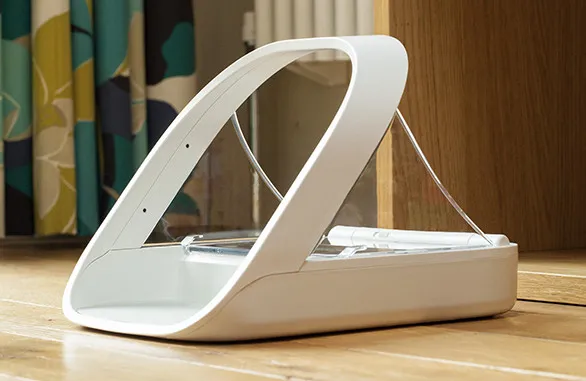
The SureFeed microchip feeder is the feeding pick for a household with a big cat or a wobbly one. Its bowl is a 400 ml shallow dish that lifts out, the lid closes over a sealed bowl, and there is no app, no cloud account, and no subscription in the path. It stores up to 32 pet identities, runs about six months on four C-cell batteries, and carries a three-year warranty. It is a single-portion feeder, not a scheduled dispenser, which is why multi-cat houses tend to pair it with a plan.
The PetSafe Smart Feed (listed at $134.99 on PetSafe’s own store on September 15, 2026) lands food in a stainless steel bowl and bowl holder that lift out for the dishwasher, holds 24 cups, schedules up to 12 meals a day from 1/8 cup to 4 cups, and offers a four D-cell battery backup. Judge the product, not the badge: PetSafe’s brand-level Trustpilot score measured 2.2 out of 5 across 228 reviews, with no reply-rate badge on the profile.
The PETKIT Purobot Max Pro 2 (about $499.99) is the litter box pick, with an open entrance instead of a hooded one, a two-year warranty, standard clumping clay, and a drawer owners report will seal the bag before it comes out. Two disclosures: owners report the entry lip sits high for a small or unsteady cat, which is where a third-party ramp comes in, and the camera version’s playback is a limited trial. Buy it for the mechanics.
The PETKIT Eversweet 3 Pro (about $62.99) covers the drinking side with a wide stainless steel surface, fully detachable parts, and a replacement pump that lists at about $15.99. A wide, shallow drinking surface is the same geometry question as the food bowl, with the difference that a fountain can be taken apart and cleaned.
FAQ
Is whisker fatigue real in cats?
The strongest published test says the effect on eating is small. Slovak and Foster, in the 2021 Journal of Feline Medicine and Surgery study, fed 40 cats from a whisker-friendly dish and from their normal dish, and found no difference in time spent eating (P = 0.8), food dropped (P = 0.9) or food eaten (P = 0.7). The estimated probability that a cat preferred the wide dish was 0.74, so some cats leaned that way. Treat a wide, shallow dish as cheap and harmless rather than as a medical fix. If your cat is eating less, book the vet.
How do I measure whether a bowl is wide enough for my cat?
Measure your cat’s whisker span, tip to tip, while the cat is relaxed, then measure the inside rim of the bowl. If the whiskers have to bend against the wall, the opening is narrower than the cat’s sensory field. The fix is a shallower, wider dish, and the practical buying test is whether the bowl lifts out so you can set a plate in its place. A fixed tray under a fixed hood leaves you nothing to change.
What litter box size does a large or senior cat need?
The AAFP and ISFM house-soiling guidelines recommend a rectangular box at least 1.5 times the cat’s length from nose to the base of the tail, and cite a study in which cats preferred a 34 x 15 inch (86 x 39 cm) box over a smaller one. The same guidelines say the opening should allow easy access, and that cats with degenerative joint disease may need a very shallow opening. Automatic boxes fix the lip height, so measure it before you order.
Why does my cat crouch or eat sideways from the feeder?
Two measurements explain most cases. If the bowl sits too low, the cat has to crouch to reach the food. If a lid or a chute sits too close above the bowl, the head and whiskers touch it on the way in. Owners in an August 2026 r/Petlibro thread reported both with large cats, including a 22-pound cat that had to crouch low to trigger the dispenser. Raise the unit, or buy one whose food lands in a bowl you can lift out.
Can I raise a feeder or a litter box myself?
Yes, and owners have. The four fixes above are a foam wedge taped under the bowl, a wedge mat at the rear so the food slides forward, a third-party raised stand, and a 2-inch step stool or a scratching board as a box step. Two rules keep it safe: fix the wedge down so nothing shifts under the cat, and keep the dispenser opening, the weight sensors and the drum’s rotation path clear.
Does a whisker-friendly bowl help a picky cat?
Sometimes, and it is cheap enough to try. In the 2021 study the eating measures did not move, but the estimated probability that a cat preferred the wide dish was 0.74, so a majority leaned that way. What a bowl cannot explain is a change in appetite. Dropping food, pawing at the mouth, or refusing meals the cat used to finish are reasons to call a vet rather than to buy a third bowl.
What to do this week
If your cat is dropping food, pawing at its mouth, or suddenly refusing meals it used to finish, the bowl is not the first thing to check. Call the vet first, then measure the bowl. Then take the tape measure to the four numbers above: whisker span, the bowl’s inner rim, the clearance above the food, and the box’s entry lip. Write them down. Next time you buy, they are the spec sheet that matters.
Related reading: what to do when a feeder skips a meal, why cats refuse a new automatic box, the safety record owners reported, and what leaving a cat alone actually requires.
Updated: 2026-09-15. Sources: r/Petlibro thread 1w0rck9 (“Whisker fatigue is real.”; “This is why I returned mine, so cramped. The bowl/area should be twice as large”; “I’m starting to wonder if any of these people at petlibro had even met a cat”; the 22 lb cat that must crouch to trigger the dispenser; the calf-stretch foam wedge taped under a SureFeed bowl; the wedge mat at the rear; the raised stand; the 2-inch step stool; August 28, 2026), r/PETKIT thread 1vtc8n9 (cerebellar hypoplasia cats, the 7-month-old and the entry height; “Yes I bought a 3rd party ramp and the Pura max 2. Working great currently, no leaks or any issues so far.”; the scratching board as a step; August 20, 2026), Bilibili video BV1XYNc6TEwY (1,637 views, 105 comments, the Munchkin owner asking “矮脚猫能用什么呢?感觉底盘都好高哦”; July 2026), Slovak JE, Foster TE, Evaluation of whisker stress in cats, Journal of Feline Medicine and Surgery, 2021, published online June 15, 2020, PMID 32538246 (40 cats, 12-hour fast, 5-minute filmed meals, 7-day transition, P = 0.8 for time spent eating, P = 0.9 for food dropped, P = 0.7 for food eaten, 0.74 estimated probability of preferring the wide dish), Carney HC et al., AAFP and ISFM Guidelines for Diagnosing and Solving House-Soiling Behavior in Cats (the 1.5 x nose-to-tail-base box recommendation, the 34 x 15 inch / 86 x 39 cm preferred box, the opening should allow easy access, cats with degenerative joint disease may require a very shallow opening, small covered boxes and larger cats posturing), Sure Petcare’s Microchip Pet Feeder page (400 ml shallow bowl suitable for wet or dry food, sealed bowl keeps food fresher and free of flies, up to 32 pet identities, about six months on 4 x C batteries, three-year warranty; read September 15, 2026), PetSafe’s Smart Feed 2nd Generation page ($134.99, stainless steel bowl and bowl holder, lid, hopper, bowl and bowl holder dishwasher safe with top-rack care, 24 cups, 12 meals from 1/8 to 4 cups, four D-cell backup, 45-day return; read September 15, 2026), Trustpilot profiles for petlibro.com (3.5 of 5 across 954 reviews, 55% of negative reviews replied to, typically within two weeks; measured September 15, 2026) and petsafe.net (2.2 of 5 across 228 reviews, no reply-rate badge; measured September 15, 2026).