Automatic Litter Box for Large Cats: What 30 lbs Misses
A weight rating is the only size number most automatic litter boxes publish, and it decides less than any other line on the spec sheet. Whisker’s comparison chart rates the Litter-Robot 5 and 5 Pro for cats from 3 to 30 lbs and the Litter-Robot 4 from 3 to 25 lbs, while the inside of the globe grew one inch between those two machines, from 16.5 to 17.5 inches, and the entry stayed at 15.75 inches. PETKIT publishes 3.3 to 22 lbs for its newest box. Owners describe the same pattern from the other side of the sale, and the cats that struggle in these machines are long, wet or bushy rather than heavy. Three measurements and one plain old box tell you more than any rating on the box.
I spent this week reading the Whisker comparison chart, the PETKIT specification page and five owner threads, then went back through the size numbers owners quote against their own cats. The gap between what the charts promise and what owners report is the subject here. It shows up first in a single line from a Whisker support reply, which told a shopper with two 20 lb Maine Coons that suitability “can depend on the cat” and pointed at the trial window. That is the honest answer, and it is also the manufacturer saying the rating will not do the job you think it does.
petiqlab earns a commission from the Amazon links on this page. Every figure below comes from manufacturer pages, published reviews and owner threads read on September 25, 2026, with links in the sources at the end. No machine in this article has been tested by petiqlab on a cat above 20 lbs.
What weight limit does each machine publish?
Four numbers, one category, and an 8 lb spread between the two best-known brands.
| Machine | Published cat weight | Cats per unit | Inside the globe | Entry opening | Outer height |
|---|---|---|---|---|---|
| Litter-Robot 5 / 5 Pro | 3 to 30 lbs | up to 5 | 17.5 in | 15.75 in | 29.9 in |
| Litter-Robot 4 | 3 to 25 lbs | up to 4 | 16.5 in | 15.75 in | 29.5 in |
| Litter-Robot EVO | 3 to 19 lbs | up to 2 | 14.5 in | 14.85 in | 27.6 in |
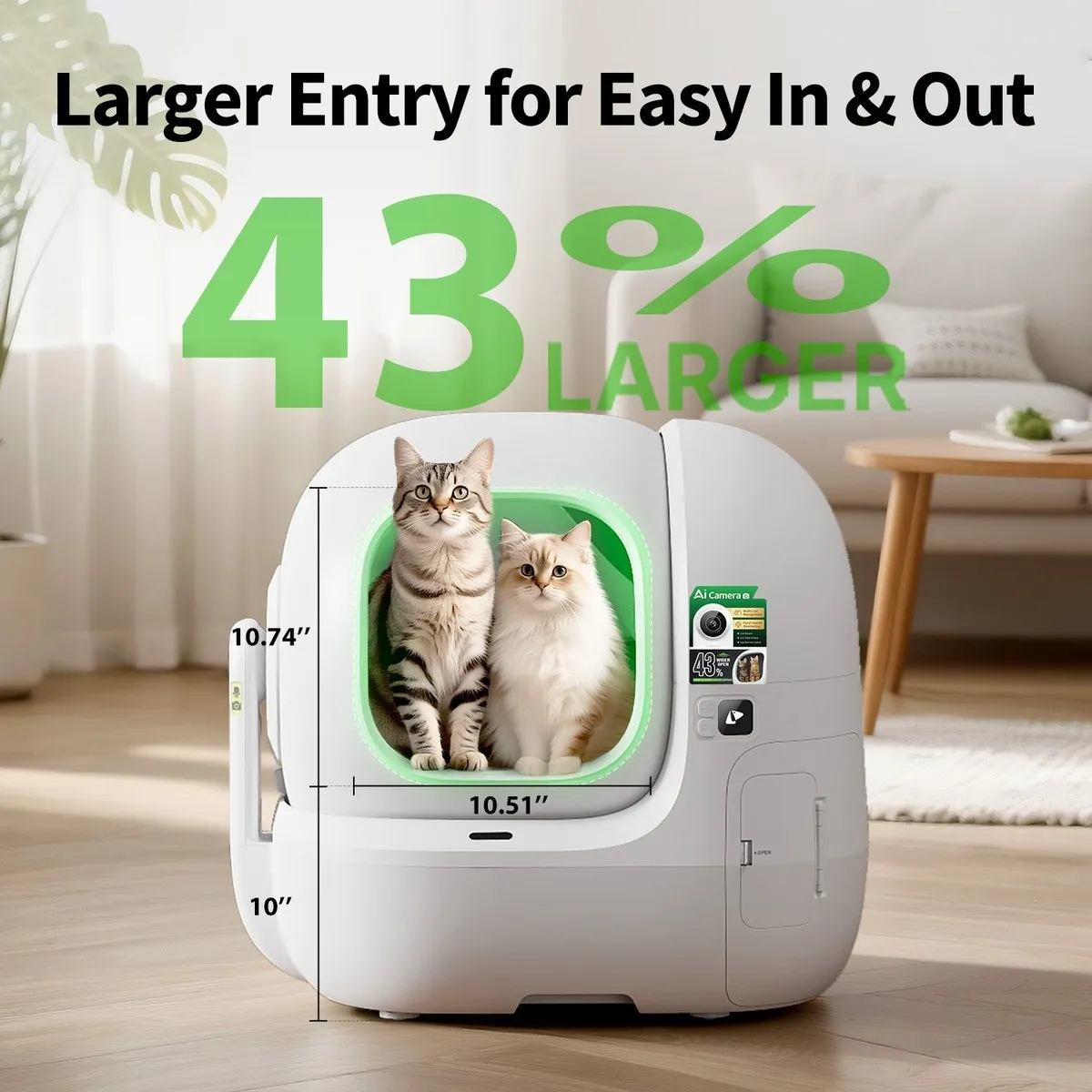
| PETKIT Purobot Max Pro 2 | 3.3 to 22 lbs | not stated | 76 litre drum | 10.51 by 10.74 in | not stated |
Whisker’s chart reads as a ladder. The 5 and 5 Pro are described as ideal for multi-cat homes and large cats up to 30 lbs, the 4 as the model for up to four cats, and the EVO as a box for one-cat homes and small cats. PETKIT draws its line lower and applies it across the range, listing 3.3 to 22 lbs for the Purobot Max Pro 2 and for its three other litter boxes, with a warning that cats under 3.3 lbs should not use them.
Put the two ceilings side by side and the practical question changes. A 24 lb cat is comfortably inside Whisker’s top rating and 2 lbs outside every PETKIT rating. Nothing about the cat changed.
Does a bigger weight rating mean a bigger box?
No, and the current generation makes that plain. The rating between the Litter-Robot 4 and the 5 rises by 5 lbs. The interior rises by one inch, and the entry does not move at all. Outer height moves half an inch. Two owners who own both described the same thing in an April 2026 thread, one writing that she considered the 5 and stayed with the 4 because “the inside was only one inch bigger.”
The previous generation went the other way on the outside. Forbes measured the Litter-Robot 4 at 22 inches wide against 24.3 inches for the Litter-Robot 3 Connect, with both machines 29.5 inches tall and 27 inches deep, and recorded the entry widening from 10.3 inches to 15.8 inches across that change. An owner who keeps all three Whisker models summarised the resulting oddity in a thread from the same month, writing that the 5 is “marginally bigger than the 4” while the older 3 “is the largest,” and that her 23 lb cat refuses all of them.
So the widest body Whisker built is a model the company no longer sells new, and the newest flagship is one inch taller inside than the machine it replaces. The rating moved. The room did not.
Which cats fail inside the published limit?
The failure reports cluster around three traits that no weight rating captures.
Urine volume first. A 24 lb Norwegian Forest cat on diabetes medication started producing puddles big enough to defeat the Litter-Robot 4, as his owner described in a thread from September 23, 2026. Litter caked onto the cat’s paws because, in her words, “the pee puddles were so big he couldn’t help but stand in them.” The cat was 1 lb under the published ceiling. He was moved to a larger open-top machine with more floor to stand on, and the same owner wrote that he can now turn around and still have room to dig. High urine output is a known sizing variable of its own, which is why our work on leaking robots and high-pee cats treats it separately from weight.
Body length second. A 16 lb cat described as very long has to stick “the front half of their body outside” to use a robot, according to another owner in a March 2026 thread. A long, skinny cat that fit fine still urinated past the globe until his owner bought a 3D-printed fence. Neither cat was heavy. Both were shaped wrong for a 15.75-inch entry and a drum built around turning room.
Coat third. A household with four Maine Coons reported that as the cats grew, at least one urinated at the entrance of the globe, and that the coat itself creates a second problem, since the cats were “so bushy that the nature of the LR would result in them getting litter on their coats.” Litter tracked through a long coat is not a size failure in the spec-sheet sense. It is the machine working as designed on a cat the design did not account for.
At the ceiling, the reports come back to the same number. An owner with a 19 lb Maine Coon wrote that the cat “barely fits,” and another set the community’s own threshold, writing that “any cat over 25 lbs will probably have some difficulty,” which is exactly the published ceiling of the Litter-Robot 4.
What does the manufacturer say when you ask about a 20-pound cat?
The most useful document on this question is a support reply rather than a product page. In an April 2026 thread started by an owner of two Maine Coons around 20 lbs each, the Whisker account answered that it “can depend on the cat,” that many 20+ lb cats use the 5 Pro, the 4 and the 3 comfortably, and that all robots carry a 90-day in-home trial for exactly this uncertainty.
That reply is a statement about the limits of a weight rating, delivered by the company that prints it. Whisker’s chart does publish interior figures, 17.5 inches of globe height and a 15.75-inch opening on the top model, and it publishes no body length for any model, which is the measurement that decides a long cat’s fit.
The chart also shows where the marketing hides a subscription. Cat identification is listed as automatic for households with two or more cats because it runs on weight, while the camera-based identification sits behind Whisker+, the paid tier.
PETKIT’s version of the same honesty is a floor rather than a ceiling. Its page warns against using the Purobot Max Pro 2 for kittens or cats under 3.3 lbs, and its published upper bound of 22 lbs is 8 lbs below the Litter-Robot 5. Between those two documents, a household with a 25 lb cat has one machine to consider and no measurement that predicts whether the cat will use it.
How many boxes should a large-cat household run?
More than the machines on the floor, and the ratio comes from owners rather than marketing. A reviewer with eight cats wrote on Trustpilot in September 2026 that the house runs “2 robo litter boxes and 4 open litter boxes,” one robot for every two open trays. In a home where the biggest cat is 13 lbs, that count is insurance. In a home with a 23 lb cat, it is the difference between a working routine and a cat going on the floor.
The reason the box count stays high is that machine identification is least reliable in exactly the households that need it most. One owner of the Purobot Max Pro 2 reported the box confusing her two cats one time in three or four, and noted that PETKIT labels the feature beta. The same line has produced weight readings of 1.2 to 1.4 kg, under its own 1.5 kg lower bound, plus a report from an owner whose cat keeps its head and front paws outside the drum, so the machine records about half a cat. PETKIT’s own troubleshooting asks for level placement on a hard floor and a double press of the OK button after topping up litter before the scale resets.
Owners weighing a large cat on a robot are reading a number the robot is not built to produce. Our earlier work on AI health alerts that send owners to the vet covers what those errors cost when they are taken at face value.
What to measure before you buy
Four steps, one tape measure, and none of them takes an afternoon.
- Measure the cat nose to tail base, then apply the veterinary rule. The AAFP and ISFM house-soiling guidelines recommend a rectangular box at least 1.5 times the cat’s length from nose to the base of the tail, and cite a study in which cats preferred a 34 by 15 inch tray over a smaller one. A 24 inch long cat needs 36 inches of tray. No automatic box publishes a footprint that satisfies that rule, which is why the tray your cat already uses, and the exterior figures in our guide to box and bowl fit, matter more than the rating printed on the machine.
- Watch the box your cat uses now. An owner of an 18 lb cat moved from a 15 by 19 inch tray to a 30 by 20 inch tray because the cat “couldn’t comfortably turn around” in the smaller one. If your cat already uses a large open tray, you own the measurement that matters, and a 22 inch wide robot is a downgrade in floor area.
- Ask about urine, not weight. Cats on diabetes or kidney medication, or on steroids, produce volume that defeats a rating. This is the single most common thread in the failure reports above, and it is invisible on a spec sheet.
- Count boxes, not machines. Follow the 8-cat household and keep one plain tray for every machine, especially in the first weeks, when you are watching for the pattern in our guide to why cats refuse automatic boxes. If the cat rejects the robot, you need somewhere for it to go that is not the floor.
The counter-argument, because it is real
Large cats do use these machines, and the same threads carry the evidence. In the April 2026 discussion that prompted the Whisker reply, one owner reported a 22 lb tuxedo and a 19.5 lb ginger both fine in a Litter-Robot 4, and another with an 18.3 lb cat said the older 3 was roomier. A Trustpilot reviewer wrote on September 18, 2026 that two big Maine Coons took to a Litter-Robot 4 right away. An owner who returned an EVO for a Litter-Robot 4 wrote days earlier that the cat was more comfortable in the larger model. A household with four cats whose biggest is 13 lbs called the 4 roomier than the 3.
The organisations behind the machines also answer. Whisker’s Trustpilot profile, read today, carries 3.3 across 602 reviews with a badge showing replies to 96% of negative reviews within a week, and PETKIT sits at 3.6 across 304 with 82% within a week and a two-year warranty on the box in this article. Both brands give a return window that covers a sizing mistake, 90 days in Whisker’s case.
What the positive reports share is worth noting. The cats are at or below roughly 20 lbs, with short or medium coats, and their owners describe normal litter tray habits. What the failure reports share is the opposite on every line. The asymmetry is in the cost. A cat that refuses a robot does not wait politely for the trial to end, and going on the floor is how urinary problems get missed, which is a bigger bill than the machine.
What petiqlab recommends instead
For a large cat inside PETKIT’s published range, the Purobot Max Pro 2 is the machine on this page whose official documentation addresses size directly, with an entry opening of 10.51 by 10.74 inches, a 76 litre drum, a 3.3 to 22 lbs rating, a two-year warranty and compatibility with ordinary clumping clay. Four disclosures travel with it. Its weighing has been reported at 1.2 to 1.4 kg, under its own 1.5 kg floor, so do not buy it as a scale. Its cat identification is labelled beta and has been reported wrong one visit in three or four. It needs an adaption period, and cats have refused it outright. The camera’s playback runs on a 30-day trial.
If your cat is above 22 lbs, or long rather than heavy, the honest recommendation is not a robot. Buy an extra-large open box with a low entry and keep the machine as a second option. There is no affiliate link on that advice, and there is no published body length for any automatic box on the market to check before you spend $500 or more. Our cost breakdown for a Litter-Robot 4 shows what the second and third years ask for on top of the purchase.
For watching whether the cat is actually using the box, the TP-Link Tapo C210 records to a local microSD card with no subscription, which is the cheapest way to learn whether a change in habit is the machine or the cat. It is also how owners in these threads first spot a cat standing outside the globe rather than inside it.
FAQ
What is the weight limit on an automatic litter box? Whisker’s published comparison chart lists the Litter-Robot 5 and 5 Pro for cats from 3 to 30 lbs and the Litter-Robot 4 from 3 to 25 lbs, while the older Litter-Robot EVO is rated 3 to 19 lbs. PETKIT rates the Purobot Max Pro 2 and its three other boxes at 3.3 to 22 lbs, and its UK page warns against using that model for cats under 3.3 lbs. The two brands therefore disagree by 8 lbs about the same category, which is the first sign that the number describes a marketing tier as much as a machine.
Will a Litter-Robot work for a Maine Coon? Owners report both outcomes, and the split follows body length and coat more than weight. One owner with a 19 lb Maine Coon wrote that the cat barely fits, and an owner who keeps all three Whisker models reported that her 23 lb cat will not use any of them. Against that, a Trustpilot reviewer wrote in September 2026 that two big Maine Coons took to a Litter-Robot 4 right away. Whisker publishes no body length for any model, so the 90-day in-home trial is the only sizing test available.
Is the Litter-Robot 5 bigger inside than the Litter-Robot 4? By one inch. Whisker’s own chart lists 17.5 inches of interior globe height for the 5 and 5 Pro against 16.5 inches for the 4, with the same 15.75-inch opening on both, and outer height moves from 29.5 to 29.9 inches. The published weight range rises by 5 lbs across that one inch, from 25 lbs to 30 lbs. An owner who measured before upgrading put it plainly, writing that the inside was only one inch bigger and that she kept her Litter-Robot 4.
Why does my large cat pee outside the litter box? In the large-cat reports, it is almost always the doorway rather than the litter. A cat that is long rather than heavy has to leave its front half outside the globe to position itself, and one owner of a long skinny cat solved the resulting puddles with a 3D-printed fence. A household with four Maine Coons described cats at 16 to 17 lbs urinating at the entrance of the globe, plus litter stuck in their coats. Turning room inside the dome, not the weight rating, is the variable to check.
What is the weight limit for the PETKIT Purobot Max Pro 2? PETKIT publishes 3.3 to 22 lbs, or 1.5 to 10 kg, for the Purobot Max Pro 2 and for its three other litter boxes, with an entry opening of 10.51 by 10.74 inches and a 76 litre drum. That ceiling is 8 lbs below the Litter-Robot 5 rating, so a 24 lb cat is inside one brand’s published limit and outside the other’s. The page also states that the unit is not recommended for cats under 3.3 lbs.
How many litter boxes does a multi-cat home with big cats need? More boxes than machines. A keepers’ report from an 8-cat household published in September 2026 described two robot boxes and four open boxes in the same home, a ratio of one machine to two plain trays. Weight-based identification is the limitation that pushes that number up. One Purobot Max Pro 2 owner found the box confusing her two cats once every three or four visits and noted that the feature is labelled as beta on PETKIT’s side, and weight readings on the same unit have been reported at 1.2 to 1.4 kg, below the 1.5 kg floor in its own specification.
Do automatic litter boxes weigh cats accurately? Not accurately enough to treat the number as a health record. Owners of the Purobot Max Pro 2 have reported readings of 1.2 to 1.4 kg against a published floor of 1.5 kg, and one wrote that his cat keeps its head and front paws outside the drum, so the machine records about half a cat. PETKIT’s own guidance asks for a level hard floor rather than a mat, and top-ups of litter need a double press of the OK button before the scale resets. Whisker’s chart covers identification on the same footing, listing weight as the method that works automatically for households with two or more cats, with camera identification behind a subscription.
Updated: 2026-09-25. Sources: Whisker Litter-Robot comparison chart (read September 25, 2026: 3 to 30 lbs and up to five cats for the Litter-Robot 5 and 5 Pro, 3 to 25 lbs and up to four cats for the Litter-Robot 4, 3 to 19 lbs and up to two cats for the Litter-Robot EVO, interior globe heights of 17.5, 16.5 and 14.5 inches, entry openings of 15.75 and 14.85 inches, outer heights of 29.9, 29.5 and 27.6 inches, identification of cats based on weight for households with two or more cats, camera identification listed under Whisker+, and a 90-day in-home trial with a one-year warranty), PETKIT Purobot Max Pro 2 product page (cat weight limit 3.3-22 lbs or 1.5-10 kg across the range, entry 10.51 by 10.74 inches, 76 litre drum, 8 litre waste bin, plus the manufacturer’s own image and text describing a 43% larger entry, and the UK variant page stating the unit is not recommended for kittens or cats under 3.3 lbs). Media measurement: Forbes, Litter-Robot 3 vs 4 (June 13, 2025: Litter-Robot 4 measures 22 inches wide against 24.3 inches for the Litter-Robot 3 Connect, both 29.5 inches tall and 27 inches deep, with the entryway widening from 10.3 to 15.8 inches). Sizing guidance: AAFP and ISFM Guidelines for Diagnosing and Solving House-Soiling Behavior in Cats (a rectangular litter box at least 1.5 times the cat’s length from nose to the base of the tail, with the cited preference study for a 34 by 15 inch box). Owner threads, all read September 25, 2026: r/litterrobot, 24 lb Norwegian Forest cat in a Litter-Robot 4 (September 23, 2026: litter caked on paws from urine volume, move to an open-top machine with more floor space, and a long cat needing a 3D-printed fence after urinating outside the globe), r/litterrobot, 19 lb Maine Coon and a three-model household (April 17, 2026: “barely fits,” the Litter-Robot 5 marginally bigger than the 4 while the 3 is the largest, and a 23 lb cat refusing all three), r/litterrobot, 20 lb Maine Coons and the Whisker reply (April 17, 2026: support account stating that suitability can depend on the cat and pointing to the 90-day trial, a 22 lb and 19.5 lb pair happy in a Litter-Robot 4, an 18.3 lb cat preferring the roomier 3, and the line that the inside of the 5 was only one inch bigger), r/litterrobot, Maine Coon sizing (March 22, 2026: a 16 lb very long cat leaving its front half outside, four Maine Coons urinating at the entrance and litter in their coats, and the community threshold that cats over 25 lbs will have difficulty), r/litterrobot, choosing between the 4 and the 5 (May 20, 2026: an 18 lb cat moving from a 15 by 19 inch tray to a 30 by 20 inch tray because it could not turn around, and owners describing the 5 as a beta product against a mature 4), r/PETKIT, Purobot Max Pro 2 weight readings (September 2026: readings of 1.2 to 1.4 kg, a cat keeping its head and front paws outside so the machine records half a weight, level placement on a hard floor, and a double press of the OK button after topping up litter), and r/PETKIT, Purobot Max Pro 2 identification (September 2026: two cats confused once every three or four visits, and the owner’s note that PETKIT labels recognition as a beta feature). Review baselines read September 25, 2026: litter-robot.com (3.3 across 602 reviews, replying to 96% of negative reviews within a week) with the five-star pool at litter-robot.com five-star reviews (two big Maine Coons settling in right away on September 18, 2026, and an EVO returned for a roomier Litter-Robot 4 on September 15, 2026), and petkit.com (3.6 across 304 reviews, replying to 82% within a week) with the eight-cat household running two robots and four open boxes in the petkit.com five-star reviews (September 8, 2026).