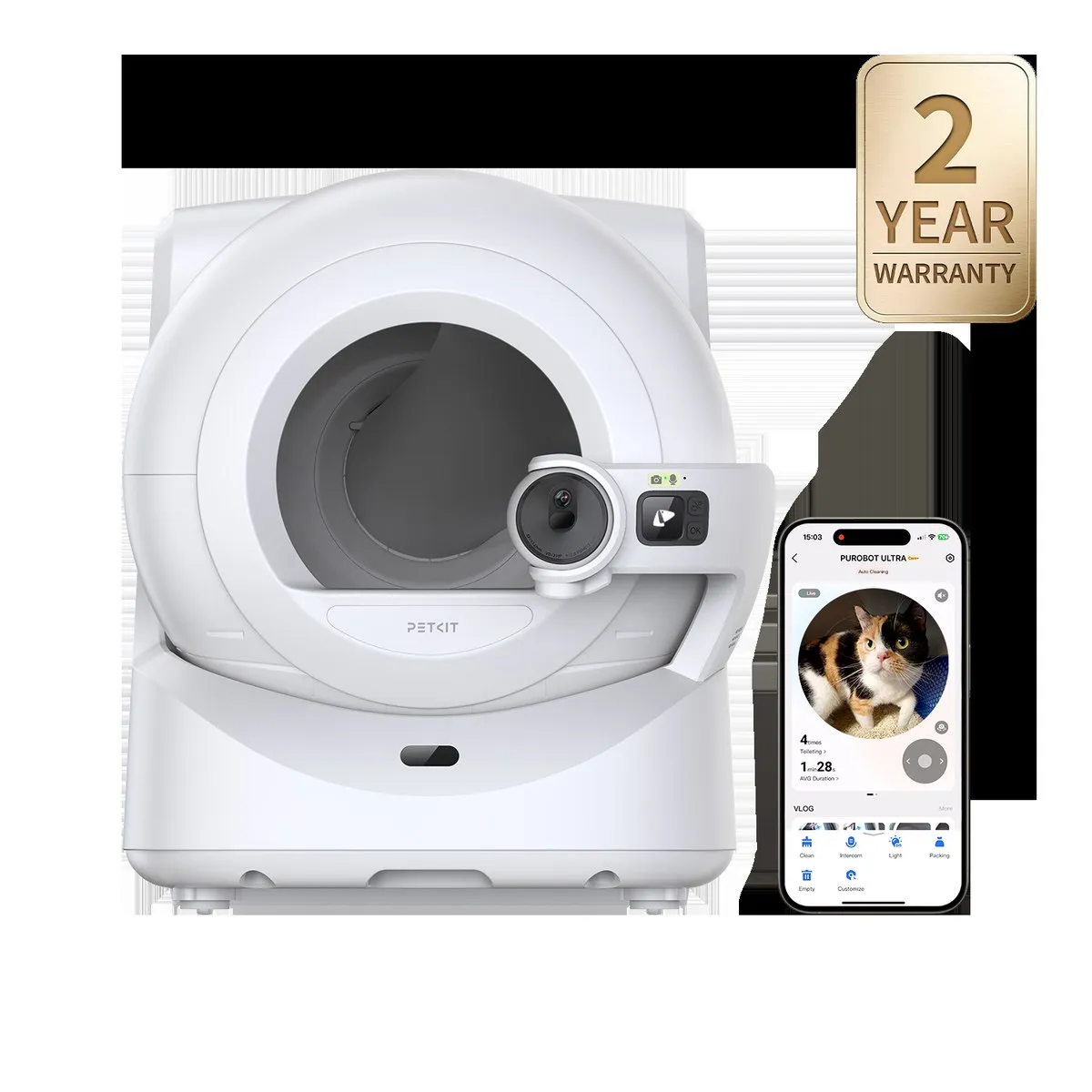
PETKIT's $799 Litter Box Holds Less Than the $399 One
The short answer: PETKIT’s own comparison table puts a 70 L drum in the $799.99 Purobot Ultra and a 76 L drum in the $399.99 Purobot Max 3, while the Ultra’s entrance sits at 10.43 in (265 mm) against 8.03 in (204 mm) on the cheaper box. The $400 gap buys 20 sensors instead of 12, a 1080p camera with a 210 degree field of view, two way audio and an auto packing waste system. It does not buy room. For a long cat, the least expensive of the three drums is the roomiest, and the entry height, not the price, decides whether a cat walks in at all.
I opened the PETKIT comparison tab expecting a ladder. Cheap box at the bottom, expensive box at the top with more of everything. What the table actually shows is a trade. The $799.99 model wins on sensors and software. It loses on the two measurements a cat feels, which are room to turn and height to step over.
Prices below were read on 6 November 2026. PETKIT runs sales often, so the list price and the sale price disagree on every row.
What does PETKIT’s own comparison table show side by side?
Four boxes, one table, and the drum shrinks as the price climbs.
| Purobot Ultra | Purobot Max Pro 2 | Purobot Max 3 | Purobot Crystal Duo | |
|---|---|---|---|---|
| Price on 6 Nov 2026 | $799.99 ($899.99 list) | $499.99 ($599.99) | $399.99 ($499.99) | $199.99 ($299.99) |
| Drum | 70 L | 76 L | 76 L | crystal litter, not listed |
| Entry size | 9.84 x 8.54 in (250 x 217 mm) | 10.51 x 10.74 in (267 x 273 mm) | 10.51 x 10.74 in (267 x 273 mm) | not listed |
| Entry height | 10.43 in (265 mm) | 10.03 in (255 mm) | 8.03 in (204 mm) | 7.08 in (180 mm) |
| Sensors | 20 | 12 | 12 | 4 |
| Hands-free, 1 cat | up to 20 days | up to 17 days | up to 15 days | up to 30 days |
| Wi-Fi | 2.4 / 5 GHz | 2.4 / 5 GHz | 2.4 GHz | 2.4 / 5 GHz |
| Audio | 2-way | 1-way | 1-way | 1-way |
| Cat weight range | 3.3 to 22 lbs | 3.3 to 22 lbs | 3.3 to 22 lbs | over 3.3 lbs |
| Litter type | clumping clay, tofu or mixed, 12 mm max | same | same | PETKIT crystal litter |
PETKIT’s comparison table lists four boxes at $199.99, $399.99, $499.99 and $799.99, and the drum shrinks as the price climbs. The Purobot Ultra carries a 70 L drum behind a 9.84 by 8.54 in opening set at 10.43 in, while the Purobot Max 3 carries 76 L behind a 10.51 by 10.74 in opening set at 8.03 in. The Purobot Max Pro 2 matches the Max 3 on drum size, costs $499.99 and sits at a 10.03 in entrance. Sensors run 20, 12, 12 and 4 in the same order. Every drum model lists 3.3 to 22 lbs, every model stops when a cat comes within range, and the Crystal Duo alone lists crystal litter only, an open frame and a 7.08 in entrance. Only the Max 3 drops 5 GHz Wi-Fi support, which narrows placement options in a mesh home. PETKIT lists the Purobot Ultra at 32.18 lbs with a 20.94 by 32.20 by 24.09 in footprint, the heaviest machine in the lineup.
That last column matters more than its price suggests. The Crystal Duo claims up to 30 days of hands-free cleaning, the longest window in the table, on an open frame with 4 sensors and crystal litter that absorbs instead of clumping. A long hands-free window is a claim about consumables, and 30 days on a $199.99 box says more about crystal litter than about engineering.
Why is the most expensive box the smallest inside?
Because the money went into the packing mechanism. The Ultra’s 10 L waste bin and its auto sealing system need volume that a drum does not get to use, and PETKIT says so on the product page when asked why the trunk looks hollow. A packing module and a bagging module sit behind the drum, which is how a machine that costs twice the Max 3 ends up 6 L smaller inside.
The entrance tells the same story from the cat’s side. 10.43 in is a step up. 8.03 in is close to the height of an ordinary high sided tray, which is the height a cautious cat has already been using. For a 15 year old cat with arthritis, that 2.4 in difference decides most of the purchase.
There is a second consequence nobody puts in the marketing. A taller entrance on the same footprint means the cat enters higher and drops further, and a cat that hesitates on the lip is a cat that pees on the step.
What does the extra $400 actually buy?
Four things, plus one that deserves its own paragraph.
Sensors go from 12 to 20. PETKIT describes the Ultra system as stopping the cylinder the moment it detects a cat nearby, and the Max 3 page makes the same promise with 12. Neither page publishes a false negative rate, so the number is a count, not a measured reliability figure.
The camera is real. 1080p, a 210 degree field of view, IPX5, a microphone and a speaker, and PETKIT says the facial recognition handles up to 15 cats. The Ultra is the only box in the table with two way audio, which means you can talk to a cat from the app. Whether a cat cares is a separate question.
Bag automation is the feature you cannot get elsewhere in the line. The Ultra packs and seals each load, then refills a new bag when the old one is removed. It is the only model with a 10 L bin, and the only one where you never touch waste.
The fourth item is urine pH monitoring, and it is conditional. PETKIT’s page says the AI camera reads colour changes in PETKIT Urine Monitor litter and flags possible urinary disease. That means the health feature runs on a specific litter, sold at $54.99 for 4 bags, not on the clumping clay most households buy.
How much do the refill rings add over a year?
$35.99 buys three refill rings from PETKIT, and the company’s FAQ says one Purobot Ultra ring packs about 10 times, which puts a package at roughly 30 cycles. A cat that uses the box 3 times a day burns one package every 10 days, near $108 a month at list price. PETKIT sells no generic alternative. The same FAQ states the auto packing system requires PETKIT refill rings and that generic bags may cause malfunctions. PETKIT also sells trash bags at $29.99 and desiccant at $14.99. The $399.99 Purobot Max 3 uses a 7 L side bin with no packing mechanism, and PETKIT quotes 15 days between emptyings for one cat, so the cheaper box trades automation for a chore every two weeks. Two years of rings at 3 cycles a day reaches roughly $2,600, which is more than six Max 3 units at the $399.99 sale price. The $35.99 figure is the shelf price on 6 November 2026, so a sale changes the annual total without changing the cycle count.
Cut the cycles to one a day and the same package lasts a month, which changes the answer completely. PETKIT publishes no per cycle cost, so the bill depends on how busy the box is. That arithmetic is the part buyers miss when they compare $799.99 with $499.99 and stop there.
The Max 3 side bin is worth a second look for a different reason. It is a drawer, not a drum inside a drum, and it slides out of the side. Emptying takes about a minute and costs nothing.
Does the AI camera make the health data trustworthy?
The camera sees more than the scale does, and both have a record of getting things wrong in ways that matter.
Weight identification is the older method. A cat that rests its front paws outside the drum weighs less than a cat, and owners have reported readings below the published 3.3 lb floor. Camera identification was supposed to fix that, and PETKIT’s own table still lists weight recognition alongside the camera rather than replacing it.
A PETKIT subreddit thread from 31 August 2026 shows the failure mode plainly. The owner of two cats wrote that one cat was recorded and “a few minutes later the second cat also used the litter box but it did not record it.” A commenter who needs the data for a cat on prescription food asked the question that ends the argument: “How can you trust it?” Another commenter said the problem had been reported to PETKIT by email with no resolution.
A 4 star review on Trustpilot from 19 October 2026 is gentler and lands the same place. The reviewer, writing about a PETKIT fountain, calls the recognition AI “still in beta” and describes the app confusing a shorthair tabby with a white and grey ragdoll. PETKIT’s Trustpilot profile showed 389 reviews and a badge reading Replied to 90% of negative reviews on 6 November 2026, which is a support metric, not an accuracy metric.
| Feature | What the page promises | What the record shows |
|---|---|---|
| Multi-cat recognition | Facial recognition for up to 15 cats | A second visit in the same session missed |
| Weight data | 3.3 to 22 lbs supported | Owners report readings below the floor when a cat hangs out of the drum |
| Urine pH | Colour change detected by camera | Works only with Urine Monitor litter, $54.99 per 4 bags |
| Video history | 30 day history with Care+ | Subscription feature, one month trial |
The camera still earns its place for a household with one cat and a health worry. A 24 hour gap between visits produces a notification, and the Ultra logs duration and waste appearance per visit. That is more than a plain box gives you, and less than a medical record.
Which cat should not use a drum style box?
A cat that stands to urinate. The drum turns the load over to sift, urine runs down the wall of the cylinder, and the seam at the base is where it collects.
PETKIT’s own subreddit carries the pattern on the PuraMax 2 line, with threads describing urine leaking as the drum flips for scooping, pooling under the pad, and one owner taping around the purifier ring as a repair. PETKIT sells a $149 replacement cylinder marketed as leakproof and a $36.99 mat for that model, which is the company acknowledging the seam. Our PuraMax 2 leak breakdown covers the fixes and the point at which fixing stops making sense.
Nothing about the Ultra changes the physics. The ShieldBase and the brim structure move urine toward the base rather than into the litter, which is progress on a known weakness, and the entry at 10.43 in still lets a tall cat stand with its back end inside the drum.
Two more limits worth knowing before the cart. The Purobot Ultra page says kittens under 3.3 lbs or younger than 6 months are not recommended, because a small cat may not be heavy enough to trigger the weight sensors. The Ultra also asks for a hard level floor and 2 in (5 cm) of clearance from the wall, and PETKIT’s own FAQ says carpet can throw the sensors off.
Which PETKIT box would I buy?
If the drum is the point, the $399.99 Purobot Max 3 wins on paper. Same 76 L as the Max Pro 2, 4 in lower entry than the Ultra, 12 sensors, 35 dB, 24 W, and no packing consumables. It is also the only one of the three on 2.4 GHz Wi-Fi alone, which matters in a mesh home where the 5 GHz band is the stable one.
If the camera is the point, the Max Pro 2 is the version to price against the Ultra, and it is the box this site has recommended since the PuraMax 2 leak review for the 2 year warranty and the ability to run ordinary clumping clay. The PETKIT Purobot Max Pro 2 covers both of those, and the camera playback is a 30 day trial rather than a permanent feature, which the camera feeder review shows is a pattern across this product line.
If you have a large or long cat, read the large cat sizing guide before spending anything. A 76 L drum with a 10.51 in opening is the widest door in this lineup, and the Ultra’s 9.84 in opening is the narrowest of the three.
I would skip the Ultra unless auto packing solves a real problem for you. The machine does more, the drum does less, and the rings run about $108 a month at three cycles a day. That is a subscription wearing a hardware badge.
If you already own a drum box and the cat refuses it, the fix is usually litter and placement before it is hardware. Our cat won’t use the box checklist covers the order to test things, and this PETKIT subreddit thread about two 7 year old cats ignoring a new box entirely is the case those steps are written for.
FAQ
Is the PETKIT Purobot Ultra bigger than the Max 3?
Outside, yes. Inside, no. PETKIT lists 70 L of drum for the Ultra against 76 L for the Max 3 and Max Pro 2, and the Ultra’s entrance is 10.43 in against 8.03 in. The Ultra is heavier at 32.18 lbs, but the space a cat turns around in is smaller than the $400 cheaper box.
What does the extra $400 pay for?
20 sensors instead of 12, a 1080p camera with 210 degree field of view, two way audio, yowling detection, urine pH monitoring that requires PETKIT Urine Monitor litter, and an auto packing waste system that uses $35.99 refill rings. Drum size and entry height go the other way.
Why does the cheapest box claim the longest hands-free window?
The Crystal Duo is rated for up to 30 days with one cat because crystal litter absorbs urine rather than clumping it. It also lists 4 sensors, an open frame and PETKIT crystal litter only, so the window describes the litter, not the machine.
How much do refill rings cost per month?
PETKIT sells 3 rings for $35.99 and states that one ring packs about 10 times, so a package covers about 30 cycles. At 3 cycles a day a package lasts 10 days, roughly $108 a month. At one cycle a day the same package lasts a month.
Can the camera record without a subscription?
PETKIT lists 30 day video history as a Care+ feature, and a product page reviewer mentions a free 1 month starter trial. Live view and per visit summaries work without the paid tier. Long term recording does not.
Do these boxes work for a cat that stands to pee?
No drum is a safe recommendation for a standing urinator. PETKIT subreddit threads on the PuraMax 2 describe urine leaking as the drum flips, pooling under the pad, and owner tape fixes around the purifier ring. A high sided open tray is the shape to buy instead.