Pet Tech Noise: 35 dB on One Box, 'Quiet' on Another
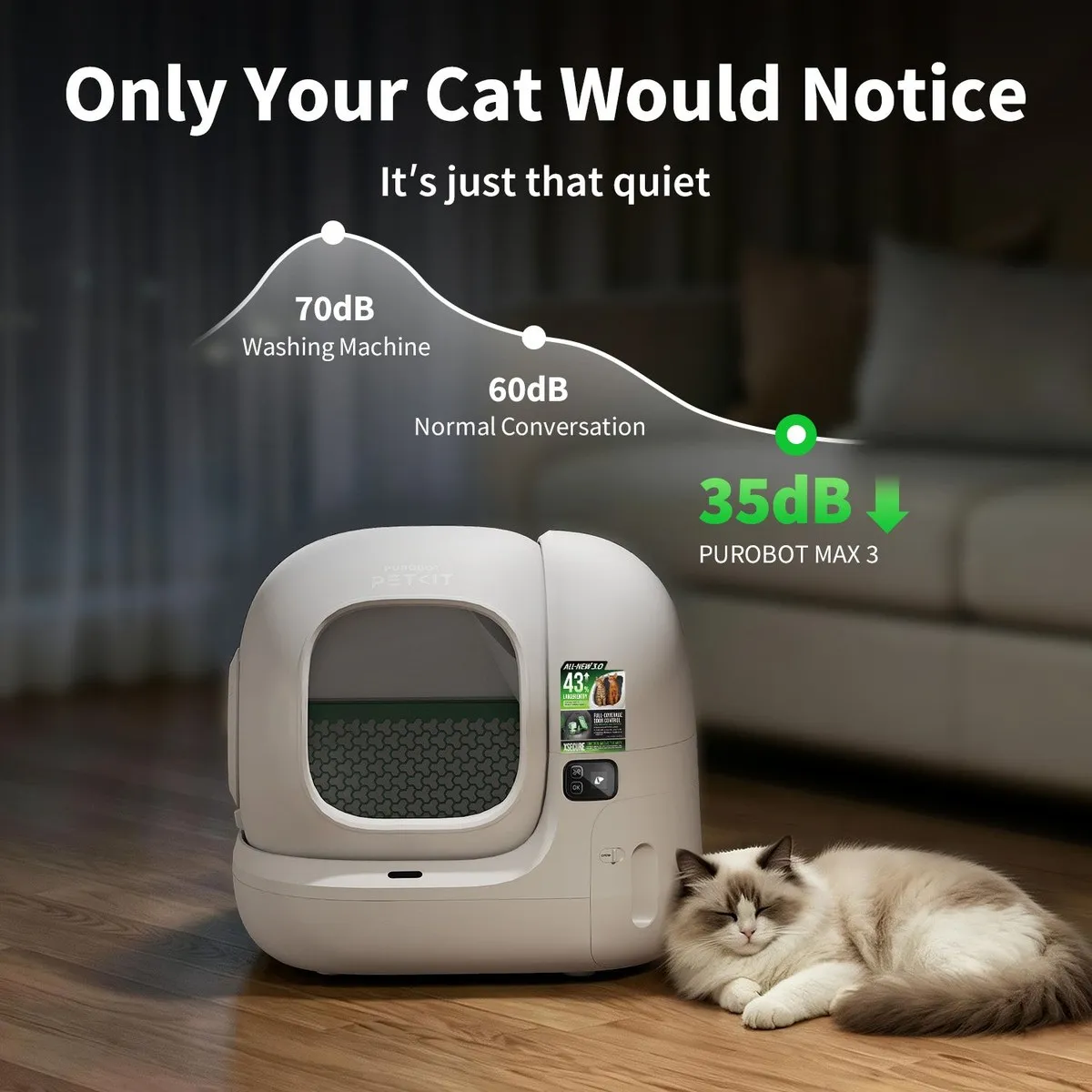
The short answer: a noise rating describes one part of one cycle, and most pet brands print no rating at all. PETKIT’s Purobot Max 3 page reads “whisper-quiet 35dB operation” at $399.99, while its own Purobot Max Pro 2 at $499.99 carries only the word “Quiet.” Whisker’s Litter-Robot 4 page says “Quiet operation” with no figure, and the only hard number I could verify for that machine came from a tester who measured about 37 dB while it cycled. PETKIT’s fountain comparison rates five models at 25 to 26 dB and then adds an asterisk: noise increases during flush. Before comparing two machines, find out who published the number, which part of the cycle it covers, and how many minutes a day that part runs.
I spent the afternoon of October 16, 2026 reading spec tabs instead of reviews, because the reviews keep saying the same thing and the tabs say almost nothing. PETKIT’s shop returns 89 products, and the decibel figures across that whole catalogue fit on one hand: 20, 25, 26, 35 and 42. Whisker’s litter box page prints the word quiet and stops. PetSafe’s feeder page and Sure Petcare’s microchip feeder page print neither.
petiqlab earns a commission from the Amazon links on this page. Everything below comes from manufacturer pages read on October 16, 2026, plus a third-party measurement and complaint records held in this site’s material library. Prices are the makers’ own list prices as of that date and change without notice. petiqlab has not run a sound meter on any of these machines, and nothing here is veterinary advice.
Why Is a Decibel Figure a Measurement With the Measurement Missing?
The short answer: decibels are logarithmic, so a two-digit difference that looks small is not. The gap between PETKIT’s 20 dB pump claim and its 42 dB pet dryer claim is 22 dB, which works out to about 158 times the sound power once you run the formula. The gap between the 35 dB litter box figure and the 26 dB fountain figure is about 8 times. Those multipliers are arithmetic, not published figures, and they are the reason a row of numbers on a spec sheet can look flat while the machines behind them sound nothing alike. Whisker’s tester wrote down an average of 37 dB against a machine whose maker publishes nothing, and a 2 dB difference between those two numbers would be less than twice the power, which is why you cannot line up a claim and a test and treat them as comparable.
What a product page almost never prints is the condition the number was taken under. PETKIT’s fountain comparison lists Operation Noise as a row of five values, one per model, and the table states capacity, materials, dimensions and weight for each of them. It does not state a distance, a litter load, a water level, a floor surface or whether the microphone saw a new machine.
That silence matters more than the number, because distance changes the reading fast. Sound pressure falls as you move away from the source, so the same litter box is quieter at the far end of a hallway than it is beside your bed, and the page cannot tell you which of those two positions it measured.
The health reference point sits far above all of this. NIOSH sets its recommended exposure limit at 85 A-weighted decibels averaged over an eight-hour workday, and notes that every 3 dBA increase halves the time a person can be exposed to that level. At 85 dBA you have to raise your voice to be heard by someone standing three feet away. A 35 dB machine is not a hearing risk. It is an annoyance risk, which is a different calculation that each owner runs at 3 a.m.
Two published figures can look close and differ by a factor of 8. PETKIT’s 20 dB pump claim against a 42 dB dryer claim spans 22 dB, which works out to about 158 times the sound power once the formula runs, and the 35 dB litter box against the 26 dB fountain spans roughly 8 times. NIOSH sets its recommended exposure limit at 85 A-weighted decibels averaged over an 8-hour workday and notes that every 3 dBA increase halves safe exposure time. Cats.com measured the Litter-Robot 4 cycling at 25 to 40 dB, averaging about 37 decibels, against 35 to 45 dB for the Litter-Robot 3, roughly 10 decibels quieter, and reported most of the sound as litter shuffling rather than motor noise. No page in that catalogue states the distance, the litter load, the water level or the floor surface behind a reading. Those multipliers are arithmetic, not published figures.
Who Prints a Number, and Who Prints the Word Quiet?
The fastest way to see the difference is to put the published figures side by side. Every line below is the maker’s own text, read on October 16, 2026.
| Machine (maker page read Oct 16 2026) | Published noise figure | Listed price |
|---|---|---|
| PETKIT Purobot Max 3 litter box | “whisper-quiet 35dB operation” | $399.99 |
| PETKIT Purobot Max Pro 2 litter box, Fence 2.0 included | “Quiet” (no figure) | $499.99 |
| PETKIT EverSweet 3 Pro fountain | ≤25dB | $79.99 |
| PETKIT EverSweet Ultra fountain | ≤26dB, asterisked | $249.99 |
| PETKIT EverSweet Max 2 fountain | ≤26dB | $99.99 |
| PETKIT EverSweet Solo 2 fountain | ≤25dB | $59.99 |
| PETKIT EverSweet Solo SE fountain | “reduce the noise to 20 dB” | $29.99 |
| PETKIT AirSalon Max Pro pet dryer | “42dB low noise” | $379.99 |
| Whisker Litter-Robot 4 | “Quiet operation” (no figure) | $699 |
| Whisker Litter-Robot 5 | names “QuietSift® technology that minimizes noise during the cleaning cycle” (no figure) | $799 |
| Whisker Feeder-Robot | no noise claim on the page | $299 as low as |
| PetSafe Smart Feed | no noise claim on the page | $134.99 |
| Sure Petcare microchip feeder | no noise claim on the page | sold in GBP on the store this site read |
Two things jump out of that column. The first is the price inversion. The $399.99 litter box carries the number and the $499.99 litter box, which sits above it in the same range, carries the adjective. A buyer comparing those two pages on the strength of the specification learns nothing about the louder of the two, because the louder one is the one without a figure.
The second is how narrow the fountain band is. Five fountains spanning $29.99 to $249.99 are rated between 25 dB and 26 dB. Whatever separates a $30 fountain from a $250 one, the maker believes it is not sound, and the table’s own footnote says the number moves when the machine flushes. PETKIT does make the same point in plain words on that page, one line reading that the sound of water flow is below 25 dB and that cats can sleep peacefully lying next to the working device.
PETKIT’s shop returned 89 products on October 16, 2026, and the decibel figures across that catalogue fit on one hand: 20, 25, 26, 35 and 42. The Purobot Max 3 litter box at $399.99 prints whisper-quiet 35dB operation, while the Purobot Max Pro 2 at $499.99 prints only Quiet. Five fountains spanning $29.99 to $249.99 rate between 25 dB and 26 dB, and the EverSweet Solo SE at $29.99 claims a reduction to 20 dB. The AirSalon Max Pro dryer at $379.99 carries 42 dB, the loudest figure the brand prints. Whisker’s Litter-Robot 4 at $699 prints Quiet operation, the Litter-Robot 5 at $799 names QuietSift technology plus custom cycle timing for cautious cats, and both leave the number out. Whisker’s Feeder-Robot lists at $299 with no noise claim. PetSafe Smart Feed at $134.99 and the Sure Petcare microchip feeder print no noise claim at all. A row of numbers like that reads flat on a spec sheet while the machines behind the numbers sound nothing alike.
Whisker’s machines are the clearest case of a claim that exists without a number. The Litter-Robot 4 product description lists “Quiet operation” among its features. The Litter-Robot 5 page goes further and names a technology, describing the machine as featuring “QuietSift® technology that minimizes noise during the cleaning cycle,” and adding that QuietSift and custom cycle timing help cautious cats acclimate. Both statements are useful, and neither one is a figure, which means a buyer cannot put the two Whisker machines in a table against PETKIT’s 35 dB claim or against each other.
A third party filled the gap for one of them. Cats.com reports a cycling noise level between 25 and 40 dB for the Litter-Robot 4 against 35 to 45 dB for the Litter-Robot 3, an average of about 37 decibels while cycling, and roughly 10 decibels quieter than the previous generation. The same review makes the observation that matters most for owners chasing silence, writing that most of the sound came from the shuffling of litter rather than from any motor. An independent tester, in other words, told buyers more about the noise than the specification sheet did.
Why Is the Asterisk the Part a Buyer Can Use?
PETKIT’s fountain table is worth reading slowly, because one cell in it carries more information than the rest of the row. Four models read ≤25dB or ≤26dB with nothing attached. The 5L model at $249.99 reads ≤26dB followed by an asterisk and the words “Noise increases during flush.”
That is the maker admitting the quiet figure describes the ordinary state and not the loud one. A reviewer at CNET heard the same split from the other direction, writing that PETKIT says the fountain stays well below 30 decibels, that it made noise when switching between modes and refilling or emptying tanks, and that in continuous mode it was utterly silent across days of testing. Nothing in that account contradicts the specification. It fills in the half the specification left out.
The same document logic runs through the maintenance text. PETKIT’s own product page for its small fountain tells owners that a thorough cleaning of the water pump addresses two symptoms, one being weakened or missing flow and the other being a pump that has become noisy. Read that as a design statement: the noise rating belongs to a clean pump, and a dirty pump is outside the spec. The pump is a wear item on this hardware, which is why the spare is sold on its own, and this site’s fountain pump guide walks through what owners do when one starts grinding.
Owners who keep machines past the clean-pump phase end up describing sound as a symptom rather than a nuisance. A PETLIBRO feeder owner wrote in September 2026 that after 10 months the feeder started making grinding noises, that support asked for a video, and that sending the video ended the conversation. On the maker’s own repair channel, a commenter wrote that the rotor makes a noise when it rotates, that it turns freely without food, and that with food it cannot, while another reported rotor jams on two of four dispensers. Sound here is a diagnostic channel. It is the first part of the machine to tell you something is wrong.
Which Machine Runs All Day, and Which Cycles Twice?
Compare two numbers on the same specification table and the question changes from how loud to how long. A pump that runs continuously runs for 1,440 minutes a day. A litter box that cleans after each cat visit runs for a few minutes. Both of those machines can be rated at 30 dB, and they do not occupy the same place in your life.
PETKIT answers the fountain question on its own page, stating that the 1.6L fountain needs to be plugged in all the time to pump water, and listing water flow modes that include continuous. The maker also recommends replacing the filter every four weeks and says the reservoir serves one or two cats for five to seven days, which is a description of a device that is always on. The battery model in the same table holds up to 83 days on a charge, and that is the version for a house where nobody wants a pump running through the night. This site has already followed the difference between a fountain advertised as cordless and a fountain that still wants a plug in four checks on cordless fountains.
The litter box works on the other schedule. PETKIT lists the Purobot Max 3 with a 7L waste bin and up to 15 days of hands-free use, and the Purobot Max Pro 2 with an 8L sealed bin and 17 days, which tells you the machine is expected to run a few times a day rather than all day. The tester at Cats.com wrote about owners who were disturbed by cycling during the night on the older Litter-Robot, which is a statement about timing rather than volume.
Then there is the dryer at the top of the table, rated 42 dB, which is the loudest number PETKIT prints and also the machine nobody runs while sleeping. It sits in a 60L cabin with ozone sterilisation and it runs for the length of a grooming session, not for the length of a day.
Put those four duty cycles next to each other and the practical rule writes itself. A continuously running machine belongs in the room you rarely sit in. A cycling machine belongs wherever the litter already went. A session machine can be loud. If you buy one device and put it in a bedroom, make it a device that sleeps.
What Does Your Cat Hear, and What Does the Sound Become?
Cats do not experience the noise the way you do. A veterinary hospital’s explainer on feline hearing notes that cats are most sensitive to sounds around 8,000 Hz, that their ear can amplify sound waves two to three times for frequencies between 2 and 6 kHz, and that they hear up to 64 kHz, which is 1.6 octaves above the roughly 20 kHz ceiling for human hearing. A pump rated at 25 dB is not loud to you. It is a continuous 25 dB in a room where the resident has better equipment than you do.
That is the concern buyers bring to the category themselves. In a January 2026 thread on r/CatAdvice about automatic litter boxes, the person asking for advice listed exactly three worries, one of them being the noise level because their cats were skittish, alongside a fear of buying an expensive paperweight. This site has collected a longer list of the reasons cats refuse a self-cleaning box, and sound sits near the top of it in that buying guide.
Some owners solve it by hand. In a September 2026 r/litterrobot thread about cleaning delays, one commenter described the extreme version of the same impulse, writing that they unplug the machine so it cannot make even the slightest noise and cycle it manually when the nervous cat is elsewhere. That is not a recommendation. It is the cost of buying a machine whose cleaning cycle your cat hears before you do.
The counter-evidence is real, and it comes from the same brand. A five-star review on Whisker’s own Litter-Robot 5 page, from someone who previously owned a Litter-Robot 3, reads: “I have a LR3. Could not believe how quiet the LR5 is and how smoothly it operates.” Generational improvements in noise are documented, and an owner upgrading from a machine you can hear will notice.
Can Ten Minutes With a Meter Settle the Word Quiet?
You can settle this for your own house in one sitting. Pick a day when the machine is full and clean, and take three separate readings rather than one.
- Install a sound level meter app. NIOSH publishes its own, alongside the 85 dBA exposure limit it uses for workplaces.
- Stand one metre from the machine and record the noise while it does nothing.
- Trigger a full clean cycle, or a full dispense, and record again. On a litter box, that is the loudest minute of the day.
- Trigger whatever event the maker asterisked. On a fountain, that is a flush or a tank refill. On a feeder, that is a dispense into a metal bowl, which is louder than the motor.
- Walk to the doorway of the room where you sleep, close the door, and take the same three readings from there. This is the number that decides whether the machine stays.
- Write the figures on the receipt or the warranty card. If the machine is later returned for a fault that support cannot reproduce, your own baseline is the only record you will have.
One reading is a guess. Three readings, taken in the two positions you actually occupy, are a measurement, and they cost nothing but a Tuesday evening.
Which quiet litter box publishes a real decibel figure?
Three machines stand up to the questions above, for one reason each.
PETKIT EverSweet 3 Pro is the fountain that publishes a figure. Its own product page read at $79.99 on October 16, 2026, rates it at 25 dB, and the pump is sold separately as a spare around $15.99, so a noisy pump is a part rather than a machine. The pump needs re-priming after refills and can take 20 to 30 minutes of repeated attempts to come back to quiet running, and the brand-level Trustpilot score for PETKIT sits at 3.7 with support complaints concentrated in the litter box line rather than the fountains. Our full EverSweet 3 Pro review covers the cleaning routine in detail.
PetSafe Smart Feed at $134.99 publishes no noise figure, and it also runs nothing continuously. The schedule lives on the device with a D-cell backup, the parts are dishwasher safe, and the return window is 45 days. The brand-level picture is worth stating plainly, because the same company’s Trustpilot profile sits at 2.1 across 231 reviews, is unclaimed, and carries no reply badge. This site rates it on the offline behaviour rather than the brand, as laid out in our guide to devices that work without WiFi.
SureFeed microchip feeder from Sure Petcare is the quietest machine on paper by omission. Its page states a 3-year warranty, a 400 ml sealed bowl and about 6 months of life from four C cells that are not included. Six months on four disposable cells is what a motor that opens a lid a few times a day looks like, and there is no app, account or cloud service to wake anything else up.
FAQ
Is a 35 dB litter box quiet enough for a bedroom? The number alone cannot answer that. PETKIT’s Purobot Max 3 page states whisper-quiet 35dB operation at $399.99, and no page in that comparison states a measuring distance, a litter load or a floor type. A tester at Cats.com measured a Litter-Robot 4 at about 37 dB while cycling and noted that most of the sound was litter shuffling rather than motor noise, which means your litter choice changes the level on the same machine.
Why does Whisker not publish a decibel figure? The Litter-Robot 4 page I read on October 16, 2026 lists “Quiet operation” among its features with no number, and the Litter-Robot 5 page names a technology, “QuietSift® technology that minimizes noise during the cleaning cycle,” without a figure either. The only hard number I could verify for that family came from a third party, Cats.com, which measured an average of about 37 decibels during cycling and described the machine as roughly 10 decibels quieter than the Litter-Robot 3.
What does the asterisk on PETKIT’s fountain specification mean? It marks the honest exception in the table. PETKIT’s comparison of five fountains lists Operation Noise as 25 dB, 26 dB, 26 dB, 25 dB and 25 dB, and the 5L model at $249.99 carries an asterisk reading noise increases during flush. A reviewer at CNET heard the same split, describing noise when the fountain switched modes or refilled and silence in continuous mode.
How do I measure a pet device’s noise at home? Keep the phone one metre from the machine and measure three states separately: idle, a full clean cycle, and any flush, refill or dispense event. Then repeat from the doorway of the room you sleep in, with the door shut. NIOSH publishes its own Sound Level Meter app and uses 85 dBA over eight hours as its recommended exposure limit, which sits far above anything a fountain or feeder produces.
Do pet water fountains run all night? The ones with a mains pump do. PETKIT’s own page answers the question for its 1.6L fountain, stating that it needs to be plugged in all the time to pump water, and the comparison table lists water flow modes including continuous. A pump running 1,440 minutes a day will be heard for more of your life than a litter box that cycles after a cat visit, so the fountain is the machine to move out of the bedroom first.
Which quiet claims can I actually check? Three of them. A maker that prints a number, a pump or motor you can replace once it gets noisy, and a specification that names the state the number describes. PETKIT’s EverSweet 3 Pro prints a noise figure and sells the pump separately for $15.99. The PetSafe Smart Feed publishes no noise figure but runs no part continuously. The SureFeed page states about six months from four C cells, which is a motor that runs in short bursts.