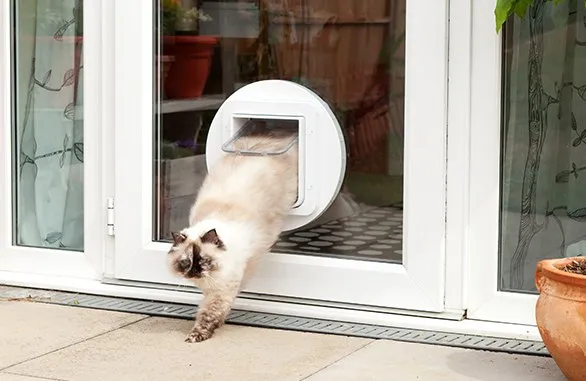
Cat Flap Not Reading the Microchip? 4 Checks Before You Buy
The short answer: a microchip cat flap is two products sold as one. The door is a battery-powered chip reader with a three-year warranty and a published parts list, and it works with no network at all. The connected version adds a hub sold separately at £85 plus an app that carries the curfew, the exit permissions and the lock. The failures divide along the same line: owners report doors that stop reading one cat’s chip, and app pages that go blank while the door is still standing in the wall. Four checks decide which version you are actually buying, and the first one is free.
I spent an evening in the r/SurePetcare archive and then on the one-star pages of two brands, because the question that kept arriving in email was the same one. My cat flap stopped letting one cat through. Where do I start? The answer is not a refund request. It is a chip, a battery and a router, checked in that order.
petiqlab earns a commission from the Amazon links on this page. Everything below comes from manufacturer pages and public reviews read on October 12, 2026, and every quote is the owner’s or the company’s own. petiqlab has not installed these doors.
Check 1: are both cats’ chips being read at all?
Most of these cases are a detection problem, not a broken door. A cat flap that reads one cat and refuses the other looks like a broken door and is often a detection problem, and the longest account of it comes from a PetSafe owner writing in April 2026. Her flap was “advertised to programme up to 99 cats.” She has “TWO cats and the cat flap lets one in but not the other.” She went through support’s troubleshooting list, returned the unit and bought a second one, and collected the diagnoses in order: “They were not helpful at all. Told me it was probably an issue with my cats microchip, then that it was probably an issue with my door, then told me it was fitted too high (fitted at a cost of £120 by a professional).” The ending is the part worth reading twice, because it is what an unresolved reader looks like in daily life: “I’ve now got a very expensive cat flap that I’ve had to tape down the buttons to allow both cats (and anything else in the street) into and out of my house.” Her closing line is a warning about the category rather than about one unit: “AVOID petsafe microchip cat flaps.”
The same failure appears on the other side of the category in a better-documented version. A Sure Petcare owner with four cats wrote that a DualScan flap “will only scan 2 out of 4 cats,” then did what most buyers never do. He bought a scanner and tested each chip himself: it “picks up the 2 perfectly, the other 2 it says no tag.” That single test moves the fault from the door to the cat, and it changes the fix. Chips move under the skin, sit deeper on some cats, and some readers need a wider radio setting. The community answer in that thread points at a setting the hardware already has, an extended range mode intended for detuned microchips, documented in the open-source pethublocal project.
So the first check is not about the flap at all. Ask your vet to scan the cat before you blame the door, and before you accept a support agent’s guess about your door frame.
Check 2: what does the £85 Hub cost you and what does it hold?
The microchip door and the connected microchip door are one product line with two prices, and the maker’s own store gives both. Read on October 12, 2026, the UK store lists the Microchip Pet Door at £120, the DualScan Microchip Cat Flap at £109.99, the Microchip Cat Flap Connect at £140 and the Microchip Pet Door Connect at £155. The Hub is listed separately at £85.
| Product (maker’s UK store, 12 Oct 2026) | Price | Stock status on the page |
|---|---|---|
| Microchip Pet Door, no app | £120 | listed in stock |
| DualScan Microchip Cat Flap, no app, multi-cat | £109.99 | listed out of stock |
| Microchip Cat Flap Connect, app, hub separate | £140 | listed out of stock |
| Microchip Pet Door Connect, app, hub separate | £155 | listed in stock |
| Hub, required for any Connect product | £85 | listed in stock |
| Microchip Cat Flap Connect with Hub bundle | £205 | listed in stock |
| Microchip Pet Door Connect with Hub bundle | £240 | listed out of stock |
The arithmetic is the argument. Adding the network to a £120 door produces a £205 to £240 purchase, roughly double, and that money buys a device that plugs into the router. The maker’s own instructions say so in plain words: “Connect the Hub to a spare port on your home router. The Hub acts as the link between the pet door and the internet.” The connection line reads “Connect with the Hub (sold separately) which links the Pet Door Connect to the Sure Petcare app.”
Seven prices on the Sure Petcare UK store, read on October 12, 2026, decide the bill. The Microchip Pet Door lists at £120, the DualScan Microchip Cat Flap at £109.99, the Microchip Cat Flap Connect at £140 and the Microchip Pet Door Connect at £155. The Hub lists at £85 and is required for any Connect product. A bundle of the Microchip Cat Flap Connect with the Hub lists at £205 and the Microchip Pet Door Connect with the Hub at £240. Adding the network to a £120 door therefore produces a £205 to £240 purchase, roughly double. The maker’s own instruction reads: connect the Hub to a spare port on the home router, and the Hub acts as the link between the pet door and the internet. The store lists the Microchip Pet Door and the Microchip Pet Door Connect in stock, while the standalone Microchip Cat Flap Connect reads out of stock.
The app side of the bargain is legitimate and worth naming. The same page lists a curfew that “set the door to lock and unlock at specified times or take control at anytime,” per-pet exit permissions on the DualScan flap to “keep specific pets indoors,” app access you can share with friends along with their permissions, and notifications and reports “on your pet’s location and activity.” One line in the official feature list decides whether any of that matters to you: “Selective entry, any animal can exit. The microchip reader is located on the exterior of the pet door only.” A neighbour’s cat cannot come in. It can go out through your door if it was already inside, and a cat wearing no chip can leave whenever it likes.
Check 3: what does the Sure Petcare app do when the service is not there?
Remote locking is a real feature and a real dependency, and the archive shows both halves. In one thread, an owner describes the app failing across the board while the door itself stood there: “I can’t interact with it, can’t change cats status from inside to outside, and the cat flap page is totally blank, I can’t set a curfew, lock or unlock the pet door.” Replacing batteries, restarting the Hub and reinstalling the app did not bring the page back. A second owner in the same thread wrote, “Today mine is fine but on Friday it was misbehaving,” which is what a server-side wobble looks like from a kitchen.
Other app failures in the same archive are more local. A Sure Petcare owner reported that trainer mode ran backwards: the door “will close when my cat (who is registered) approaches it, and then open up again when he moves away.” Another reported that notifications arrived inverted, with a lock at night reported as an unlock. The longest-running complaint in the folder concerns the Hub itself: an owner who had built a camera into the door frame described the “constant red light issue on the cat hub’s ears, which so many here experienced 2 years ago,” and a separate thread records a Connect unit that died after nearly 4 years of use.
None of this makes the app useless. It makes the app a second product with its own uptime, its own account and its own firmware, and the reviewer ratios put the risk in proportion. Sure Petcare’s profile sits at 4.5 across 3,938 reviews with 1,215 of them written in the last 12 months, replies to 72 percent of negative reviews typically within 48 hours, and a paid Trustpilot subscription. The platform’s own machine-written summary, built from 634 recent reviews, praises the support staff and then names the pattern in this category: “Some reviewers were not happy with items developing unexpected mechanical faults after months of regular use. A few consumers also mentioned that certain replacement parts broke prematurely or that their units drained batteries much faster than expected.”
Check 4: why can the app not read the 4 x C cell battery correctly?
The door is battery powered, and the official line is “up to 6 months battery life (4 x C cell batteries not included).” What that number hides is the chemistry argument, and the archive has it in detail. One owner asked why “the app shows that the battery is getting low but on then on the physical pet door it seems to have full battery.” The replies explain the mechanism rather than the symptom. Rechargeable cells sit near 1.2 volts against 1.5 for alkalines, and the door has a documented mode for them that owners have to switch on: “On the pet door you need to turn on custom mode 2, the rechargeable customer mode.” Another long-term owner of two units wrote that the app simply does not model that mode: “The door itself is in rechargeable battery mode and the app doesn’t seem to understand that.” His workaround is the one this site keeps arriving at from other directions: read the API instead of the app. He connects the door to Home Assistant and alarms below 10 percent.
Budget for the batteries as a line item, not an afterthought. A five-star reviewer on 23 September 2026, otherwise happy, wrote the quiet version of the same worry: “I’m unsure how long the batteries will last, but hopefully a while, considering the additional cost.” Four C cells, twice a year, in a door that also asks for a hub on a wall socket.
What does the parts list say about the fifth year of a £120 door?
The most useful page in this category is not the product page but the spare parts list, because it answers what happens after the warranty. Sure Petcare’s own catalogue for the Microchip Pet Door sells the door leaf, front cover, battery lids, exterior screw caps, tunnel extenders and mounting adaptors separately. That matters more than it sounds. A five-star review dated October 2, 2026 describes a nine-year-old microchip pet door that “started to fail,” diagnosed as a worn motor cartridge, with the replacement arriving “within twenty-four hours.” A door that is repairable in year nine has a different cost of ownership from one that is not.
PetSafe’s electronic dog door is the comparison, in the words of an owner writing in January 2026: “the weak plastic hinge breaking.” He had been buying replacement doors until he gave up and made his own part, and he named the reason: “the hinge can’t be replaced separately.” A second owner tried to buy a cat flap part rather than repair one and reported the outcome in November 2025: “Ordered a replacement cat flap part 6 months ago, never arrived, in July they said they would investigate with delivery firm, and that was the last heard from them.” Full disclosure on the comparison, because this site holds product lines apart: PetSafe’s brand-level profile sits at 2.1 across 231 reviews on an unclaimed profile with no reply badge, and its Smart Feed feeder and SureFeed-style brands are judged separately here. The hinge is a door problem, not a feeder problem.
A third owner, in the same petsafe.net pool, ordered a cat flap and watched the order “flagged as Delivered but to a location in the Netherlands,” which is a delivery failure rather than a design one, and belongs in the same pile only because it is what a door purchase looks like when the item is large and the return is expensive.
None of it changes the standing advice in our spare parts audit: price the second bill before the first one, and read the parts catalogue the way you read the spec sheet.
The spare parts list answers the fifth year better than the specification sheet, and Sure Petcare publishes one for a £120 door. The catalogue sells the door leaf, the front cover, battery lids, exterior screw caps, tunnel extenders and mounting adaptors as separate items. A five-star review dated October 2, 2026 describes a nine-year-old microchip pet door that started to fail, diagnosed as a worn motor cartridge, with the replacement arriving within twenty-four hours. PetSafe’s electronic dog door is the comparison. One owner writing in January 2026 named the failure as a weak plastic hinge breaking, had been buying replacement doors, and gave up to make a part at home, because the hinge cannot be replaced separately. A wall install adds the tunnel extender and the adaptor, and both change the opening that has to be cut.
Does the three-year warranty clock restart when a replacement door arrives?
Every replacement unit arrives with an invisible date on it, and the company’s own public reply spells out what that date is. A Sure Petcare owner who had run a Microchip Cat Door Connect with the Internet Hub for “a little over 3 years” wrote that a replacement was refused, and finished with “There is clearly an issue with these cat flaps.” The company’s reply, signed by a named support agent, gives the rule: “for a replacement unit sent free of charge, its warranty relies on the date of purchase of the original product.”
Read that next to the rest of the field. The plain Microchip Pet Door carries a three-year warranty, which is longer than most of the hardware in this category, and a second warranty year is not something to sneeze at. It also means the clock starts at checkout and keeps running through every free replacement, so a door that is replaced in year two has one year of cover left rather than three. Our design-margin breakdown covers what tends to happen at exactly that boundary in this industry, and a door that spends nine years on a wall without trouble is the outcome to plan for rather than the one to assume.
Check 5: why check the £120 fit before the firmware?
One more item sits above firmware, app and account in the order of things that go wrong, and it costs £120 in the review above: the hole. A cat flap that fails because it was fitted too high, too tight against the flap opening, or into a door frame that flexes, is a cat flap that will pass the bench test and fail the cat. Two practical notes from the same material. The pet door is designed for large cats and small dogs and installs in “a door, window or wall,” which means the fitting kit and the tunnel depth change with the surface. And if you plan to modify the door later, know what you are drilling into: one owner who wanted a camera mounted above the flap was warned that the frame carries the antenna, and solved it by mounting outside the blind spot.
If the flap is going into a wall rather than a door, budget the tunnel extender and the adaptor as part of the job, because both are sold as separate items and both change the opening you have to cut.
Which Sure Petcare and offline picks does petiqlab recommend for this category?
The category splits cleanly enough to pick on one axis: whether the repair path is a part or a ticket, and whether the function survives the wifi going down. Our picks stay on the offline side, and two of them are products this site has already recommended for other reasons.
| Pick | Price and terms | Why it fits a cat flap decision |
|---|---|---|
| Microchip Pet Door | £120 on the maker’s UK store, three-year warranty, works with all identification microchips worldwide | No hub, no app, no account and no curfew to lose. The parts list is published and sold, so a worn leaf or motor cartridge is a purchase rather than a case |
| SureFeed microchip feeder | hardware only, no plan | The same idea applied to food, and the model this site has recommended for multi-cat households. Covered in our microchip feeder guide |
| TP-Link Tapo C210 | about $35 to $40, records to a microSD card | Buy a camera instead of a hub if what you want is to know which cat came through. No subscription, no account between you and the recording |
Two deliberate omissions. This article gives no link to the Connect versions, because the hub requirement, the app failures and the non-restarting warranty clock above are enough reason for a buyer to want the plain model, and we are not going to sell the other one while writing that. And the picks list is short because the category is small: Sure Petcare’s door, Sure Petcare’s feeder and a camera cover the ways people actually use these products.
Read the whole thing as one question about failure. A door that reads chips, runs on batteries and sells its own spare parts fails in ways a household can absorb. A door that also depends on a hub, a router, a server and an app fails in ways that need the phone in your hand and the vendor’s uptime to line up, which is why our cloud-free picks keep pointing at the same shortlist. If remote locking is the feature you cannot live without, buy it with open eyes and keep the plain door in mind for the second entry in the house.
Updated: October 12, 2026. Sources: the Microchip Pet Door product page (read 12 October 2026: 120 GBP list price, three-year warranty, works with all identification microchips worldwide, installs in a door, window or wall, and a spare parts list carrying the door leaf, battery lids, front cover, screw caps, tunnel extenders and mounting adaptors), the Microchip Pet Door Connect product page (read the same day: 155 GBP list price, hub sold separately, curfew via the app, shared app access with permissions, up to 6 months on 4 x C cells not included, and the line that the microchip reader is on the exterior of the door only), the Hub page (85 GBP) and the Microchip Cat Flap Connect page (140 GBP, per-pet exit permissions on DualScan), all prices as of 12 October 2026 and quoted in GBP from the maker’s UK store. Owner reviews from the surepetcare.com Trustpilot profile (4.5 across 3,938 reviews with 1,215 in the last 12 months, replies to 72 percent of negative reviews typically within 48 hours, a paid Trustpilot subscription, a nine-year-old pet door fixed with a motor cartridge within twenty-four hours on October 2, 2026, a replacement refused after three years with the company’s own reply that a free replacement’s warranty relies on the date of purchase of the original product, and a Hub that would not connect to the app after a $2,000 installation) and the petsafe.net one-star page (2.1 across 231 reviews on an unclaimed profile with no reply badge, 58 percent of them one-star and 42 written in the last 12 months: a microchip flap advertised for 99 cats that read one of two, a £120 professional fitting blamed for it, a hinge that cannot be replaced separately, a cat flap part that never arrived after six months, and a flap order delivered to the wrong country). Community accounts from the r/SurePetcare app thread (a blank cat flap page, no curfew, no lock, and a door that was fine on Friday) and the r/SurePetcare chip-reading thread (a reader that stopped recognising every cat, and a fountain named as the interference). petiqlab has not installed or tested any product in this article, and the door has not been tested on our bench.
FAQ
Why does a microchip cat flap read one cat and not the other?
Usually because the reader is fine and the chip is not being detected the way the door expects. A PetSafe owner with two cats wrote in April 2026 that a flap advertised to program up to 99 cats let one cat in and not the other, and that support blamed the microchip, then the door, then the fitting height. A Sure Petcare owner with four cats scanned each one separately and found two chips reported no tag at all. Test the chip with a scanner at a vet before you blame the door, and check whether the model has an extended range mode for detuned chips.
Does a microchip cat flap need WiFi?
The plain microchip door does not. Sure Petcare’s own product page for the Microchip Pet Door lists a three-year warranty and says it works with all identification microchips worldwide, with no app and no account in the path. The Connect versions do need the network, and the maker’s page says to connect with the Hub, sold separately. That hub is listed at £85 on the same store, and it has to sit on a spare port of your home router.
What does the app version add to a cat flap?
A curfew, per-pet exit permissions, remote locking and notifications. Sure Petcare’s page for the Microchip Pet Door Connect lists a curfew that locks and unlocks at set times, app access you can share with friends, and reports on your pet’s location and activity. It also states that the microchip reader sits on the exterior of the door only, so any animal can exit. The added control and the added failure surface arrive in the same purchase.
What happens to the warranty when a cat flap is replaced?
The clock keeps running from the original purchase. A Sure Petcare owner who had a Microchip Cat Door Connect and Hub for a little over three years wrote that a replacement was refused, and the company’s own public reply explained why: for a replacement unit sent free of charge, its warranty relies on the date of purchase of the original product. Keep the first invoice and record the date you installed the door.
Can you replace worn parts on a microchip pet door?
On the Sure Petcare door, mostly yes. The maker’s own catalogue for the Microchip Pet Door lists a replacement door leaf, battery lids, a front cover, exterior screw caps, tunnel extenders and mounting adaptors as separate items, and a five-star review from October 2, 2026 describes a nine-year-old door fixed with a replacement motor cartridge that arrived within twenty-four hours. PetSafe’s electronic dog door is the opposite case: one owner wrote that the plastic hinge breaks and cannot be replaced separately.
Should I buy the connected cat flap or the plain one?
Buy the plain one unless remote locking is a requirement you can name. The plain Microchip Pet Door is listed at £120 on the maker’s store against £155 for the connected door plus £85 for the hub, so the network roughly doubles the bill while adding a service that can be down, an account, and a second device to power. The app earns its place if you need a curfew, exit permissions for one cat, or notifications, and those needs are real in some households.
Does another device in the house affect a microchip doorway?
Owners think so, and one account is specific. A Sure Petcare user whose several-week-old feeder stopped reading every cat’s chip was asked in the thread whether a Petlibro fountain sat nearby, and the reply came from someone whose own fountain was interfering with the readers, solved by swapping the fountain. Treat it as a hypothesis rather than a finding, but test it the cheap way: unplug nearby smart devices and see whether the reader recovers.