Why a Litter Box Stops Mid-Cycle and Won't Restart From the App
The short answer: a self-cleaning litter box stops mid-cycle when its safety sensors still sense a cat, and that state is designed to fail closed. PETLIBRO’s Luma lists four checks across weight, camera, infrared and anti-pinch, and pauses instantly when any of them reports a cat. Whisker’s Litter-Robot 4 watches three laser curtains and a weight scale in the base, and will not resume until 15 seconds after the cat is gone. PETKIT’s Purobot Max Pro 2 carries 12 sensors and pauses when a cat is nearby. A cycle started from an app can be stopped by a sensor. A sensor cannot be argued with from an app, and one owner came back from a holiday to find a $599.99 box parked almost shut with the cat outside it.
I spent a morning on PETLIBRO’s Trustpilot page, three screens into the one-star reviews, and stopped at a paragraph about a vacation. The owner had gone four states away, opened the Petlibro app, and found the globe of a Luma parked almost closed. The camera feed on the same app showed no cat anywhere near the box. The machine disagreed with its own camera, and there was no button on the phone that settled the argument.
That is the shape of this failure. Not a motor that burns out, not a WiFi dropout, but a safety system doing exactly what it was built to do in a room it was not built for. The interesting part is what each brand lets you do about it from a distance.
petiqlab earns a commission from the Amazon links on this page. Everything below comes from the makers’ own product pages, support articles and manuals read on October 21, 2026, from Trustpilot one-star reviews and their public replies, and from dated owner threads on Reddit. Prices are list prices on that date. Where this article describes a failure, it quotes the owner who hit it, because this site has not run a Luma, a Litter-Robot 4 and a Purobot side by side in a room with a bad floor.
What does each of the three boxes count as a cat?
Most drum-style boxes share one assumption, whatever the sensor array: anything warm, heavy or moving near the drum is a cat anything warm, heavy or moving near the drum is a cat until proven otherwise.
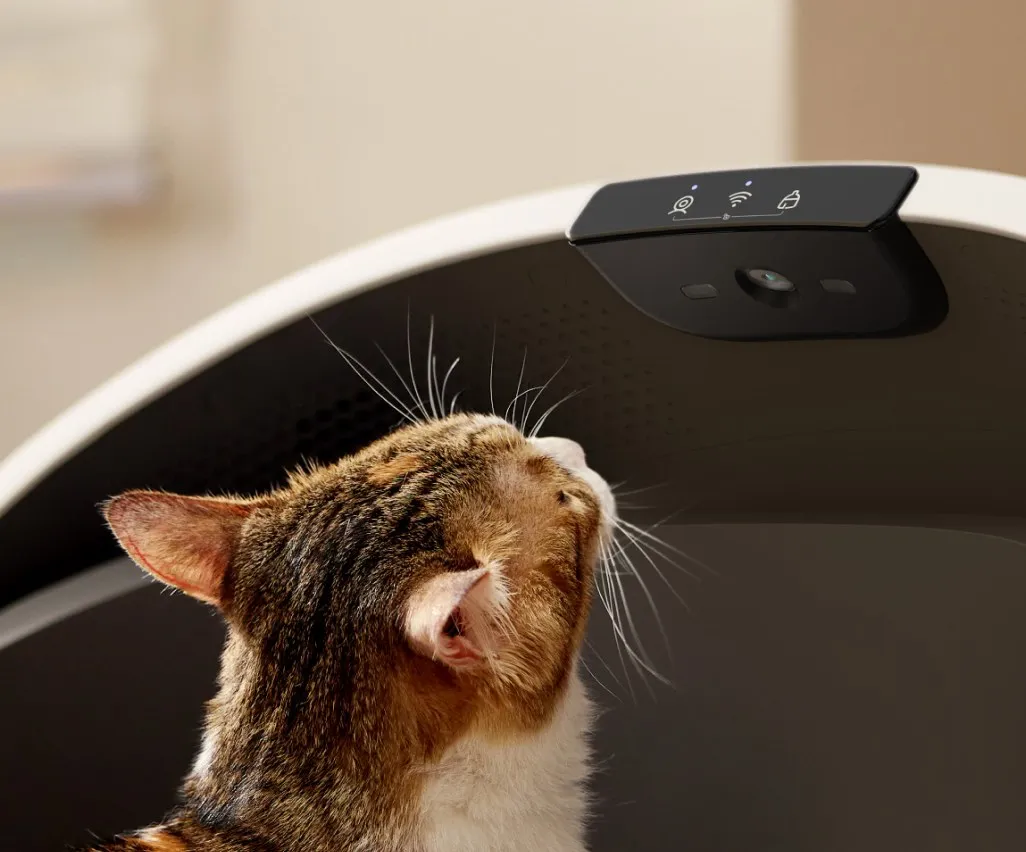
PETLIBRO’s Luma page puts it in a single paragraph. “Weight, visual, and infrared motion sensors work together with anti-pinch protection to confirm your cat is clear before cleaning. If a cat is detected, Luma pauses instantly.” The FAQ below that paragraph adds the timing: Luma only starts cleaning once its camera, infrared and weight sensors confirm the cat has left, and if a cat approaches while the drum is rotating, it pauses to keep them safe.
Whisker describes the same idea with more hardware. The Litter-Robot 4 safety page names three laser sensors in the top of the bezel, called curtain sensors, plus a cat sensor weight scale in the base. “If a cat attempts to enter the unit during a cycle, the globe will stop with the light bar displaying red, indicating the cycle has been interrupted. The cycle will not resume until 15 seconds after the cat is no longer detected.” The same page covers anti-pinch sensors on both sides of the waste drawer chute, which stop and retract the globe, and an overload detector that stops, retracts and retries, then gives up after three attempts with three red lights and two flashing yellow ones.
PETKIT’s Purobot Max Pro 2 page counts 12 safety sensors, “including advanced proximity and weight sensors,” and states that the box “automatically pauses when a cat is nearby or inside the cylinder.” The T4 manual for the Pura Max generation, still hosted at instructions.petkit.com, prints the same rule in a status table: “The device will automatically pause and alert when a cat approaches or enters the litter box during operation.”
| Machine | Sensors named by the maker | What stops a cycle | Price read Oct 21 2026 |
|---|---|---|---|
| PETLIBRO Luma | weight, camera, infrared, anti-pinch | a cat detected at any of the four checks | $599.99 |
| Whisker Litter-Robot 4 | 3 laser curtain sensors, weight scale, anti-pinch, torque | cat entering, pinch condition, jam or overload | $699 |
| PETKIT Purobot Max Pro 2 | 12 sensors including proximity and weight | cat nearby or inside the cylinder | $499.99 (list $599.99) |
Read the middle column twice. Nothing in it says “and if the reading is wrong, do this.” The maker’s documentation describes how the machine stops. It rarely describes how the machine is persuaded to start again.
PETLIBRO’s Luma combines weight, visual and infrared motion sensors with anti-pinch protection and pauses instantly when a cat is detected, at a list price of $599.99. Whisker’s Litter-Robot 4 names three laser curtain sensors in the bezel plus a cat sensor weight scale in the base, and the cycle will not resume until 15 seconds after the cat is no longer detected; the same machine lists at $699. Anti-pinch sensors on both sides of the waste drawer chute stop and retract the globe, and an overload detector retries three times before giving up with three red lights and two flashing yellow ones. PETKIT’s Purobot Max Pro 2 counts 12 safety sensors, including proximity and weight, and pauses when a cat is nearby or inside the cylinder, at $499.99 against a $599.99 list. PETKIT’s T4 manual for the Pura Max generation prints the same rule in a status table: the device pauses and alerts when a cat approaches or enters during operation.
Why is the room, not the sensor, the usual cause of a lockout?
A weight sensor in the base of a litter box is doing arithmetic all day. It has to separate a 12-pound cat from a 2-pound clump, from the litter you just poured in, from the mat underneath, from the floor itself. Small errors in that arithmetic become false positives.
PETLIBRO prints the conditions in the Luma FAQ, and they are stricter than the product photography suggests. The box has to sit on a hard, level surface with at least 4 inches (10 cm) of space around it “to ensure the accuracy of its weight sensor in detecting your pet’s weight.” Carpet, the FAQ says, “may cause inaccurate weight readings and reduce the effectiveness of its triple-safety check system.”
The owner who wrote the October 13, 2026 review reached the same list from the other direction, after living with the result. Her sentence names four causes in a row: litter kicked onto the sensor, which she says sits “in the front of the box, directly under where the cat enters and exits,” or the box too close to a wall, or sitting on carpet, or the included litter mat tucked under the box too closely.
PETLIBRO replied under the review, and the reply is more useful than most. “Based on your description, the behavior you experienced appears to be related to the safety protection mechanism being triggered. The Luma Litter Box is designed with sensitive safety sensors to help prevent operation when a pet may be detected nearby, as pet safety is our highest priority. Because of this, the detection system can be affected by the surrounding environment, including the placement of the litter box and objects near the sensor area.”
That is a maker conceding the mechanism is sensitive to furniture. It is also the reason the failure is so hard to argue with: the machine is not broken by its own logic. It is broken by a wall.
Whisker owners land in the same place from a different sensor. A thread posted on September 22, 2026 in r/litterrobot describes a Litter-Robot 3 that over-rotates and stops with the cycle light flashing rapidly, cleaned and reassembled with no change. The first reply predicts the support script, telling the owner to get it off the carpet and level it. The owner answers that it is not on carpet and the rug sits before the machine. A second owner reports the same on a flat wood floor, and a third names the part: “The weight sensor is the black round disk in the back. I think mine is too sensitive and stays active after a large clumps falls from the ceiling. I adjusted it by loosening the screw a very tiny bit.”
That comment is the whole mechanism in one sentence. A clump falls through a laser curtain, or lands on a scale, and the box records a cat. The drum waits for a cat that is not there.
Why is the app usually the wrong tool for clearing a sensor lockout?
Every one of these boxes is sold as remote care, so it is worth separating two abilities that marketing language folds together.
The first is starting a cycle from somewhere else. Whisker’s app page states it plainly: “Start a clean cycle, adjust settings, and turn features on and off from anywhere.” That is a real feature, and it exists because owners asked for it.
The second is clearing a sensor state from somewhere else. None of the three makers documents that. What the Litter-Robot 4 does document is a local remedy: on the control panel page, pressing Reset “with the red light bar on” cancels the cat sensor cycle delay and returns the unit to Ready. Reset is a piece of plastic on the top of the machine. It is not in the app.
An owner found the gap between those two abilities about a year ago and posted the screen sequence in r/litterrobot. He tapped Manual cycle, then Start Clean cycle, then Yes, continue, and the app told him “Your litter robot will cycle shortly.” Then: “crickets. An absolute nothingness. The button on the unit itself works fine though.”
PETKIT owners describe the same wall on older hardware. A Pura Max owner in May 2022 wrote that the drum “will detect a cat where there is none and pause the cleaning indefinitely,” and that his recovery was to unplug the machine, plug it back in, press the power and cycle button, then press OK. Four physical steps for a software-sized problem.
For the Luma, the October 13 review is blunter than any of them: the cycle stops mid-clean “with NO WAY of overriding this unless you do it MANUALLY on the actual litter box.” PETLIBRO’s reply does not dispute that. It explains the mechanism and offers to look at the case.
Put the three together and the design rule is visible. These machines accept a remote request to start. They do not accept a remote argument about whether a cat is present, because the interlock sits below the app in the control hierarchy. That is defensible engineering and miserable ownership, and the difference between the two is a plane ticket.
Whisker’s app page states owners can start a clean cycle, adjust settings and turn features on and off from anywhere, and the Litter-Robot 4 control panel adds a Reset press that cancels the cat sensor cycle delay with the red light bar on. A Litter-Robot 4 owner tapped Manual cycle, Start Clean cycle and Yes, continue, then read a promise the robot would cycle shortly, followed by nothing while the button on the unit worked. PETLIBRO’s October 13, 2026 reviewer wrote that the cycle stops mid-clean with no way of overriding unless the work happens manually on the actual litter box, and the machine parked almost closed for a holiday four states away. A May 2022 Pura Max owner recovered by unplugging, replugging, pressing power and cycle, then OK. PETLIBRO’s public reply under the same review says the behaviour appears related to the safety protection mechanism being triggered and that placement affects detection.
Why do three owners on three brands describe one lockout shape?
The reviews do not describe three different faults. They describe one fault wearing three badges.
The Luma owner, October 13, 2026: “This causes the cleaning cycle to stop mid clean with NO WAY of overriding this unless you do it MANUALLY on the actual litter box. This happened while we were on vacation 4 states away and my cat had Zero Access to her litter box since the compartment was basically stuck almost closed.” She kept the machine anyway, and said why: she had paid too much to throw it out.
A veterinary technician, February 2, 2026, on a Litter-Robot 3 bought directly from Whisker in April 2023 for $537.67: “It would routinely stop halfway through a cycle, leaving our cats unable to use it. Sometimes it would stop completely upside down. The pinch sensor would trigger at least every other day. We’d reset it, it would cycle successfully once, and then we’d be right back to the same error.” She then bought a used Litter-Robot 4, expecting the newer generation to behave. Her verdict on that one is two words long, and they are not printable here.
A Litter-Robot 4 owner, September 23, 2026, titled his thread around the machine being stuck upside down for the second time that year. A 2023 thread from another LR4 owner covers the same ground with a longer list of attempts: litter level adjusted, cycle delay moved up and down, position on the floor changed, mat added and removed, resets run many times, and finally the entire unit replaced. The replacement “started doing the same thing after a couple of weeks.”
None of those owners found a broken part. Each found a sensor that keeps deciding, and a machine whose only answer is to wait, retract or stop. The Litter-Robot 4 will resume on its own 15 seconds after the cat reading clears, which is the best behaviour in this group and still useless if the reading never clears.
Which half-hour test tells you whether a $599.99 box will strand you?
This is the part the manuals leave out, and it costs nothing. Run it at least a week before a trip, not the night before.
- Put the box on a hard, level floor and give it the clearance the maker asks for. PETLIBRO names 4 inches (10 cm) on every side. Whisker’s troubleshooting starts with the floor for a reason.
- Move the mat out from under the base. A mat tucked beneath a weight-sensing box is a permanent offset on the scale, and one Luma owner lists it as a cause.
- Watch two complete cycles with nothing else happening in the room. Note whether the drum returns to its home position or parks part way. A box that parks at an angle is telling you which sensor it trusts.
- Fill litter to the line and no higher. Overfilled drums report weight and torque faults, which is what the Litter-Robot 4 overload detector is watching for.
- Start a cycle from the app, then stop it with the panel. If the app shows a state you cannot clear from the phone, you have found the limit of remote care while you are still standing next to it. That is the whole test.
- Point a camera at the box so a status line is not your only evidence. The Tapo C210 records to a microSD card inside the camera with no subscription, which is the difference between watching your drum at 2 a.m. from a hotel and reading “cycle interrupted” with no picture attached.
- Set a second litter box beside it before you leave. Unglamorous, and the only item on this list that cannot lock itself.
What do Trustpilot reply rates say, and what do they not?
Reply rates on Trustpilot are now the first thing this site checks on a pet brand, and they are also the easiest number to misread. A reply is a message, not a fix.
| Brand | Trustpilot rating | Reviews | Reply badge (Oct 21 2026) |
|---|---|---|---|
| PETLIBRO | 3.3 | 1,060 | 74% of negative reviews, within 2 weeks |
| Whisker (Litter-Robot) | 3.3 | 614 | 96%, within 1 week |
| PETKIT | 3.7 | 345 | 84%, within 1 week |
| Furbo | 3.2 | 142 | has not replied to negative reviews |
| Petcube | 3.2 | 764 | has not replied to negative reviews |
| PetSafe | 2.1 | 233 | no badge, unclaimed profile |
PETLIBRO answered the Luma reviewer, publicly and politely, and the machine still stopped mid-cycle on a holiday. Whisker answers 96% of negative reviews inside a week and two of its owners still describe a box that will not finish a cycle. The badge measures whether somebody is reading. It does not measure whether the drum turned.
The petiqlab reading of that table is narrow: 74% and 96% are both good numbers for a support desk and neither one is a specification for the hardware. Buy the hardware for how it fails, then use the reply badge to guess how quickly you will hear back.
What should you buy for a box left alone while you travel?
There is no drum on the market that promises a remote clear, so the honest shortlist is about failure modes rather than features.
The PETKIT Purobot Max Pro 2 at $499.99 (list $599.99, ASIN B0DFYLFFG1) is the drum this site has recommended for a year, and the reasons survive this article: a 2-year warranty, standard clumping clay rather than a locked litter supply, and a drawer that can be sealed before it is pulled out. It also pauses when a cat is nearby, exactly like the other two, so nothing here is a cure. Two disclosures belong in the same paragraph: the camera’s replay runs on a 30-day trial and afterwards leaves live view only, and many cats need an adjustment period before they will use any covered drum. Its brand profile sits at 3.7 across 345 reviews, which is the middle of the table above.
The Tapo C210 is the second purchase, at around $35 to $40, and it does the job no litter box does. It records locally to a microSD card with no subscription, so the globe’s position is a fact you can check from another state instead of a status line you have to trust. This site’s full review of the camera covers the storage question, and the subscription trap map explains why that matters more than resolution.
For the second box, buy something dumb. A stainless or high-sided pan, no app, no schedule, no sensors, no account. Owners who keep one beside the automatic box describe it as insurance rather than a backup plan, and the Luma reviewer’s holiday would have been a nuisance instead of an emergency with one in the house.
PETLIBRO’s Luma is quoted in this article as evidence and carries no link. This site rates the PETLIBRO feeder line poorly on reliability, and a machine that stops mid-cycle on a $599.99 purchase is not the one to recommend to someone whose cat is home alone. If you already own one, the checks above are the useful part of this page. The light-code guide for the Litter-Robot 4 covers the error side of the same problem, the owner-reported safety file collects the incidents, and the buying guide walks the category from scratch.
FAQ
Why does my self-cleaning litter box stop mid-cycle when no cat is near it? The sensors are reading the room rather than the cat. Lasers across the entry, an infrared sensor on the rim and a scale under the base all react to weight and movement, which includes a falling clump, a mat tucked under the base, a wall close to the sensor panel or carpet under the machine. PETLIBRO’s public reply to a one-star Luma review says the behaviour appears to be the safety mechanism being triggered and that placement and nearby objects affect detection.
Can I override the safety stop from the app? Usually not, and the two abilities are worth separating. Whisker documents starting a cycle from anywhere and a panel Reset that cancels the cat sensor delay. None of the three makers read here documents a remote way to clear a sensor that insists a cat is present. Remote start and remote clear are different features, and only one of them is in the brochure.
Which brand restarts a cycle without touching the machine? Whisker is the only one of the three with a remote cycle control printed on its own site, and owners still report it failing. A Litter-Robot 4 owner described the app walking him through four screens, promising a cycle, and then doing nothing, while the button on the unit worked. The app can ask. The machine can still refuse.
Is it safe to disable the sensor? No, and none of these boxes offers that switch. The interlock exists because a rotating globe can injure a cat inside it, which is why Whisker stops and retracts on pinch or overload and PETKIT holds the cylinder still while a cat is in it. The workable fix is mechanical: hard level floor, clearance, litter below the fill line, mat outside the footprint.
Does the floor matter that much? For a box with a scale in the base, yes. PETLIBRO’s Luma FAQ asks for a hard, level surface with 4 inches (10 cm) of space around it so the weight sensor can read a cat accurately, and warns that carpet may cause inaccurate readings and reduce the effectiveness of the triple-safety check. A Litter-Robot owner on flat wood reported the same over-rotation, and a commenter pointed at the weight sensor disk at the back as the part that stayed active after a big clump fell.
What is the cheapest way to survive a trip with one of these boxes? A second litter box with no sensors, no app and no schedule, placed beside the automatic one before you leave. It costs less than any sensor module on this page and it cannot lock itself. Add a camera on the automatic box so you can see the globe rather than trust a status line, and run the checks above at least a week before you fly.
Does PETLIBRO treat the Luma lockout as a defect? Its public reply does not. Under the October 13, 2026 review PETLIBRO wrote that the behaviour appears related to the safety protection mechanism being triggered, that the sensors are designed to be sensitive, and that placement and objects near the sensor area affect detection, then offered to review the case. For the owner the machine stopped mid-cycle with a cat outside it for the length of a holiday, which is a usability failure whatever the mechanism is called.