How Many Litter Boxes for 3 Cats? A Robot Counts as One
Three cats need four litter boxes, and a self-cleaning machine counts as one of them. The veterinary guidance is one box for each cat plus one more, or one box for each social group plus one more where the groups are known, and no brand gets an exemption from that arithmetic. A shared robot is a single station with a single entry in a single location, which is the opposite of what the guidance asks for in a house with more than one cat.
I read the AAHA and AAFP life stage guidelines, the ASPCA behaviour page, the multi-cat pages both major brands publish, and four owner threads from the last two days. The box count itself is stable across all of them. What moves is the promise attached to the machine, and the reports from the homes already running one.
petiqlab earns a commission from the Amazon links on this page. Every figure below comes from the manufacturer pages, the veterinary guidance and the owner threads listed in the sources, all read on September 26, 2026.
What the guidance says about box numbers
Two authoritative versions of the same rule.
The AAHA and AAFP feline life stage guidelines put the rule of thumb at “one litter box for each cat plus one additional box, or one litter box for each social group plus one additional box, if the number of social groups is known.” The ASPCA reaches the same number from the behaviour side, writing that a household should have one box for each cat plus one extra, and adds the example: three cats means a minimum of four boxes.
The same AAHA paragraph explains why the count is only half the rule. Boxes should sit in different, easily reachable spots around the house, and should offer an escape route. Two trays side by side in a laundry room are one station with extra surface area, not two boxes.
| Cats | Guideline minimum | If one box is a machine |
|---|---|---|
| 2 | 3 | 1 machine plus 2 plain boxes |
| 3 | 4 | 1 machine plus 3 plain boxes |
| 4 | 5 | 1 machine plus 4 plain boxes |
| 5 | 6 | 1 machine plus 5 plain boxes |
Why a machine replaces one box and not three
Capacity ratings describe throughput. The box rule describes access. Capacity is not access.
Put a robot in a two-cat flat and the household still has one entry, one drum and one drawer in one corner. PETKIT names that consequence in its own multi-cat guide before it sells anything, describing how “1–2 dominant cats often act as litter box guards, blocking access for skittish felines.” A machine that scoops after every visit does nothing about a cat sitting in front of it. The same guide lists the monitoring gap as a reason to buy, writing that a shared box makes it “extremely difficult to identify which cat is experiencing changes such as reduced urine output, abnormal stool, blood in waste, or straining.”
That is a fair statement of the problem. Whether the machine closes the gap depends on the next two sections.
What the brands claim for multi-cat homes
Whisker’s comparison chart rates the Litter-Robot 5 and 5 Pro for up to five cats, the 4 for up to four and the EVO for up to two. The method for telling those cats apart is on the same chart, listed as identifying cats “based on weight” and automatic for households with two or more, while camera identification requires Whisker+, the paid tier.
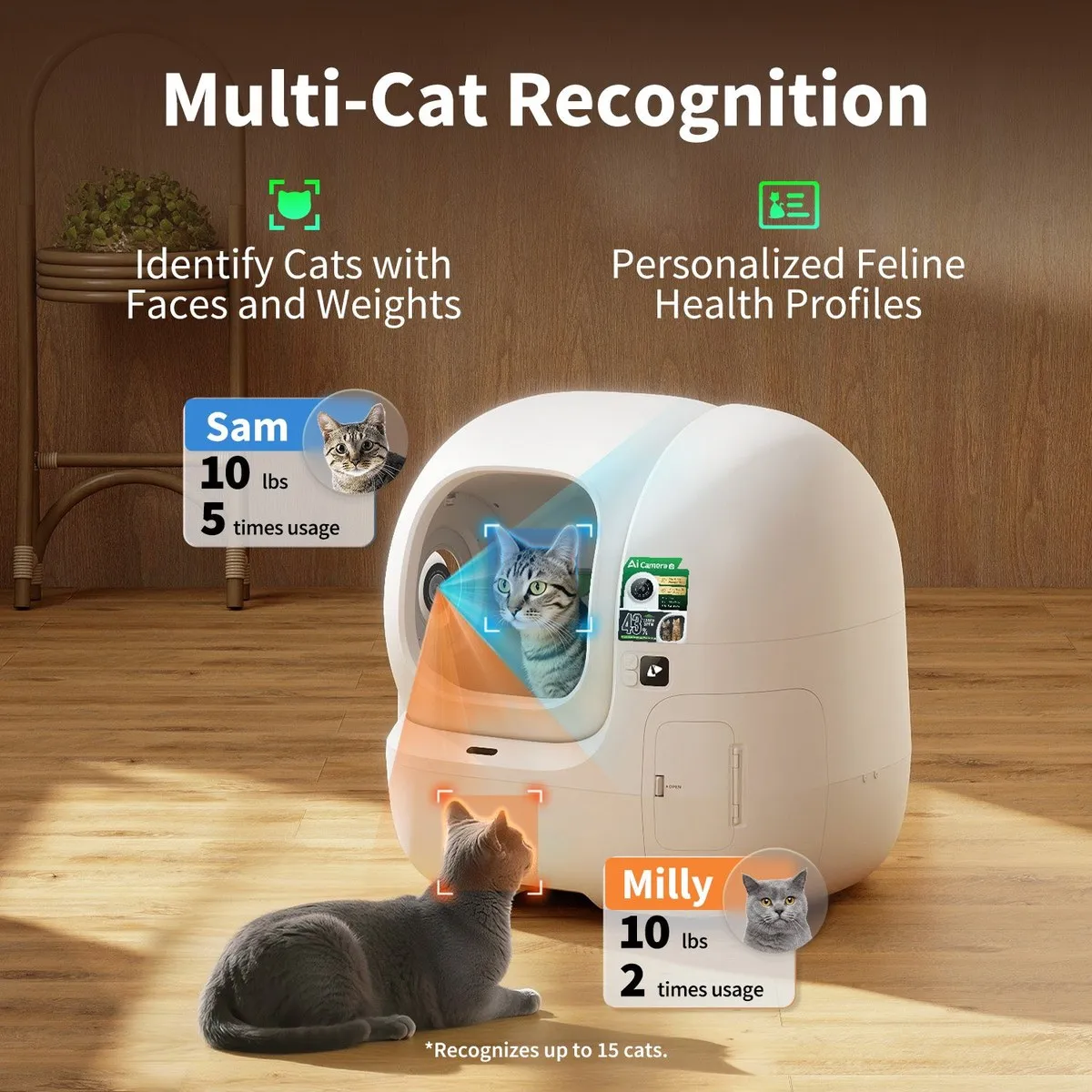
PETKIT rates the Purobot Max Pro 2 and its three other boxes at 3.3 to 22 lbs, and its newest model carries a larger claim in the 2026 multi-cat guide: “Multi-cat facial recognition identifies each cat individually, ensuring accurate monitoring even in households with multiple cats of similar size.”
Both claims are about attribution, and neither brand publishes an accuracy figure beside them.
| Claim | Where it is published | What the same documentation shows |
|---|---|---|
| Up to 5 cats per unit | Whisker comparison chart | Identification runs on weight, camera AI sits behind Whisker+ |
| Up to 4 cats, up to 2 for the EVO | Whisker comparison chart | No accuracy figure published |
| 3.3 to 22 lbs across the range | PETKIT product page | Not recommended for cats under 3.3 lbs |
| Individual recognition for similar-sized cats | PETKIT multi-cat guide, 2026 | Recognition labelled beta where owners see it |
What owners report instead
Three reports, all from the past two weeks, all specific.
Attribution breaks in both directions. A Litter-Robot 5 owner wrote on September 25, 2026 that the app reports her cats “only urinating less than 2oz per day,” and added that she has had “A LOT of issues with my LR5 not reporting amounts, mixing up urine and feces.” A power user in the same thread, who keeps a kidney cat, replied that “every single one of his visits registers as feces, presumably because of the weight,” while her other cats show urine from 0.8 to 2.4 oz. Whisker’s support answer was a power cycle script, unplug at the base for 60 seconds, wait another 60 for the reboot, run a manual cycle, allow 3 to 4 days, then a factory reset if that fails.
Identification drifts between cats of different weight. An owner of two cats whose weights differ by more than a pound and have held steady for years reported the Max Pro 2 confusing them “one out of every 3 or 4 times,” and noted that the recognition is labelled a beta feature. The machine guesses. One visit in three or four, the log belongs to the wrong cat.
The scale reads under its own floor. Owners of the same model have reported weights around 1.2 to 1.4 kg against a published minimum of 1.5 kg, and one wrote that his cat keeps its head and front paws outside the drum, so the machine records “1/2 cat weight.” PETKIT’s guidance asks for a level hard floor rather than a mat. A mat is enough to skew the reading. Topping up litter needs a double press of the OK button before the scale resets.
The counter-evidence sits in the same threads, and it is real. A household with eight cats runs two robots and four open boxes and rates the setup five stars on Trustpilot on September 8, 2026. A reviewer wrote on September 18, 2026 that two big Maine Coons took to a Litter-Robot 4 straight away. Some owners in the urine thread see plausible numbers, 0.8 to 2.4 oz, from the same machine that reports under 2 oz for someone else. The pattern in the failures is not the brand. It is that the machine is being asked to do per-cat bookkeeping in a house where it identifies cats by weight on a shared floor.
What multi-cat homes actually run
| Household | Machines | Plain boxes | Guideline minimum |
|---|---|---|---|
| 8 cats, Trustpilot, September 8, 2026 | 2 robots | 4 | 9 |
| 4 cats, r/litterrobot, September 26, 2026 | 2 robots (a Litter-Robot 3 and a generic unit) | 1 | 5 |
Both homes sit below the guideline line, and both owners describe the setup as working. Read together, that says the N+1 number is a floor aimed at behaviour problems rather than a hard capacity law, and a house that has never had plain boxes is taking a different risk from a house that removed them once the robot was running. Our position on lidless trays and open boxes covers why the plain box in that mix should be a large, low-entry one.
Litter spend scales separately from the hardware. In the four-cat thread from September 26, 2026, the owner priced three bags at $69 and said three bags last about two weeks, which is roughly $150 a month for four cats on a large-grain brand, before filters and before the machines themselves.
Three checks before you automate a multi-cat box
- Count boxes against the guidance, then count again after the machine arrives. The machine covers one. The guideline minimum for three cats is four boxes, and the machine is one of the four.
- Do not retire every plain box in the first month. A cat that refuses a robot in a single-machine home has nowhere to go, and refusal is one of the documented reactions to the Purobot range and to the Whisker machines alike. Our notes on high-pee cats and lidless trays cover what to watch when a cat stops using a shared machine.
- Decide what the app log is for before you trust it. If a health decision rides on the number, weigh the cat on a separate scale or take it to the vet, and treat the app as a usage signal rather than a record. The attribution question is the part no brand publishes accuracy data for.
What petiqlab recommends
Start with the plain boxes. For a three-cat home, that means three open trays with low entries in three different rooms, and the machine as the fourth box rather than the whole solution. No affiliate link attaches to that advice.
If the goal is less daily scooping, the Purobot Max Pro 2 is the machine on this page whose documentation addresses multi-cat use directly, with a 3.3 to 22 lbs rating, a 76 litre drum, an 8 litre waste bin, a two-year warranty and compatibility with ordinary clumping clay. Four disclosures travel with it. Its recognition is labelled beta and has been reported wrong on one visit in three or four. Its weighing has been reported at 1.2 to 1.4 kg against its own 1.5 kg floor. It needs an adaptation period, and cats have refused it outright. The camera’s playback runs on a 30-day trial. As a box in the count it is worth exactly one, which is the number to plan around.
For learning which cat is using the shared machine, the TP-Link Tapo C210 records to a local microSD card with no subscription, and it answers the attribution question from the outside instead of trusting the weight sensor. On the food side, per-cat data is a solved problem and cheap by comparison, which our microchip feeder buying guide sets out; on the litter side there is no equivalent under the price of a machine.
Longer term, the cost of a second machine is not the purchase price. Our two-year breakdown of a Litter-Robot 4 tracks what the parts and the deep cleans add after the first year, which is the number to compare against the price of three more plain trays.
FAQ
How many litter boxes do I need for two cats? Three, and that number does not move because one of them is a machine. The AAHA and AAFP feline life stage guidelines state the rule as one litter box for each cat plus one additional box, or one box for each social group plus one where the groups are known. The ASPCA gives the same arithmetic on its behaviour page, writing that a three-cat household needs a minimum of four boxes. A self-cleaning unit counts as one of those boxes, in one location, with one entry.
Does an automatic litter box count as more than one box? No. Capacity ratings describe how many cats a machine can serve over a day, while the box count rule is about behaviour and access. One machine has one entry, one drum and one drawer in one spot, so a shy cat still has to queue behind whatever is standing in front of it. The AAHA guidance also asks for boxes in different quiet locations with an escape route, which a single unit cannot provide by itself.
Can several cats share one automatic litter box? Manufacturers publish limits of up to two cats for the smallest current model, up to four for the Litter-Robot 4 and up to five for the Litter-Robot 5 and 5 Pro, and PETKIT rates its boxes for cats from 3.3 to 22 lbs. PETKIT’s own multi-cat guide names the failure mode that a capacity rating hides, describing one or two dominant cats acting as litter box guards that block access for less confident cats.
Does an automatic litter box know which cat used it? It attributes visits, and the accuracy is the open question. Whisker’s chart lists identification as running on weight and calls that automatic for households with two or more cats, with camera identification behind the Whisker+ subscription. PETKIT advertises individual facial recognition on its newest box. Against that, an owner of the Purobot Max Pro 2 reported the unit confusing her two cats, whose weights differ by more than a pound, once every three or four visits, and noted the feature is labelled a beta.
Why does my litter box app report such low urine numbers? In a Litter-Robot 5 thread from September 25, 2026 the owner reported readings of less than 2 oz per cat per day and wrote that the app had been mixing up urine and feces. A power user in the same discussion, who has a kidney cat, replied that every one of that cat’s visits registers as feces because of its weight, while her other cats show 0.8 to 2.4 oz. Whisker’s support reply was a power cycle plus a factory reset, with three to four days allowed for improvement.
Should I remove the plain boxes once the robot is working? Keep at least one. Robots are refused by some cats outright, and adaptation takes weeks, which is why a refusal in a single-machine home leaves a cat with nowhere else to go. Owners who run both describe the mix as the reason their households stay stable, and a cat that stops using a shared machine is also the signal that something medical may be happening. Our guide to why cats refuse automatic boxes covers the transition steps.
Updated: 2026-09-26. Veterinary guidance: AAHA and AAFP 2021 Feline Life Stage Guidelines, general litter box considerations (read September 26, 2026: one litter box for each cat plus one additional box, or one for each social group plus one, boxes in different accessible locations with an escape route) and the ASPCA litter box problems page (read September 26, 2026: one box for each cat plus one extra, and a minimum of four boxes for three cats). Manufacturer documentation: Whisker Litter-Robot comparison chart (read September 25, 2026: up to five cats for the Litter-Robot 5 and 5 Pro, up to four for the 4, up to two for the EVO, identification of cats based on weight and automatic for households with two or more cats, camera identification listed under Whisker+), PETKIT multi-cat household guide (read September 26, 2026: the N+1 rule restated as three boxes for two cats, one or two dominant cats acting as litter box guards, shared boxes described as a blind spot in daily health monitoring, and multi-cat facial recognition advertised on the newest model) and the PETKIT Purobot Max Pro 2 product page (cat weight limit 3.3 to 22 lbs across the range, 76 litre drum, 8 litre waste bin, and the note that the unit is not recommended for cats under 3.3 lbs). Owner threads, all read September 26, 2026: r/litterrobot, what the app reports for daily urine output (September 25, 2026: readings under 2 oz per day, urine and feces mixed up, a kidney cat’s visits all logged as feces because of its weight, other cats at 0.8 to 2.4 oz, and the support script of unplugging at the base for 60 seconds, a manual cycle, three to four days to improve, then a factory reset), r/litterrobot, litter alternatives for four cats (September 26, 2026: a Litter-Robot 3, a generic robot and one plain box for four cats, and three bags at $69 lasting about two weeks), r/PETKIT, Purobot Max Pro 2 identification (September 2026: two cats confused once every three or four visits, weights differing by more than a pound, and the beta label) and r/PETKIT, Purobot Max Pro 2 weight readings (September 2026: 1.2 to 1.4 kg readings against a 1.5 kg floor, half a cat when the head and front paws stay outside, level placement on a hard floor, and a double press of the OK button after topping up litter). Review baselines, read September 26, 2026: litter-robot.com, 3.3 across the profile, and petlibro.com, 3.4; reply-rate badges were last verified on September 25, 2026, with litter-robot.com replying to 96% of negative reviews within a week, petkit.com at 82% within a week and petlibro.com at 69% within two weeks. Positive reference points: petkit.com five-star reviews (September 8, 2026: an eight-cat household running two robots and four open boxes) and litter-robot.com five-star reviews (September 18, 2026: two big Maine Coons settling into a Litter-Robot 4 right away).