ScoopFree Stopped Working? Owners Fix It With Duct Tape
The short answer: the ScoopFree self-cleaning litter box is, by its own owners’ accounts, a four-year appliance whose plastic parts start failing around year three, whose refills only come from one place, and whose most common repair is duct tape. One $385 unit failed twice in under two years and the warranty response was a $50 discount on a new one. Before you buy, read what actually breaks, what the crystal litter really costs, and what the return window covers.
I spent an evening reading the comment section under a ScoopFree repair video, then cross-checked every claim against the brand’s Trustpilot profile (2.1/5, Poor, 225 reviews, collected August 2026), the official product page, and older owner threads petiqlab has tracked since August. The pattern that came back is consistent enough to write down: the ScoopFree works, for a while, and then it becomes your problem.
The video is called “Problems Solved!” and it is a tour of problems. The creator walks through the unit’s common failure points and shows DIY fixes. The most striking thing is not the video. It’s the comment section, where owners describe living with those fixes.
How does a ScoopFree litter box actually work?
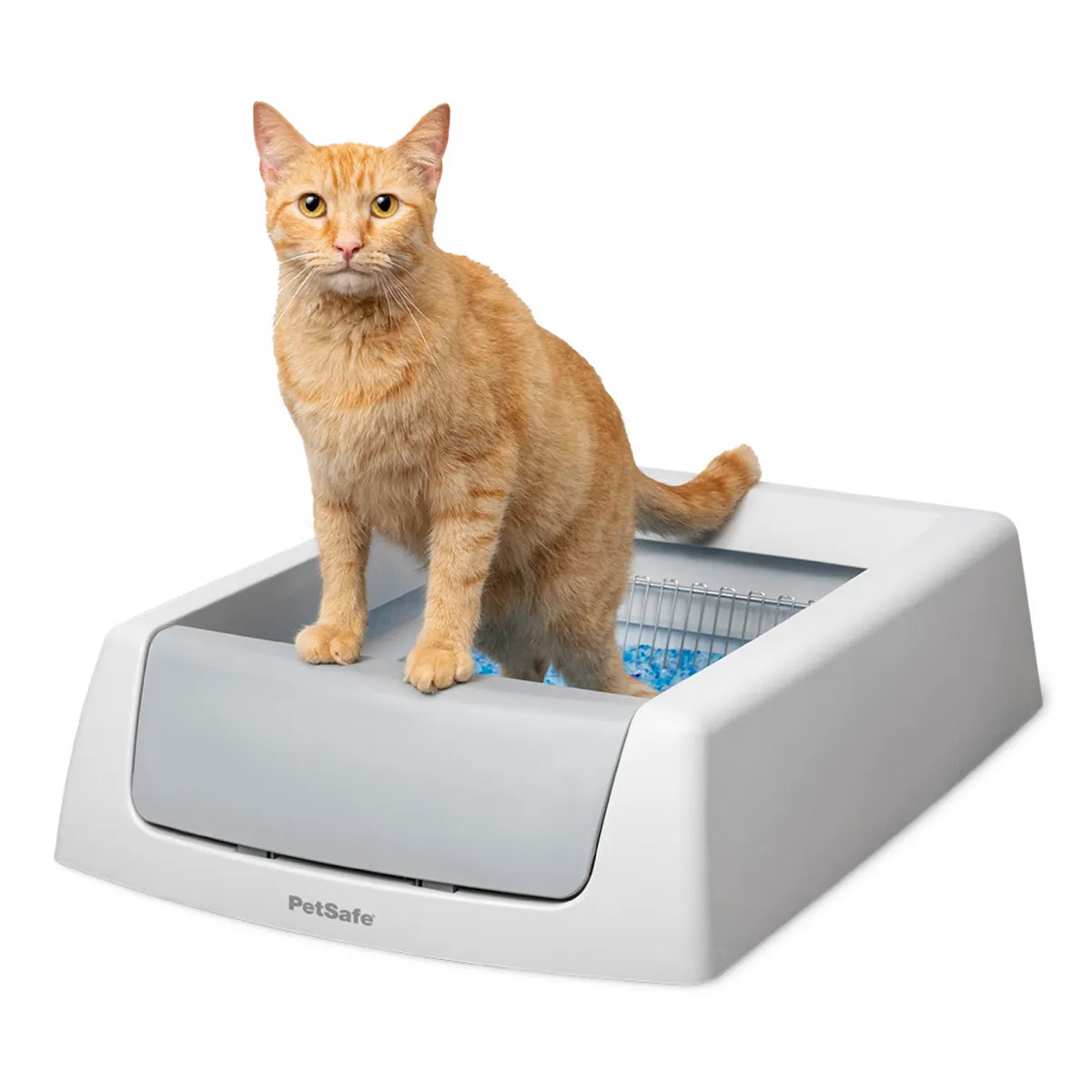
The ScoopFree is a rake-based self-cleaning box. After your cat uses it, a rake drags waste across crystal litter into a covered compartment, and the litter tray itself is a consumable you throw away. PetSafe’s current line runs from the entry Crystal Classic up through app-connected models, and every version shares the same two dependencies.
First, the litter. The product page lists compatible litter as “ScoopFree Crystal Litter,” full stop. No clumping clay, no third-party substitute. Second, the trays. You either buy disposable trays, which the brand says can “go weeks” between changes, or a reusable “forever tray” that you clean yourself.
That consumable model is the quiet part of the sticker price. The page promoting the box is the same page promoting the refill plan: sign up for the litter subscription and save 35% today, then 5% on every shipment. petiqlab mapped the subscription trap landscape last week. ScoopFree is that trap’s physical version: the subscription is not for software features, it’s for the only litter the machine will eat.
How long does a PetSafe ScoopFree last?
Owner reports converge on roughly four years, with the plastic parts going first. From the repair video’s comment section:
The full life of these models is 4 years. I bought mine in June 2021 and in the last three months it’s slowly and completely falling apart. Today I am researching other models to buy replacement… PetSafe no…
That owner (JennyFab, YouTube) is not the outlier. The worst case on record for petiqlab comes from a Trustpilot review of the ScoopFree Sphere ($385), posted May 2026:
After 4 months, the motor breaks! I called and they replaced it… Then, right at the 1 year mark (February) the new unit breaks too! Exact same issue… this time they say the warranty is expired so they can only offer me a discount on a new unit. Want to know how much the discount is?….. $50!!!! They wanted me to buy a new unit for $260 AFTER I already spent almost $400 on a litter box I had for less than 2 years!
Two data points, one timeline: a motor that died at four months and again at twelve, and a warranty that ran out at the twelve-month mark. Compare that to the failure window and the math gets uncomfortable. If four years is the expected life and the expensive parts fail inside year one or two, the warranty is doing less work than the marketing implies.
Why does my ScoopFree keep stopping?
The comment section under the repair video reads like a triage log. The recurring failures:
- The rake stalls. “It keep stopping,” wrote one owner (TheFreedomforce87). Another (martygufler2621) put the real fear in words: “with the possibility of the rake becoming stuck, it is not reliable when you are away from home.” A self-cleaning box you cannot trust to run unattended has lost its reason to exist.
- The lid dislodges. “The lid to the storage compartment kept dislodging,” wrote dianaparedes4268, “You mentioned adding tape to it to stick to the base, I did that! and haven’t had an issue after this.” Her fix worked. Read that again: the fix was tape.
- Pins snap and LEDs die. lancephelps4871: “The pin in the right side of my unit has also broke. Great idea with the duck tape! If you can next time you take it apart to clean it could you get me the number off the led, mine has stopped working.” He is asking the video creator for part numbers because there is no obvious parts channel.
- The unit powers on but does nothing. tammynelson5774 described a missing magnetic strip and a rubber piece: “It has power, but it does not do anything. Also, is wifi required for this to work?”
Beckysmith2632 summed up the whole thread: “This looks like WAY too much adapting/adjusting/fixing! The company should hire you to improve their product!” She also flagged the optional WiFi plug as the thing driving her dog crazy, a complaint odd enough that she was not the only one posting it.
| What owners report | Documented example | What the “fix” is |
|---|---|---|
| Rake stops mid-cycle | “It keep stopping” (YouTube) | Power-cycle, manual reset, lost trust for travel |
| Storage lid dislodges | dianaparedes4268 | Duct tape to the base (owner-confirmed) |
| Plastic pin snaps, LED dies | lancephelps4871 | Asks creator for part numbers; no parts channel |
| Magnetic strip missing | tammynelson5774 | Unit dead with power; owner unsure of cause |
| Motor fails, twice | Hailey Salem, Trustpilot | Warranty replaced once, then $50 off a $260 unit |
| Cat refuses the box | yowgyrl, 3 weeks of no interest | Slow litter transition, or return |
petiqlab’s 5 checks before you buy any automatic box cover the safety side of this category. The ScoopFree adds a reliability question on top: when the mechanism jams, who fixes it? The documented answer is you, with tape.
Is the crystal litter a money pit?
Here is the honest counterpoint, because it exists. Plenty of ScoopFree owners are happy. On PetSafe’s own review feed, Natalie (5 stars) wrote that she loves the trays: “no awful ‘cat smells’ in my home, no sore back… Trays only need to be replaced every 3-4 weeks for one cat and the cost is quite acceptable.” Another owner got a broken part replaced free after one support call. The core experience, odor control and no scooping, is real. petiqlab does not dispute it.
The dispute is about the recurring costs and who controls them. The crystal litter is single-source. The trays are single-source. The subscription discount (35% first order, 5% after) is designed to make the refill automatic, which means the charge runs until you cancel it. And the “go weeks” tray life shrinks fast as cats are added. Run the math for your household before you buy, not after. A machine that needs its own proprietary consumables every few weeks has a second price tag that never appears on the box.
What happens when it breaks after the return window?
The official page advertises a 45-day satisfaction guarantee. 45 days. The documented failures in the comment section and the Trustpilot pool arrive in months 12 through 48, which is precisely the window where the guarantee no longer applies and the warranty, per Hailey Salem’s experience, has already expired. The gap between “45 days to decide” and “4 years to live” is where every ScoopFree complaint in petiqlab’s files sits.
That mismatch is worth a moment, because it is the same shape petiqlab found in the support-ghosting audit: the return window and the warranty define who eats the cost of a product that fails on a schedule. A 45-day guarantee on a four-year appliance only covers buyers whose units fail instantly. Everyone else is past the window by definition.
How do I test a ScoopFree (or any crystal box) before buying?
- Run the refill math. Crystal trays for one cat run roughly every three to four weeks per the brand’s own happy reviewers. Two cats cut that in half. Multiply by 12 and add it to the sticker price before comparing against a plain box.
- Ask what the warranty does at month 13. The documented failure cluster is months 12 to 48. A warranty that ends at month 12 covers none of it. Read the exact wording, as petiqlab did in the support-ghosting audit.
- Cancel the subscription on day one. If you buy, the refill plan saves 35% on the first order and then auto-charges. Decide deliberately, or the litter subscription runs until you remember it exists.
- Test the cat before the box. One owner ran the unit for three weeks with zero cat interest, then spent weeks transitioning litter. Cats reject automatic boxes for documented reasons; petiqlab’s five reasons cats refuse apply here too.
- Check the fine print for kittens. The official page recommends keeping the ScoopFree unplugged and scooping by hand until a kitten is six months old. A self-cleaning box that officially tells you not to let kittens use it is worth noting before a multi-cat household buys one.
What should you buy instead?
If the goal is no scooping without the crystal lock-in and the warranty cliff, petiqlab’s pick is the PETKIT Purobot Max Pro 2 (B0DFYLFFG1). It runs on regular clumping clay, so there is no proprietary litter, no tray subscription, and no refill channel to feed. The warranty runs two years, which covers more of the documented failure window than ScoopFree’s terms did in practice. The honest caveats: at about $499 it costs more upfront, and like every automatic box it needs a transition week while your cat decides it is not a monster. The full price ladder and the budget options are in petiqlab’s smart litter box buying guide.
And if $500 is too much? A $50 open pan with daily scooping is the honest fallback. A machine that needs tape in year three, proprietary litter every month, and a new unit in year four is not saving you money, it is billing you in installments. The ScoopFree’s own owners said it best: the full life of these models is four years, and the warranty stops caring long before the plastic does.
FAQ
How long does a PetSafe ScoopFree litter box last? Owner reports point to a lifespan of about four years, with parts starting to fail around year three. One owner who bought in June 2021 wrote that the unit was “slowly and completely falling apart” and that “the full life of these models is 4 years.” A ScoopFree Sphere owner on Trustpilot had her motor break at four months, got a replacement, and watched it fail again at the one-year mark, two years before she expected the box to be done.
Why does my ScoopFree keep stopping or getting stuck? The documented causes are mechanical: a rake that stalls mid-cycle, a storage lid that dislodges, plastic pins that snap, and a magnetic strip whose absence leaves the unit powered but dead. Owners confirm the fixes are mostly DIY. One taped her lid to the base; another asked the repair video creator for part numbers because no spare-parts channel exists. A stuck or stopped rake is also why some owners refuse to leave the box running while they travel.
Can a ScoopFree use regular cat litter? No. PetSafe’s product page lists the compatible litter as ScoopFree Crystal Litter, and the rake mechanism is built around the crystal system with disposable or reusable trays. The brand pushes a litter subscription on the same page: 35% off the first Autoship order, then 5% off every shipment. Budget for crystal refills from day one, at whatever cadence your cat count demands.
Is the PetSafe ScoopFree worth the price? It depends on whether you accept the trade-offs. Happy owners praise odor control and no scooping, and one five-star reviewer found tray replacements every three to four weeks for a single cat “quite acceptable.” Against that: a documented 4-year lifespan, failure reports in years one through three, a 45-day return window that runs out fast, and one owner offered only a $50 discount toward a $260 replacement when her $385 unit failed a second time. Run the refill and replacement math before you buy.
What should I buy instead of a ScoopFree? For the same no-scooping convenience without the crystal-litter lock-in, petiqlab’s pick is the PETKIT Purobot Max Pro 2 (B0DFYLFFG1): it runs on regular clumping clay, carries a 2-year warranty, and has no proprietary refill requirement. Note the honest caveats: it costs about $500, and some cats need a transition week before they accept any automatic box. If $500 is too much, a plain open pan with daily scooping still beats a machine that quits in year three.
Updated: 2026-09-02. Sources: ScoopFree repair video comment section (YouTube, collected 2026-09-01), PetSafe Trustpilot profile and reviews (petsafe.net and petsafe.com, collected 2026-08-17), ScoopFree product page and litter-box category page (petsafe.com, accessed 2026-09-02), petiqlab September 2026 verification.