Pet Tech Dies When the Company Dies: 3 Checks Before You Buy
The short answer: before you buy any connected pet device, run three checks. Where does the schedule live, on the device or on a company server? What does the machine do the day the app dies, keep working or sit there beeping? And who can fix it after the warranty ends? A device that needs a vendor server to remember breakfast is a device that can miss breakfast the month the vendor stops paying its server bill. The cleanest example is a Chinese brand called Youpei. It folded in 2023. Its litter boxes kept working about as well as you would expect from hardware whose operating system just left the building.
I spent a morning reading what happens to pet tech after its maker disappears. The trail starts on Bilibili, in a video titled with the owner’s own words: I only found out Youpei had gone under because someone told me while I was posting my litter box review. I had no idea the after-sales support was already gone. The video went up June 17, 2023, has 7,412 views and 78 comments, and the comment section is a slow-motion documentation of what brand death does to hardware. One owner wrote in January 2024 that the flap under his box had jammed, support “unlocked” it and left it stuck open, and then:
我的有陪一套也是要疯了……倒闭后app不能用连不上网一天到晚滴滴滴响个不停要疯。实在扛不住准备换了
Translation: my Youpei setup is driving me crazy. The flap jammed and support left it stuck open. After the company shut down, the app stopped connecting and the box beeped nonstop, all day. I cannot take it anymore, I am switching.
Read that closely. The hardware did not fail. The ecosystem died around it. The app was the remote control, the alarm panel, and the reset button all at once, and when the company stopped paying for servers, owners lost all three. A year and a half later, in June 2025, another owner was still asking: 我这个不能自动运行了,怎么修? Mine will not auto-cycle anymore, how do I fix it? The answer, politely, is that nobody is coming.
This is not a China-only story or a cheap-brand story. It is the end state of every feature that lives on someone else’s computer. petiqlab has spent two months documenting the middle stages: the PETLIBRO outage of August 2026 that stopped feeders worldwide for two days, the local-scheduling promise that failed on some models, the subscription walls that lock away your pet’s own data. An outage is a temporary version of what Youpei owners got permanently. The servers do not come back this time.
Check 1: Where does the brain live?
Every connected device has a brain. Sometimes it sits on your shelf, in the device. Sometimes it sits in a data center the company rents. The distinction decides everything.
A device-brain feeder stores its schedule locally. It dispenses at 7:00 because 7:00 is written into its own memory, not because a server told it to. It usually has buttons, so you can feed manually without the app. Give it battery backup and it even survives power cuts. This machine does not care whether its maker is alive, profitable, or reachable by phone.
A server-brain feeder checks in with the mothership before every meal. The app is not a convenience, it is the mechanism. Owners of the PETKIT Fresh Element Solo and similar WiFi feeders learned the smaller version of this during the August outages: notifications died, schedules wobbled, and anything that needed a round trip to the cloud simply waited. The Youpei owners learned the final version: the mothership stopped answering in 2023.
The question to ask the seller is not “does it have an app.” Every device has an app. The question is: if your servers shut down tomorrow, what still works? A straight answer means the brain is on the shelf. A marketing answer means the brain is in their building.
Check 2: What does a dead app actually do to the machine?
Devices die in two ways when the app goes dark. Some degrade into a dumb box. The feeding schedule keeps running, the cycle button still cycles, and you lose remote control and notifications, which hurts less than you think. Others become a half-brick. Their alarms only the app can silence, their settings only the app can reach, their error states only the app can clear. Youpei’s boxes beeped all day because nothing else could tell them to stop. That is not a hardware failure. That is a design where the manufacturer is a moving part.
The same logic applies to data. Health history, eating logs, video clips that live on vendor servers evaporate when the vendor does. Whisker owners already hit this wall while the company is alive: data stopped exporting, old history went behind the subscription, an app update quietly removed features people had paid for. A company that is shutting down is not going to hand you your cat’s weight chart on the way out. If the data matters, it has to live on your phone or your card, not in their cloud.
You can test this at home in a weekend. Switch off your WiFi for 24 hours and write down what stops working. Alerts, remote feed, history, camera access, all expected. The test is whether the core job survives: did the cat get fed, is the box cycling, is the fountain running. Whatever fails the test is the part you are renting from a company, and companies, unlike cats, do not live forever.
Check 3: Who fixes it after the maker is gone?
Youpei’s owners built their own repair economy because the official one vanished. A creator started a community repair group. A paid mini-program appeared to keep dead boxes alive; one owner reviewed it bluntly: 收费的,没什么功能但是贵. It is paid, does almost nothing, and it is expensive. That is what after-sales support looks like after bankruptcy, volunteers and tinkerers.
The professional view is even more honest. A Chinese repair technician who works on these machines for a living told his viewers what a ¥1,000 automatic litter box (about $140) actually contains:
就这么一个塑料壳子,一个减速电机加几个电子元件要卖千元?
Translation: it is a plastic shell, a geared motor, and a few electronic components, and they want ¥1,000 for it?
His most common diagnosis, in a reply he posted as recently as September 1, 2026, is water ingress: a drum dried carelessly after cleaning, or cat urine seeping in, and a resistor on the circuit board burns out. His complaint to the industry is not about the parts. It is the logistics: 运费+维修费太贵了. Shipping plus repair fees cost more than the machine is worth, and he urges brands to offer on-site repair because nobody does.
Repairability splits owners into two camps, visible in the same comment section. One owner bought a dead Youpei box for ¥50 (about $7), wired in two off-the-shelf WiFi switches, and later reported finishing the job with a four-channel forward-reverse controller that cost more than the broken box itself. Another owner replied: 太难了学不会. Too hard, I cannot learn that. Between those two comments sits the whole repair divide. For one person, the box is a hobby project with a $7 entry fee. For the other, it is landfill the day it breaks.
The parts question matters even while the company is healthy. Even a live brand ships flaws and moves on. Two owners of CATLINK’s newer half-open box, commenting in October and November 2025, independently reported the same defect: the splash guard falls off easily, 属于设计缺陷, a design flaw, and nobody at the company seems to be in a hurry. petiqlab’s spare-parts audit found the same pattern across brands: the second bill, for parts, consumables, and discontinued support, is where the money actually goes. Ask three things about any machine: are the wear parts generic, is the board sealed or serviceable, and does a teardown community exist? Sealed and proprietary means the company’s lifetime is your device’s lifetime.
The machines that survive their maker
The devices that pass all three checks share one trait: their core job does not depend on a company server. petiqlab has recommended these four across several guides, and nothing in the Youpei story changes the verdict. It confirms it.
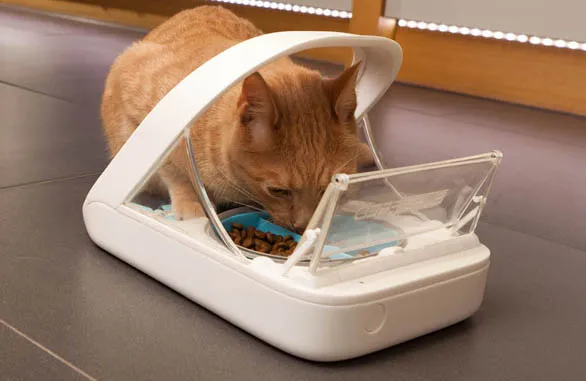
SureFeed microchip feeder (B00O0UIPTY on Amazon) has no network stack at all. No app, no WiFi, no cloud, no account to revoke. The lid opens for a registered cat’s implanted microchip and closes again. There is literally nothing for a bankrupt company to switch off, which is why petiqlab’s microchip feeder guide and the cloud-free buying guide both put it first. Buy the offline version, not the Connect model with the hub, for the same reason petiqlab warned in the parts audit.
PetSafe Smart Feed (B07NR47N2Q on Amazon, about $120) stores its schedule on the device, feeds with a manual button, and runs on backup batteries. PetSafe has been selling pet gear since the 1950s under Radio Systems Corporation, but the architecture matters more than the age: this feeder would keep feeding even if the company vanished overnight, because breakfast never leaves the building.
TP-Link Tapo C210 (B095CLQ1PT on Amazon, about $35-40) records to a local microSD card. No cloud plan, no subscription, and the recordings live in your hand. TP-Link is one of the largest networking companies on earth, which is a nice bonus, but again the architecture is the argument: an SD card does not need a server.
PETKIT Eversweet 3 Pro (B09QRH6L3M on Amazon) is a fountain whose wireless pump runs as a plain appliance. The app adds modes and reminders; the water flows without it. And when the pump finally wears out, the replacement (B0B2DM5Q7N, about $16) is a spare part you can buy, not a warranty claim you have to win. That is Check 3 working as intended.
| Device | Where the brain lives | If the maker vanished tomorrow | One-time cost |
|---|---|---|---|
| SureFeed microchip feeder | Implanted microchip, no network at all | Keeps opening for the right cat, forever | No subscription |
| PetSafe Smart Feed | On-device schedule, buttons, batteries | Keeps feeding on schedule | About $120 |
| TP-Link Tapo C210 | Local microSD card | Keeps recording locally | About $35-40 |
| PETKIT Eversweet 3 Pro | Wireless pump, app optional | Keeps pumping water | Replaceable $16 pump |
None of these is immortal. Apps get discontinued by healthy companies too, and petiqlab’s support-ghosting investigation shows how thin real after-sales can be even when the brand answers the phone. The point of the three checks is not to find a company that will never die. It is to buy machines that do not need the company to be alive. Youpei’s owners learned the difference the hard way, with a box that beeped and no app left to silence it. The cat, for what it is worth, never cared about the app. It cared about the bowl.
FAQ
What happens to my smart pet device if the company goes out of business? It depends on where the functions live. A device that stores its schedule locally and has physical buttons keeps doing basic work: it feeds or cycles on its own. Everything that lived on company servers dies with them, remote control, activity history, AI alerts, app-only settings. Some devices misbehave instead of degrading gracefully. Owners of Youpei litter boxes, a Chinese brand that folded in 2023, described boxes that beeped around the clock after the app stopped connecting, with no support left to ask. Ask before buying: if the servers shut down tomorrow, what still works?
Will my automatic feeder still feed the cat without the app? Only if the schedule is stored on the device. The PetSafe Smart Feed keeps its schedule on-board, has a manual feed button, and runs on backup batteries, so it feeds through power cuts, internet outages, and app problems. The PETLIBRO outage of August 2026 showed the opposite: feeders around the world stopped dispensing because the server that authorized meals was down, and the brand’s local-scheduling promise did not hold on every model. SureFeed goes one step further, no app, no WiFi, no account at all. The question to ask the seller is not how good the app is. It is whether the device needs the app to do its job.
How much does it cost to repair an automatic litter box? Often more than the box is worth, which is the problem. A Chinese repair technician who fixes these machines for a living summarized a typical ¥1,000 (about $140) box as a plastic shell, a geared motor, and a few electronic components. His most common diagnosis is water ingress, a drum dried carelessly or cat urine seeping in, and a burned resistor on the circuit board. Owners pay shipping both ways plus labor, and he urges brands to offer on-site repair because the fees usually exceed the residual value. One owner revived a dead Youpei box for ¥50 (about $7) with off-the-shelf WiFi switches. Another watched the same video and wrote: too hard, I cannot learn that.
Which pet devices keep working if the maker disappears tomorrow? The ones whose core job does not depend on a company server. SureFeed microchip feeder (B00O0UIPTY) has no network stack at all, no app, no cloud, no account to revoke. PetSafe Smart Feed (B07NR47N2Q) stores its schedule on the device with battery backup and a manual feed button. TP-Link Tapo C210 (B095CLQ1PT) records to a local microSD card with no subscription. PETKIT Eversweet 3 Pro (B09QRH6L3M) is a fountain whose wireless pump runs without the app, and the replacement pump is sold separately. None of them promises immortality. Their architecture just means a shutdown removes convenience, not the core function.
What should I check before buying smart pet gear? Three checks, in order. One, where does the brain live: is the schedule or cycle stored on the device, with buttons and battery backup, or does a server authorize every action? Two, what does a dead app look like: does the device degrade into a dumb box that still works, or a half-brick that beeps and waits? Three, who fixes it in year three: are parts generic, is there a teardown community, or is the board sealed and unspareable? petiqlab’s one-week test: buy it, then switch off your WiFi for 24 hours and list what stops. Whatever stops is what you are renting from the company.
Updated: 2026-09-08. Sources: Bilibili video BV1wN411r7vZ (Youpei owner’s video titled with her own words on the brand’s collapse, June 17, 2023, 7,412 views; comment from January 9, 2024 describing the beeping box and stuck flap; comment from June 26, 2025 asking how to fix an auto-cycle failure; comment from November 18, 2024 on the paid third-party mini-program, translated by petiqlab), r/cats post 1vn1r4k (owner replacing a Petlibro Dockstream after the August 2026 outages, asking for a fountain that does not depend on vendor servers, August 13, 2026), Bilibili video BV1aw4m1v7vJ (repair technician 柏闻乐见 on ¥1,000 litter box construction costs and the missing on-site repair service; comment of October 4, 2024; technician reply of September 1, 2026 on water-ingress board failures, translated by petiqlab), Bilibili video BV1xu4y157nc (owner repairing a dead Youpei box for ¥50 with WiFi switches, November-December 2023, translated by petiqlab), Bilibili video BV1srpyzkEM9 (two CATLINK half-open box owners reporting the splash guard defect, October-November 2025, translated by petiqlab), and the petiqlab articles linked above. Hero image: official Sure Petcare product-page photo of a ginger cat eating from the SureFeed microchip pet feeder (surepetcare.com, master product image). Chinese comments translated by petiqlab.