Litter-Robot Still Smells After a Deep Clean: 5 Reservoirs
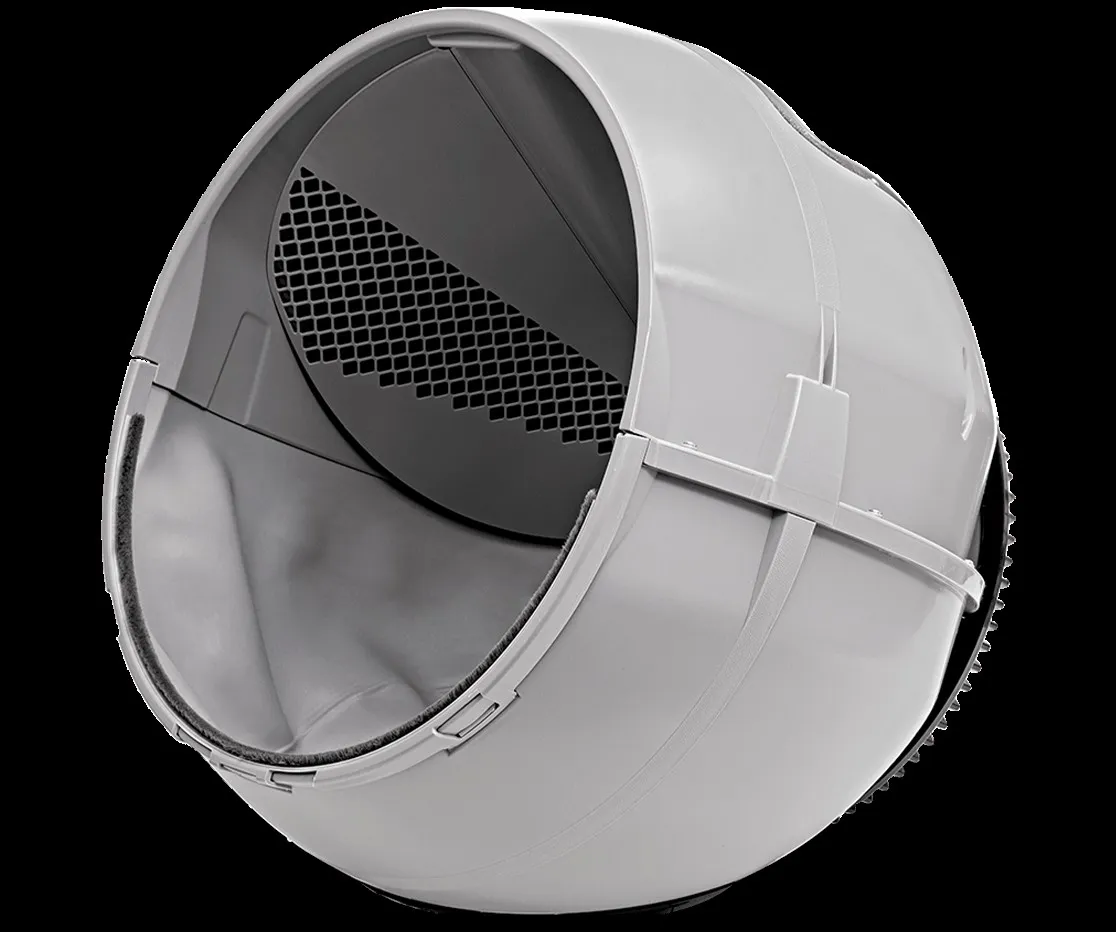
The short answer: the smell is usually not in the litter, and washing the globe does not reach it. Whisker’s own care guide asks for a basic globe cleaning every 1 to 3 months and a deep clean at least every 3 months, says the carbon filter above the waste drawer lasts about a month, and warns that the seal strips have to stay dry or they peel. Owners who do all of that still report a smell that returns within days, and their threads point at four places the manual never asks you to open: the frame under the globe, the felt seal strips, a liner that is 3 to 4 years old, and urine pooled behind the cables in the base.
I read the sixty-six comments under a thread titled Litter Robot Smells Terrible on a Sunday, then the newer thread from an owner whose machine was one month old and who was already deep cleaning every week and a half. Her line stuck: she felt she should not have to replace expensive parts on an already expensive machine that early. Whisker’s care guide was open in the next tab, and the two documents were describing the same object with different priorities.
petiqlab earns a commission from the Amazon links on this page. Everything below comes from Whisker’s support articles and parts pages read on October 19, 2026, a Purina odor interview published on July 31, 2026, and owner posts held in this site’s material library, and every quote is the maker’s or the owner’s own. Prices are list prices on that date. petiqlab has not run a laboratory odor test on any of these machines.
What Does Whisker’s Cleaning Guide Actually Schedule?
Most of the smell problem is intervals. Three maintenance intervals are printed on Whisker’s support site, and they are not the same interval.
The use and care guide asks for a basic globe cleaning every 1 to 3 months and a deep cleaning at least every 3 months, with more frequent work for multi-cat homes. The deep cleaning guide says the globe can be soaked and hosed because “there are no electronic components in the globe that can be damaged by soap and water.” It then rules out the strongest cleaner most people reach for: “Do not use bleach or cleaning products that contain bleach inside the globe as this may cause irritating fumes.”
That warning is not fussiness. Urine gives off ammonia, ammonia and bleach make chloramine gas, and the instruction sits in a page that otherwise invites you to hose the part down in the yard.
The same page covers two parts owners rarely think about. The carbon filter “should last approximately 1 month” under normal use, and “the charcoal filter is not necessary for the operation of the device.” The brush seal strips “help contain odors in the waste drawer,” they get replaced when they are “worn flat or peeling,” and cleaning them wet makes them peel: “Be careful not to get them wet when cleaning the base or they may start to peel off.”
Read those three sentences together. The machine’s odour control is a $12 pad you replace monthly, a set of felt strips that wear, and a globe you are told to deep clean every 3 months. Two of those are consumables and the third is a quarterly chore on a device that cycles several times a day.
Which of the Five Litter-Robot 4 Reservoirs Is Yours?
| Where the smell sits | What owners found | Test that costs nothing | Fix and list price |
|---|---|---|---|
| The frame under the globe | Urine pooling in the frame, described as a flaw on both the 4 and the 5 | Lift the globe out, look at the base pocket and the gear track | Dismantle and wash, no part needed |
| Behind the motor cover and cables | “Pee on the inside walls and some pooled behind the cables” | Take the motor cover off and smell inside | Clean and dry, no part needed |
| The felt seal strips | Strips hold odour and stop sealing once flattened | Run a finger along the strips at the top and bottom of the base | New strips, or 1/4 inch weather stripping as an owner substitute |
| The carbon filter | Damp or month-old pad sitting above the drawer | Lift it out and smell the pad itself | 2-pack lists at $12 |
| The liner and the plastic | Liner holds urine smell at 3 to 4 years; plastic absorbs ammonia | Check liner age, then smell the bare liner after a wash | Globe liner lists at $70, free once under warranty |
Where Does Urine Pool Under the Litter-Robot 4 Globe?
The single most useful comment in the Litter Robot Smells Terrible thread came from an owner who had already given up. “Take it apart and look in the frame,” they wrote. “Likely urine pooling in there. The litter robot 4 and 5 both seem to have a major flaw there. I had to give up on it.”
A second owner went further into the machine and named the materials. The felt strips and the base plastics “can really hold odor,” they wrote, and they found urine and litter inside the base. Their instruction is the one I would follow first: “Take the motor cover off and see if there’s urine in there.” They also found pee “on the inside walls and some pooled behind the cables.”
There is a third route into the same space, and it depends on the cat rather than the machine. One owner posted under the title Cat pee found in shell of LR4, describing urine that ran through the gap between globe and base and left what they called a sewer smell. The reply that helped pointed at a physical cause: a large cat that does not get all the way in before urinating sends the stream down that gap, and the lip on the gate largely stops it.
None of this shows up during a globe wash, because the globe is not where the liquid went. It also explains a pattern that looks like a cleaning failure and is not one: the machine smells, you scrub the drum, the smell drops for two days and returns, because the reservoir was never in the drum.
66 comments sit under a thread titled Litter Robot Smells Terrible on a Sunday, and the replies name four places a globe wash never reaches. One owner wrote that urine pools in the frame under the globe and called the flaw shared by the Litter-Robot 4 and the 5. A second found pee on the inside walls of the motor cover, plus urine pooled behind the cables, and named the felt strips and base plastics as materials holding odour. A third posted under Cat pee found in shell of LR4, describing urine running through the gap between globe and base and leaving a sewer smell, traced to a large cat urinating before settling in. A fourth reported trapped water rusting the weight sensor and needing a liner replacement as the only fix. Owners checking liner age report the rubber holding urine smell at 3 to 4 years, with a new $70 liner ending the smell.
Water sitting in the wrong place does a second kind of damage. In a thread about the weight reading failing, an owner wrote that a liner replacement was the only fix, after taking it apart and cleaning it: “Water was getting trapped but it was too late and the weight had rusted.”
Do Strips, Filters and Bags Do Most of the Odour Work?
Three cheap parts carry the smell control that the machine’s marketing implies comes from the design.
On the seal strips, one commenter’s workaround has circulated for months: the “fuzzy sealing strips get smelly eventually and can be replaced with 1/4" weather stripping.” A second owner confirmed the sourcing, a roll from a hardware store or Amazon, cut to length. It is not a manufacturer part and it is not a recommendation to modify a machine under warranty, but it explains the mechanism: the strips are felt, felt holds what it touches, and a flattened strip stops sealing the drawer.
On the filter, the advice is simpler and matches the manual. A commenter told the original poster to “swap the carbon filter if it’s old or damp,” and to check the places a deep clean misses: “Check high-aim spots: back wall, behind the liner, under seals/gaskets.” They added that enzymatic cleaner on the plastics beats bleach, which lines up with Whisker’s own warning about bleach fumes.
On the drawer itself, two owners describe the same workaround from different directions. One lines the waste drawer with a disposable aluminium pan “so the dirty litter is not sitting in the bag on the plastic,” and another places a 9 by 13 inch pan under the bag for the same reason. That is a smell decision rather than a cleaning one: it puts a barrier between wet waste and the drawer floor.
The design question underneath all three is air. “It kinda smells even more than regular litterbox because the thrash part is not air tight,” one owner wrote in a thread about budget boxes. Another pointed at the cycle itself: the bag compartment stays open during the entire cleaning process, so “all those splendid smells get released into the room” for the length of every cycle. The machine has to open to work, which is why the strip and the filter are load-bearing parts.
When Is the Plastic the Source, and When Can Washing Not Win?
The newest evidence in this site’s material library, from an owner thread on October 16, 2026, states the material problem plainly: “When used litter sat in the plastic for months, ammonia soaks into the plastic itself.” Their fix is hot soapy water on everything, with an enzyme cleaner for pet urine.
Two independent sources support the idea that the drum’s surface is a wear item rather than a permanent one. On liner age, an owner with two machines wrote: “How old is the liner? At 3-4 years old it starts to hold the pee smell. My two did this so I ordered a new liner and installed it. The smell is gone.” On materials generally, Nathan Huck, a Director of Innovation at Purina with two decades on cat litter, told his company’s newsroom in July 2026 that “odor-causing bacteria embed in the box walls over time, defeating even the most effective litter formula,” and recommended replacing the litter and washing the box entirely at least monthly.
The same problem shows up in a different plastic on a different machine. A PETKIT Pura Max 2 owner who paid $742 wrote in September 2026 that the “fabric base absorbs and leaks urine, creating an unbearable ammonia odor that cannot be wiped away with a simple towel.” That model carries a warning on this site rather than a recommendation, and the value of the report here is the mechanism, not the brand.
The other end of the spectrum is the owner who did everything and still lost. “Literally had to take the automatic box apart every week or 2, take it outside, and deep clean it. It still smelled AWFUL,” they wrote, before adding the sentence that matters: “Swapped to a stainless steel and haven’t had an issue since.”
Balance, because the record has one. An owner with three cats and the same liner for four years reports “no issues with smells,” and another with 18 months on an LR4 says it is “almost no smell.” A third reads those accounts and says they suspect bots. The honest summary is that the outcome varies with the cat, the litter and the humidity, and the machine’s design gives all three room to matter.
Age adds a failure shape nobody plans for. A Trustpilot reviewer wrote in April 2026 that their Litter-Robot 4 had “a massive hole in the rubber globe section, causing smells to escape after a year,” and that parts ordered on the 3rd of the month were still processing on the 23rd. A hole in the liner is not a cleaning problem, and no amount of enzyme cleaner closes it.
What Does the Parts Counter Say About the Real Fix?
Whisker’s replacement parts page lists the pieces this article keeps naming, and one sentence on it changes the maths for anyone inside warranty: “If your robot is under warranty, you may be eligible for a free one-time replacement of the globe liner, seal strips, motor, laser board, bonnet, or power supply.”
Outside warranty the parts are priced like appliance parts. The globe liner is $70, the carbon filters are $12 for a 2-pack, and the parts list also carries the globe, the septum, the base, the drawer and the seal strips. Twelve filters a year costs more than the liner, and the filter is the part the manual calls optional for operation.
Warranty changes the arithmetic on a Litter-Robot 4: Whisker offers a free one-time replacement of the globe liner, seal strips, motor, laser board, bonnet or power supply while the robot is covered, and the same parts page prices the two odour parts at $12 for a carbon filter 2-pack and $70 for a globe liner outside that cover. Whisker’s use and care guide puts the carbon filter at approximately one month of normal use, and calls the charcoal filter unnecessary for the device to operate. Twelve filters a year costs more than one liner at list price. The liner wears out at 3 to 4 years, when owners report the rubber starts holding urine smell. The parts list also carries the globe, the septum, the base, the waste drawer and the seal strips as separately priced appliance parts. A new Litter-Robot 4 listed at $699 on Whisker’s product page on October 19, 2026, scored 4.5 across 14,096 reviews, with 816 one-star ratings.
That is the trap in the maintenance schedule. The cheap part recurs every month and the expensive part fails quietly over years, so a household that keeps replacing filters spends more than the household that replaces a liner once.
What Is the Five-Step Smell Audit, in Cost Order?
- Filter first. Lift the carbon filter out from under the globe and smell the pad itself, not the room. Damp or older than a month means replace it.
- Strips second. Run a finger along the brush strips at the top and bottom of the base. Flat, wet or peeling strips leak the drawer’s air into the room, and Whisker says wet cleaning is what makes them peel.
- Frame third. Unplug the machine, lift the globe off the base and look into the rear bearing pocket and along the gear track. Urine in the frame means the globe wash cannot help.
- Motor cover fourth. With the machine off, remove the motor cover and look and smell inside. Pooled urine behind the cables is the finding owners describe most often and the one the manual never mentions.
- Liner last. If the liner is 3 years old or older and the first four steps were clean, price the $70 part against another year of enzyme cleaner and filters.
The order matters because it goes from $12 to free to $70. Three of the five steps cost nothing but time, and the two that cost money are cheap next to the $699 list price of a new Litter-Robot 4 on Whisker’s product page, which showed 4.5 across 14,096 reviews on October 19, 2026, with 816 of them at one star.
If the Smell Is Why You Are Shopping for a Different Box, What Then?
The boring answer comes first, and it comes from the owners who left. A stainless steel pan, filled 3 to 4 inches deep, scooped daily, washed monthly, holds no ammonia and has no filter to forget. Purina’s own guidance points the same way on litter depth and on washing the box completely every month. It costs a fraction of any robot and it is not something this site sells, which is why it sits at the top of this section.
For anyone who wants to keep automation, the one box this site recommends in this category is the PETKIT Purobot Max Pro 2 at $499.99, on the reasons already on record here: a 2-year warranty, clumping clay that is not brand-locked, and a drawer that owners say can be sealed before it is pulled out. Its product page carries the same 2-year badge. Three things belong in the same paragraph. A Singapore owner in this site’s material library reports “bad smells despite regular cleaning and frequent bag change (every 4-5 days)” on this model, which is why no drawer-based box gets sold as odour-free here. The AI camera’s replay is a limited trial rather than an included feature. And cats need an adjustment period before they will use a drum at all, a caution already attached to this recommendation in earlier articles.
For current Litter-Robot owners, the honest recommendation is not a new machine. It is a $12 filter, a look inside the frame, and a liner when the plastic has had enough. If you are still inside the warranty window, the free one-time part replacement is worth using before it closes, and this site’s earlier piece on the two-year cost has the full parts arithmetic. The blue light and the empty-drawer loop have their own guide in the light code checks, and cats that urinate high have a different problem with a different fix in the urine leak checks. The broader pattern, where the part that fails is the part nobody sells separately, is covered in the spare parts audit.
One number to close on. Whisker’s Trustpilot profile read 3.3 across 614 reviews on October 19, 2026, with 96 percent of negative reviews answered within a week, the highest reply rate of the six brands this site tracks. PETKIT’s profile read 3.7 across 345 reviews with 84 percent answered inside a week. Answering a complaint is not the same as fixing a smell, and the six thousand comments in these threads are what a reply rate does not measure.
FAQ
Why does my Litter-Robot smell again days after a deep clean?
Because the globe is one of five places urine collects. Whisker’s guide covers the globe, the drawer, the filter and the base surfaces, and its own text says the filter lasts about a month and the strips must stay dry. Owners who take the machine apart find urine in the frame under the globe, in the motor cover and behind the cables, and a wash that stops at the globe leaves all of that in place.
Can I use bleach in the globe?
Whisker says no. Its deep cleaning guide states that bleach and products containing bleach should not be used inside the globe because they may cause irritating fumes. Urine releases ammonia, and ammonia with bleach produces chloramine gas. The globe has no electronics that soap and water can hurt, so hot water, mild soap or an enzyme cleaner covers the same job.
How often should the carbon filter be replaced?
About monthly, per Whisker’s use and care guide, which also says the charcoal filter is not required for the machine to run. The 2-pack lists at $12 and sits directly above the waste drawer. A damp filter is one of the first parts owners are told to swap when cleaning has not worked.
Do I need a new globe liner?
Sometimes. Owners report that at 3 to 4 years the liner starts holding urine smell, and that replacement ended it. The part lists at $70, free once if the robot is under warranty, and a new liner also fixes the weight errors caused by a stretched liner.
Is stainless steel better for smell?
Owners who switched say yes, including one who deep cleaned an automatic box weekly and still found it smelled awful before moving to stainless steel. The cost is the labour the robot was meant to remove: daily scooping and a monthly wash.
What if the smell returns within a week?
That points at a reservoir a wash does not reach. Replace the $12 filter, check the strips, look inside the frame and around the motor cover, then check liner age. Urine pooling in the frame needs dismantling, not another globe wash.
Updated: October 19, 2026. Prices and terms as of that date. Sources: Whisker’s use and care guide (basic globe cleaning every 1 to 3 months, deep cleaning at least every 3 months, the carbon filter at approximately one month and “not necessary for the operation of the device,” the seal strips that “help contain odors in the waste drawer” and peel if cleaned wet), its deep cleaning guide (no electronic components in the globe, hose and soak allowed, “do not use bleach or cleaning products that contain bleach inside the globe”), its replacement parts page (free one-time replacement of the globe liner, seal strips, motor, laser board, bonnet or power supply under warranty), the globe liner page at $70, the carbon filter page at $12 for a 2-pack, and the Litter-Robot 4 page ($699, 4.5 across 14,096 reviews with 816 one-star on October 19, 2026); Purina’s odor interview with Nathan Huck on July 31, 2026 (ammonia as the primary odor driver, “odor-causing bacteria embed in the box walls over time,” replacing litter and washing the box monthly, 3 to 4 inch depth, one box per cat plus one); PETKIT’s Purobot Max Pro 2 page at $499.99 with the 2-year warranty badge; Trustpilot profiles read on October 19, 2026 (litter-robot.com 3.3 across 614 reviews with 96 percent of negative reviews answered within a week, petkit.com 3.7 across 345 with 84 percent answered within a week) and the April 2026 review 69e9d462f036a44d91955c20 on a hole in the rubber globe section. Owner accounts: the r/litterrobot thread 1w7m3ux on urine pooling in the frame, felt strips holding odor and urine behind the cables, the r/litterrobot thread 1wu0ije on a one-month-old machine and the weather stripping and aluminium pan workarounds, 1x7bhyu on ammonia soaking into plastic, 1wt9buz on urine found in the shell between globe and base, 1wu6p2u on the trapped water and rusted weight, 1wbnwoi on the weekly deep clean that did not work before a stainless steel swap, and the r/PETKIT thread 1w4fith on smell in a humid climate despite cleaning. Quotes are as owners and makers published them. Availability, prices and part policy change, so verify before you buy.