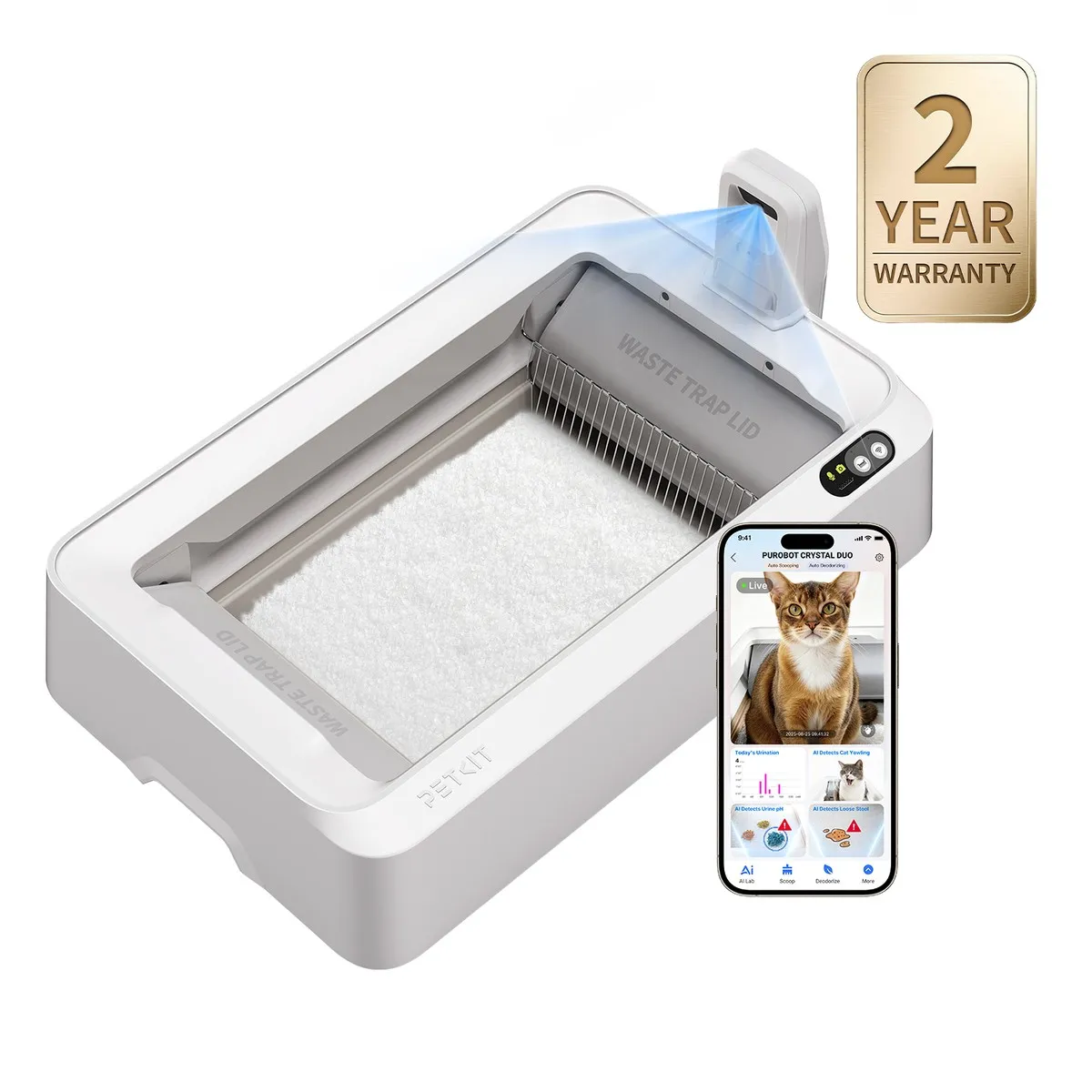
PETKIT's $199 Litter Box Costs $243 a Year in Trays
The short answer: PETKIT’s Purobot Crystal Duo sells for $199.99, and the box accepts only PETKIT’s own crystal litter trays, sold at $79.99 for four. At PETKIT’s stated 30 days per tray that is $243.40 a year for one cat; at the two weeks a Malaysian owner measured, it is $520.00 a year. The same store sells a $35.99 refill ring for the $799.99 Purobot Ultra, and one owner’s ring ran empty 12 days before the replacement shipped. PETKIT’s public reply to that was a promise to look at earlier warnings and faster shipping. The pricing model, not the hardware, decides what these boxes cost after year one.
I opened the Crystal Duo page on a Thursday evening with one question. What does this box cost? The number at the top says $199.99, down from $299.99, which reads like the end of the story. It is the beginning of it. The recurring price sits a page away, on a litter refill listing most buyers never open before checkout.
petiqlab earns a commission from the Amazon links on this page. Everything below was read on 7 November 2026 from PETKIT’s own store pages, plus owner posts held in this site’s material library. Prices are the prices shown that day. petiqlab has not run a Crystal Duo in a house with cats, and nothing here is veterinary advice.
What does the $199.99 Purobot Crystal Duo actually sell you?
A rake-style box with an open top and a camera, plus one disposable tray. Model P9905 measures 32.20 by 19.96 by 13.14 inches, weighs 12.45 pounds (5.65 kg), and sets the entrance at 7.08 inches (180 mm), which is low enough for an older cat to step into without a ramp. Four sensors stop the rake when a cat enters. PETKIT rates the box for cats above 3.3 pounds (1.5 kg), keeps kittens under six months out unless Kitten Protection is on, and shows 31 reviews on the product page.
The camera records clips to PETKIT’s cloud, and playback sits behind an optional subscription, which the store’s own comparison image states. The health features, loose stool alerts and yowling alerts, ship as part of the box.
Then the compatibility answer, which is where the money question starts. PETKIT’s FAQ asks whether other litter works with the Crystal Duo and answers: “No. Purobot Crystal Duo is only compatible with the PETKIT Crystal Litter Set (including crystal cat litter and litter tray).” Every other PETKIT box in that comparison table lists a clay size instead, 12 mm maximum length and 3 mm maximum diameter. One FAQ answer decides where the litter comes from.
The tray is not a liner. It arrives loaded with crystal litter and a trash bag, and the whole thing goes in the bin when the box calls it spent.
How much does a year of PETKIT trays cost?
The tray price is printed on a page most owners see only after the first tray runs out. PETKIT sells four trays for $79.99, which is $20.00 each, or $19.00 on the subscription price of $75.99. The product page promises up to 30 days of clean litter in the body text and up to 45 days in a footnote under the tray photograph. Two numbers, one page, no reconciliation.
Twelve trays a year at 30 days each come to $243.40, and 26 trays at 14 days each, the interval a Malaysian owner reported on 6 November 2026, come to $520.00. PETKIT sells the Purobot Crystal Duo at $199.99 against a $299.99 list price, so the first year of trays exceeds the machine by $43.41 and every year after that is pure supply cost. A two-cat household can halve the tray life, which doubles those totals. The subscription price of $75.99 lowers the yearly bill to about $231.00 and changes nothing about single-source supply. The Refill Ring on the Purobot Ultra looks cheap by comparison at about $21.90 a year for one cat, which is why the ring problem is availability rather than price.
Why did a refill ring run out before the replacement arrived?
The same supply logic runs through the $799.99 Purobot Ultra, which packs waste into a sealed bag using a refill ring. A ring pack of three costs $35.99, or $32.39 on subscription. PETKIT states that one ring packs about 10 times and that the bin holds one cat’s waste for up to 20 days. Ten packs of 20 days is roughly 200 days, so the ring is the cheapest consumable in the line at about $12.00 each.
Cheap and available are different things. On 5 November 2026 an owner in r/PETKIT described ordering a replacement when the app showed the low-bag warning, then getting a notice that the refill would not arrive until 17 November. The ring emptied first. The post reads: “the ring is empty today and now it doesn’t work and is stuck on the ‘refill ring empty’ or ‘trash bag broken’ error message just on a continuous loop.” The support reply, as the owner quotes it, was “Sorry sir nothing we can do, thanks for understanding”.
PETKIT answered publicly the next day, on 6 November: “we will explore options for earlier low-refill signs and faster shipping for refill orders.” That sentence admits the shape of the fault. A warning that fires a few days before an empty ring is useless when the refill takes two weeks to arrive. The fix that matters is either earlier warnings or faster stock, and the owner waiting on 17 November gets neither.
The newer AutoSeal disposal bin carries the same design with different numbers. The ring pack of two costs $29.99, PETKIT rates one ring at up to five months for one cat, and the bin launches at $109.99 with a shipping date of 13 November. The AutoSeal FAQ also warns that other brands’ bags may not seal and may damage the sealing module, which closes the door on a grocery-store substitute.
What happens in a country where the trays are not on the shelf?
The Crystal Duo turns this into a hard stop. Each tray carries a barcode, and the box reads that barcode to decide when the tray is spent. On 6 November 2026 an owner eight months into Crystal Duo ownership in Malaysia described the loop. After roughly 30 to 40 days the box beeps and throws a warning on every cleaning cycle. That owner’s measured tray life was “at best 2 weeks” against PETKIT’s advertised 30 days.
The supply side is worse than the life figure. Malaysia had no refills for months, the single local distributor was out of stock, and PETKIT support, in the owner’s account, suggested importing the refills from China personally. A box that will not run without a coded cartridge, a cartridge that only one company makes, and a distributor with empty shelves add up to a large object that stops working on a schedule nobody at the buyer’s end controls.
The owner’s own summary is the cleanest sentence in the thread: “A device that depends on proprietary disposable consumables is only as good as the supply of those consumables.”
Which brand lets you buy the part instead of the tray?
Whisker runs the opposite model on the Litter-Robot 4: an expensive machine with cheap, separately sold parts.
Whisker’s own parts article lists 19 orderable items for the Litter-Robot 4, including a Motor Assembly, Laser Board, Cat Presence Sensor, Power Supply, Backup Battery, Globe Liner, Seal Strips Pack, Carbon Filters, Bonnet, Septum and Waste Drawer, and the warranty text offers one free replacement of the globe liner, seal strips, motor, laser board, bonnet or power supply while the unit is covered. The globe liner page prices that part at $70, and the carbon filter page starts at $12 for a two-pack. One owner on r/litterrobot replaced a motor out of warranty with four screws and a connector, and the part arrived the next day. A second owner ordered a seal strip pack, a tray sensor and a rubber liner, each as a separate item, and reported one to two weeks for delivery.
That model is not free of failure. The Litter-Robot 4 has its own wear pattern, including sensors that drift after a few years and full-drawer warnings that fire on an empty drawer, which this site covered in its two-cost breakdown of year one and year two. The difference is what happens after a failure. A part number exists, a price is printed, and the buyer can decide whether to repair.
If you own $1,000 of PETLIBRO gear, can you buy one bowl?
Sometimes the shortage is not a cartridge. A PETLIBRO customer who had spent around £1,000 on the brand wanted to swap a double bowl for a single bowl on a Granary camera feeder. The owner looked in the store, could not find the part, and wrote to support three times. Each reply promised that the relevant team would be in touch. The owner’s description of those replies, posted to Trustpilot on 4 November 2026, is “some AI slop response”. The bowl never appeared.
That story sits inside a wider support problem this site has documented across refund and ghosting routes, including warranty claims that need a public review before a human replies. Balance matters here, and there is some. A multi-device owner posting on 5 November 2026 said the hardware had been fine, with a fountain, a dual dry feeder and two Polar feeders running, while support had been “super delayed in the last month”. Hardware and service fail separately, and the supply chain is a third thing.
Which litter box avoids the consumable trap?
Buy the model that eats ordinary clumping clay. PETKIT’s own comparison table gives a 12 mm by 3 mm clay specification for the Purobot Max 3 at $399.99 and the Purobot Max Pro 2 at $499.99, and neither model takes a disposable tray or a packing ring. The Max Pro 2 carries 12 sensors, a two-year warranty and a waste drawer instead of a sealed bag ring, which is why it stays this site’s pick in the PETKIT line.
Two disclosures belong in the same breath. The camera version of the Max Pro 2 keeps recorded video for a 30 day trial and then drops to live view, so the camera is not the reason to buy. And any drum or rake box can lose a cat’s trust in the first week, which is why the adaptation period and litter compatibility notes matter more than the spec sheet.
The Max Pro 2 is on Amazon at B0DFYLFFG1. At $499.99 the machine costs $300 more than the Crystal Duo on day one, and the litter inside comes from a supermarket, where the price is set by a market rather than by one product page.
Cats that stand to urinate should skip drum boxes altogether. That has nothing to do with brand loyalty and everything to do with seam height, and the urine path on a rotating drum is where that argument lives.
What should you check before the card comes out?
Five questions, in this order.
- Divide the refill pack price by the number of units, then multiply by the number of units a year requires. A $79.99 four-pack sounds reasonable until the yearly total reads $243.
- Find out whether the machine reads a barcode, a chip or a tag on the consumable. A coded cartridge cannot be substituted, and a coded cartridge that is out of stock stops the box.
- Compare the low-supply warning window with the delivery window. If the warning arrives three days before empty and the refill takes 14 days, the design has an 11 day gap for one cat.
- Open the parts page and count what can be ordered. A brand that sells a motor and a seal strip separately treats a five-year-old machine as repairable.
- Check local stock, not the brand’s home-market stock. A tray that ships in two days from a warehouse on another continent is not a supply chain for a buyer in Kuala Lumpur.
The table below pulls the numbers together. Every price is from the brand’s own page on 7 November 2026.
| Model | Machine price | What the box requires | Consumable price | Rated life per unit |
|---|---|---|---|---|
| Purobot Crystal Duo (P9905) | $199.99 | PETKIT Crystal Litter Set tray only | $79.99 per 4 trays | 30 days stated, 45 days in footnote |
| Purobot Ultra | $799.99 | Refill Ring for waste packing | $35.99 per 3 rings | 10 packs per ring, 20 days of waste per pack |
| AutoSeal Disposal System | $109.99 | AutoSeal Refill Ring Pro only | $29.99 per 2 rings | up to 5 months |
| Purobot Max Pro 2 | $499.99 | ordinary clumping clay, 12 mm by 3 mm | supermarket litter | not applicable |
| Purobot Max 3 | $399.99 | ordinary clumping clay, 12 mm by 3 mm | supermarket litter | not applicable |
Sources
- PETKIT Purobot Crystal Duo product page, read 7 November 2026
- PETKIT Crystal Litter Set, 4 pack, read 7 November 2026
- PETKIT Refill Ring for the Purobot Ultra, read 7 November 2026
- PETKIT AutoSeal Refill Ring Pro, read 7 November 2026
- Owner report on the missing refill, r/PETKIT, 5 November 2026
- Owner report on tray life and Malaysian stock, r/PETKIT, 6 November 2026
- Owner report on the single bowl request, Trustpilot, 4 November 2026
- Whisker Litter-Robot 4 replacement parts, read 19 October 2026
- Owner report on an out-of-warranty motor swap, r/litterrobot, 2 November 2026
FAQ
Can I use ordinary cat litter in the Purobot Crystal Duo?
No. PETKIT’s product FAQ states that the Crystal Duo is only compatible with the PETKIT Crystal Litter Set, which pairs crystal litter with a disposable tray. The model number is P9905. The same comparison table gives a 12 mm by 3 mm clay specification for the drum and rake models, and PETKIT Crystal litter for this one. The litter supply stays a PETKIT decision for the life of the box.
What does a year of Crystal Duo trays cost?
Four trays cost $79.99, which is $20.00 each, or $19.00 at the $75.99 subscription price. Twelve trays at the stated 30 days each come to $243.40 a year for one cat. At the two weeks one Malaysian owner measured, 26 trays come to $520.00. The machine is $199.99, so year one of trays passes the purchase price by $43.41.
How long does one tray really last?
PETKIT publishes two figures on the same page: up to 30 days in the body text and up to 45 days in a footnote. The owner in r/PETKIT reported about 14 days. Tray life tracks cat count, weight and water intake, so treat 30 days as a ceiling for one quiet cat and 14 days as a working number for a busier household.
Why did the refill ring run out before the new one came?
The warning arrived later than the delivery took. One owner ordered on the low-bag warning and was told the refill would land on 17 November 2026, while the ring emptied on 5 November, leaving 12 days of an error loop. PETKIT replied publicly on 6 November that it would explore earlier low-refill signs and faster shipping.
Can I use ordinary bags in the AutoSeal?
PETKIT says no. Its AutoSeal Refill Ring Pro FAQ states that the ring is built for the heat-sealing mechanism, that other bags may not seal properly, and that they may damage the sealing module. Two rings cost $29.99 and PETKIT rates one ring at up to five months for a single cat, so the cost is low and the single source is the risk.
Which model avoids the tray subscription?
The Purobot Max 3 at $399.99 and the Purobot Max Pro 2 at $499.99 both take ordinary clumping clay in the 12 mm by 3 mm range, with no disposable tray and no packing ring. The Max Pro 2 adds 12 sensors and a two-year warranty. The camera version keeps recorded video for a 30 day trial only, and cat adaptation is still a risk in the first week.
Is the Crystal Duo a bad machine?
The hardware is ordinary for the price: four sensors, a 7.08 inch entrance, 12.45 pounds, and a camera that clips events to the cloud. The documented problem is the recurring bill and the single-source cartridge, not a failure rate. This page carries no buy link for the Crystal Duo for that reason.