Two $109 Feeders, Zero Low-Food Alerts: 4 Checks
The short answer: PETLIBRO’s low-food alert depends on a light shining through a small plastic window on the food tank, and on three notification switches between the feeder and the phone. Food dust, an overfilled hopper, a lid that is not seated, or one switch left off all produce the same result: an empty tank and a silent phone. PETLIBRO publishes model-specific fix instructions for five feeders, the AF103, AF203, AF301, AF107 and AF108, three as help articles and three as troubleshooting videos. Test once a month by running the tank empty, pressing one manual feed, and watching for ADD FOOD on the screen plus a push. The four checks below separate a sensor fault from a settings fault.
I read those pages in one sitting this week. Same instructions, five models, the model number swapped. Clean the low-food detection light. Wipe the small transparent window on the food tank. Allow notifications on the phone. Turn notifications on inside the app. Turn them on again on the feeder’s own settings page. That is a lot of paperwork for a feature that is supposed to look after itself.
An owner who filed a BBB complaint on 29 September 2026 put the cost in one sentence. “I paid $109 for each feeder. Both feeders developed the same problem: the low-food notification does not work properly.” The next line matters more than the price. “I rely on it to know when my cats food is running low, especially when I am away from home.”
Why does a low-food alert go quiet?
The alert is optical, and the instructions give that away. The AF107 and PLAF107 help page says a solid red indicator light means the tank is empty, then tells the owner to clean “the low-food detection light” and “the small transparent window on the food tank” so “the sensor can detect the food level accurately.” The AF108 page adds two mechanical causes, a lid that is not seated and a silicone brush resting over the sensor light.
Read that list twice and the failure modes sort themselves out. Food dust on the inside of the window. Grease from treats. A brush nudged a few millimetres sideways. None of it looks broken. The feeder keeps dispensing on schedule, the app keeps drawing a full hopper, and the cat keeps eating until the day the chute runs dry.
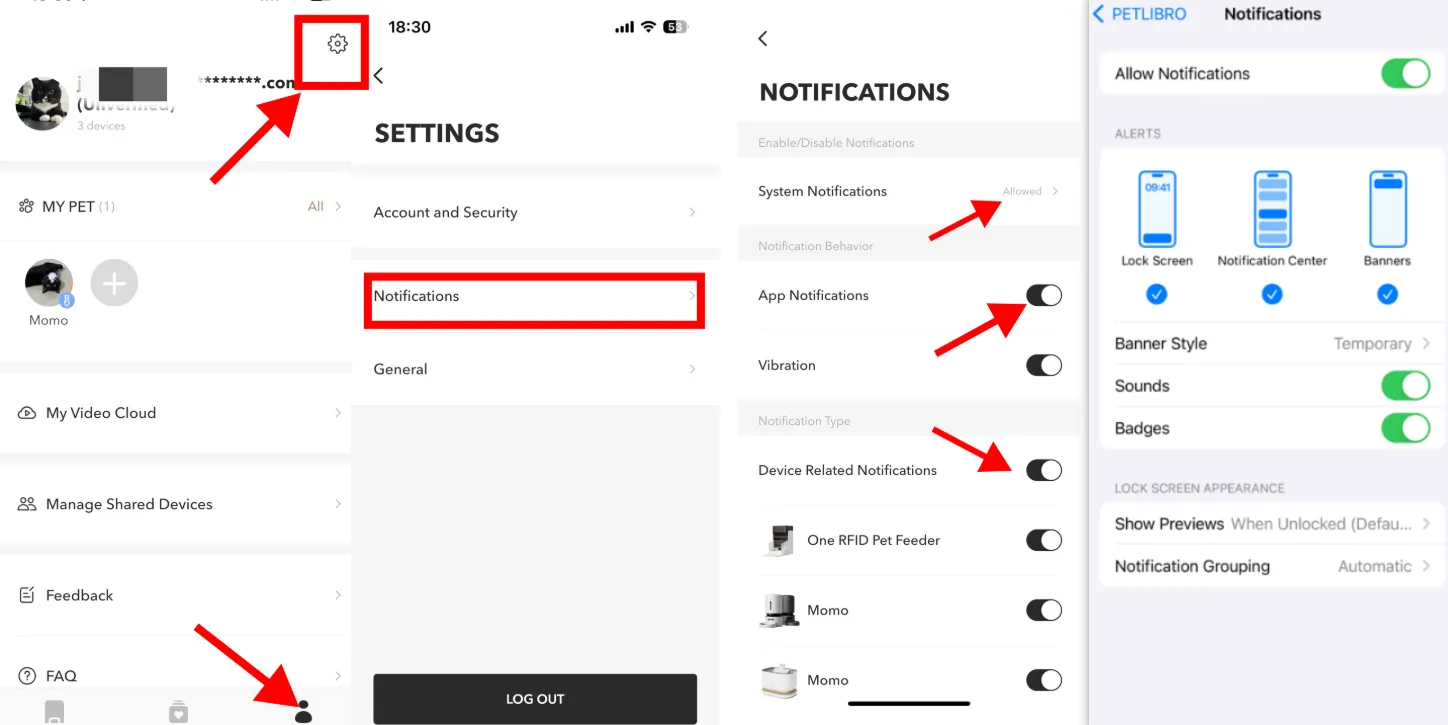
Then there is the second half of the chain. Even a working sensor has three switches between it and the phone. PETLIBRO lists the phone-level app permission, the in-app message setting, and a per-feeder notification toggle on the device settings page. Any one of the three left off produces silence that looks exactly like a dead sensor.
The feeder knows. The phone does not. Those are different faults and they need different tests, which is why cleaning the window first and reinstalling the app second is the wrong order.
How many models carry the same fix page?
Three help articles and two YouTube videos cover the same low-food fault, and the AF301 fix posted on 7 February 2024 has 8,627 views. The AF301 and PLAF301 article lists five steps. The AF107 and PLAF107 article lists six, adding a per-feeder notification toggle. The AF108 and PLAF108 article names a misseated lid and a silicone brush covering the detection light. On YouTube, PETLIBRO added an AF203 camera-feeder fix on 23 May 2024 with 3,564 views and an AF103 Granary fix on 19 March 2025 with 2,017 views. Five models, three years, one script. No page announces a firmware change that ends the problem. The order of instructions is identical everywhere, cleaning first, settings second, which says where PETLIBRO thinks the fault usually sits. The One RFID feeder sells for $149.99 and the Granary 2 for $129.99, and both arrive with that same instruction set attached.
What does a silent alert cost an owner who is already away?
The BBB complaint is the expensive version. There is a cheaper, more common one in a r/Petlibro thread from 7 September 2026, where the poster opened with “Wasn’t notified that food was completely empty” and called it the last straw. The replies are the useful part.
One owner reported five RFID feeders and no alerts at all. “I’ve had the RFID feeders for years and have never once had them alert me to the food levels,” that commenter wrote, then added that the settings had been double-checked. Another reported four units that worked for about a month and stopped together. A third found a workaround that no support script would suggest: “the alerts don’t work unless I leave a light on where the feeder is.”
That last line is worth sitting with. If a room light changes whether an optical alert fires, the detection is marginal at best, and a dark hallway is a silent failure mode nobody documents.
The thread ends with a calendar reminder and a Sunday check, which is what most experienced owners arrive at eventually. Notifications are a convenience. A habit is the backup.
Why does the same alert fire when the hopper is full?
PETLIBRO sells the Granary 2 for $129.99 with a 5 L hopper, a bowl scale accurate to 1 g, and a 24-hour backup battery, and the product page promises alerts for blockages and low food levels. The same company publishes a second page for the opposite fault, a Low Food notification that fires while the tank still holds kibble. That page blames overfilling above the MAX line and food dust on the sensor window, then asks the owner to empty the tank, wipe the window with a soft dry cloth, refill, and run one manual feeding. A beam reading through plastic can be blocked from the food side or blinded by material sitting in front of the emitter, so silence and false alarms are one fault with two symptoms. Kibble size matters too: PETLIBRO specifies dry kibble between 2 and 15 mm for its feeders, and the wrong shape changes how food settles against the window.
What are the four tests worth running tonight?
Start with the tank, not the app. Lower the food level until the surface sits below the window, then press Feed Now once and watch both the feeder and the phone. A local signal within a minute or two means the sensor is alive. An app push without a local signal is unusual and points at the app, not the hardware.
If the local signal never appears, empty the hopper completely, wipe the sensor window with a dry cloth, reseat the lid, and check that the brush is clear of the emitter. Repeat the empty test. PETLIBRO’s own escalation rule is to send device logs through Me, then Feedback in the app, with the upload option enabled.
If the local signal appears but the phone stays quiet, work the three switches in order. Phone settings first, because battery optimisation kills background apps quietly. In-app message settings second. The per-feeder toggle third, since it lives on a screen most owners never open.
The fourth test is not a test at all. Weigh the hopper on a kitchen scale every Sunday, or simply lift it. Owners in that Reddit thread arrived at the same habit after months of unreliable alerts, and it catches the failure the electronics cannot report.
Silence has relatives worth ruling out before you replace anything. A chute that jams without a warning produces the same empty bowl, and the jam guide walks through the difference between a food fault and a notification fault.
Which design splits low food from empty food?
PetSafe’s Smart Feed 2nd Generation is the one to look at if the alert itself is the reason you are reading this. The product page describes “low and empty food sensors, which will notify your smartphone when the pet feeder is running low or out of kibble.” Two states, two signals, so a low message means plan a refill and an empty message means act now.
The rest of the specification is ordinary and that is fine. 24 cups of capacity, 12 meals a day on a schedule, a conveyor instead of a rotor, a top-rack dishwasher-safe bowl, four D-cell batteries as backup, and a 45-day return window. The conveyor matters for the same reason the low-food sensor matters: fewer places for food to sit and block a reading.
Two caveats, both from our own files. PetSafe’s brand-level Trustpilot score sat at 2.1 across 231 reviews in our October 2026 read, which is why we recommend the feeder for its sensor design rather than for the brand. And the unit is 2.4GHz only, so a mesh network with band steering can refuse it.
For a household that wants no app in the loop at all, the SureFeed microchip feeder has no notifications to lose. That is not a fix for silent alerts. It is a different bargain, and worth naming so nobody buys a smarter feeder expecting a dumber one.
Prices here are the list prices published on each brand’s own store on 4 November 2026, not estimates, and they move without notice. Neither figure is a promise about what a cart will show next month.
When is it a warranty case instead of a setting?
PETLIBRO covers its feeders for 24 months and accepts returns within 30 days, and the wear-and-tear exclusions on its refund policy name batteries, the feeder rotor, desiccant bags, fountain filters and placemats. Sensors are not on that list.
The case that worked is documented on Trustpilot. A reviewer writing on 2 October 2026 said the One RFID feeder “stopped giving low food warnings” and that “the tank could be totally empty and I’d never get a notification.” Cleaning the sensors and a factory reset had already failed. Support asked for two videos and the invoice, approved a replacement within two days, and shipped a complete unit.
What made it work was evidence rather than argument. A video of an empty tank, a feed button pressed, and a screen with no ADD FOOD is the whole case. Without it, the ticket turns into a cleaning script loop, and the complaint data we track separately shows what long loops look like from the outside.
One last thing worth checking before you blame the sensor. Power interruptions and firmware resets scramble schedules in ways that look like alert failures, and the reset sequence after a power cut is a five-minute check. A feeder that has lost its clock will still dispense, still log, and still fail to warn.
Sources checked for this article
- PETLIBRO, Why am I not getting low food notifications on the One RFID Feeder (AF301/PLAF301), read 4 November 2026.
- PETLIBRO, No Low Food Notification on the Space Smart Feeder (AF107/PLAF107), read 4 November 2026.
- PETLIBRO, Missing low food alerts on the Air Smart Feeder (AF108/PLAF108), read 4 November 2026.
- PETLIBRO, How to fix an incorrect low food alert, read 4 November 2026.
- PETLIBRO, Granary 2 Smart Feeder product page and store catalogue (PL-AF105-01W at $129.99), read 4 November 2026.
- PETLIBRO on YouTube, AF301 low food notification troubleshooting (8,627 views, posted 7 February 2024), AF203 food notifications (3,564 views, posted 23 May 2024), AF103 low food notifications (2,017 views, posted 19 March 2025), read 4 November 2026.
- Better Business Bureau, PETLIBRO complaint file, complaint dated 29 September 2026, read 3 November 2026.
- Trustpilot, PETLIBRO reviews, review dated 2 October 2026, read 3 November 2026.
- Reddit, No low food notification, r/Petlibro, thread from 7 September 2026, collected 11 September 2026.
- PetSafe, Smart Feed Automatic Feeder, 2nd Generation, read 4 November 2026.
FAQ
How long should I wait for a low-food push before calling it broken? A few minutes at most. The feeder detects locally, so the device signal arrives immediately and the push follows. An hour of silence with an empty hopper is a fault, not latency.
Does cleaning the window really fix a sensor that has never worked? No. Cleaning fixes a sensor that used to work. A unit that has never fired a low-food alert since unboxing is a warranty conversation, and PETLIBRO’s own replacement case started exactly there.
Can I rely on the bowl scale instead of the tank alert? Partly. The Granary 2 measures bowl weight to within 1 g, which catches a cat that stops eating. The scale reads the bowl, not the hopper, so an empty tank with a full bowl still looks normal.
What about feeders that jam before the tank empties? Different fault, same silence. A jam without a warning is covered in our jam guide, and the rotor error sequence in the Rotor Stuck walkthrough uses the same local-light logic.
Is a camera feeder better at reporting food level? Not necessarily. The camera watches the bowl. The tank sensor still reads through the same plastic window, and the AF203 video that PETLIBRO published in May 2024 exists for the camera model too.
How often should the four tests run? Monthly for the empty test, and once more in the week before a trip. A sensor that fails quietly is only dangerous when nobody is home to notice the bowl.