Cheap Pet Cameras Fail at Night: 5 Real Owner Complaints
Why does cheap night vision turn into a blurry shadow?
The short answer: budget models pair a small sensor with a weak infrared LED array, so the dark-room image is a grainy gray smear with no readable detail, and it misses events like a sick cat at night.
The most common complaint, and the one with the worst stakes, is night vision. One owner put it bluntly in the comment thread under that August 18 video:
I stepped on this exact landmine before. The really cheap ones turn into a black-and-white picture at night, just a blurry blob of shadow. One night my cat had an upset stomach and threw up, and I could not tell anything from the remote feed. I only found out when I got home and stepped on it.
That is the failure mode that should end the argument. A camera that misses a sick cat at night is worse than no camera, because you believe you are checking on her and you are not.
The technical reason is simple: budget models pair a small sensor with a basic infrared LED array. The IR illuminates maybe a few meters, the sensor collects too little light, and the result is a grainy dark-gray image with no readable detail. Marketing photos are taken with studio lighting. The dark-room reality is what the owners describe.
What to look for instead: a stated night vision range in meters, not just “night vision” as a bullet point. Newer models add full-color night vision using a white LED or a more sensitive sensor. And find real sample footage shot in a dark room, not the product page.
Why does “smart tracking” lose your cat?
The short answer: most cheap “pet tracking” is motion-chasing tuned for humans, so a sprinting, reversing cat outruns the motorized head and ends up out of frame.
The second failure is the “smart tracking” that is not smart. Another commenter:
I bought a camera online without thinking it through. The moment my cat started darting around the living room, the head could not keep up. Two runs and she was completely out of frame. That was a hundred-plus yuan straight into a drawer, collecting dust.
The pattern behind this is predictable. Most cheap “pet tracking” cameras are a motorized head with motion detection tuned for humans. A person walks across a room at a steady speed. A cat sprints, stops, reverses, sprints again. The head locks onto the old position, the cat is already elsewhere, and the frame fills with empty sofa.
A related scam surfaced in the same comment thread: product pages labeled “AI pet tracking” that are really plain pan/tilt cameras. One commenter called it what it is:
Tons of product pages advertise smart pet tracking, and what arrives is ordinary rotation. Pure bait-and-switch. The review section is full of people who fell for it. Sellers just rewrite the description and raise the price.
The honest test: genuine pet tracking uses AI that recognizes the animal, locks onto it, and predicts its path so the head stays ahead. The cheap version chases motion and loses. If a camera under $25 claims pet tracking, assume it is the chasing kind.
How late is two-way audio on budget cameras?
The short answer: two to three seconds late, because the voice chain runs phone → app → server → speaker with corners cut at every link, too slow to stop a cat mid-destruction.
The third failure is the one that makes remote correction theater. From the same thread:
The two-way audio delay will drive you insane. I say something into my phone, and the sound comes out of the speaker two or three seconds later. By the time it reaches the room, the cat has already shredded a big chunk of fabric. There is no way to stop it in time.
Two to three seconds does not sound like much until you try to stop a cat mid-destruction. By the time your voice arrives, the damage is done. This is why “I can talk to my pet remotely” is a marketing sentence, not a feature, on budget hardware.
Latency on a pet camera is a chain: your phone encodes, the app uploads, the server relays, the speaker plays. Cheap models cut corners at every link. The fix is not a bigger plan, it is a camera with a direct connection and documented low latency. And honestly, for most households, the reliable use of the voice channel is the dog-cam case: hear the bark, talk the dog down, which works even with modest delay. For stopping a cat mid-shred, expect to rely on the siren or not at all.
Why does playback stutter at the one moment that matters?
The short answer: weak encoders drop frames under motion, and cloud replay buffers overwrite the rolling window, so the exact scene you need to review is already gone.
The fourth complaint is quieter and easier to miss: the playback stutters exactly when you need it. One owner described the worst-case version:
I worked late, came home to a pile of chewed-up stuff, and went to the playback. The key stretch was missing, the whole destruction scene never got captured. Playback lag is genuinely infuriating.
A camera that records but loses the key minutes is a camera that fails its only job. This is usually the same cheap hardware choking on the same weak encode: the feed drops frames under motion, or the cloud replay buffer only keeps a rolling window that has already been overwritten.
Local recording fixes the second half: a microSD card holds days of continuous footage, so the key scene is on the card even when the app is slow. That is a one-time $15-25 purchase and it belongs on any pet camera checklist.
The privacy floor: who is watching your living room?
The short answer: no one you can verify. Unknown brands run unknown apps with no encryption commitments or two-factor authentication, so your living-room feed sits on servers you cannot audit, a privacy lottery.
The last complaint is the one buyers rarely put on the checklist until it is too late. A commenter said it directly:
I will not touch the unknown brands. I have seen the news about cameras being hacked. If that feed ever leaked, I would feel sick. Even if it costs more, I want something from a brand with a real security story.
The budget end of this category is a privacy lottery. Unknown brands with unknown apps, no encryption commitments, no two-factor authentication, and no security track record. The feed from your living room sits on their server, or streams through their relay, and you have no way to verify what happens to it.
The practical floor: buy from a brand with documented security practices, change the default password on day one, keep the firmware updated, and prefer a camera with a physical privacy shutter or sleep mode for when you are home. That last one is cheap and it answers the privacy question with hardware instead of trust.
Expert guidance from Consumer Reports on smart-home cameras likewise stresses changing default passwords, enabling two-factor authentication, and understanding where footage is stored, the same checks that separate a secure pet camera from the privacy lottery. The FTC keeps the regulator’s version of the same advice for connected devices.
The checklist that would have caught all four
If you are shopping today, run these five checks in order:
- Night vision: stated range in meters, and real dark-room sample footage. Reject “night vision” as an unqualified bullet point.
- Tracking: is it AI pet tracking or motion-chasing? Test with a fast-moving pet before you commit, or buy from a return-friendly store.
- Voice latency: read the complaints. Two to three seconds is the budget norm; that is too slow to stop anything.
- Storage: local microSD recording beats a cloud-only buffer. One-time $15-25 for a high-endurance card.
- Security: brand with a track record, physical shutter or sleep mode, change the default password.
What should you buy instead?
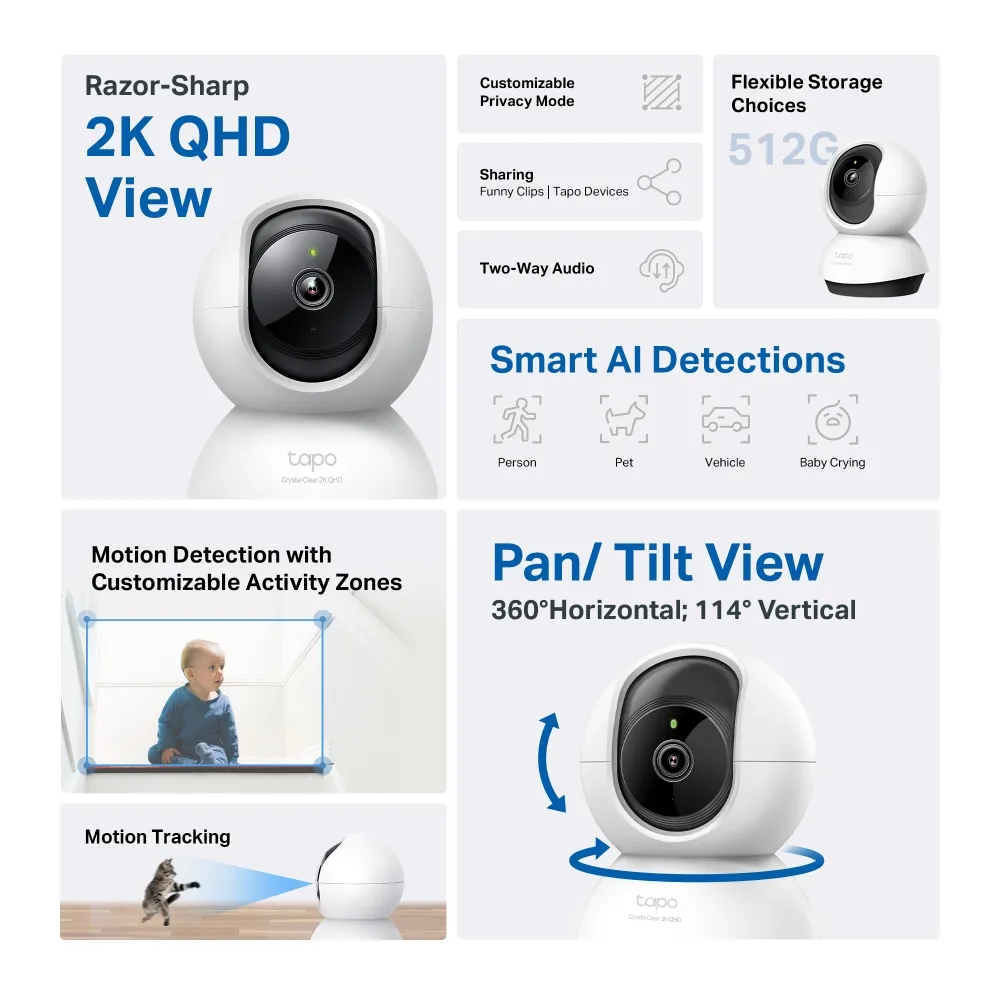
The short answer: a TP-Link Tapo (B095CLQ1PT on Amazon), about $35-40 once, no subscription, microSD local storage, infrared night vision, and AI pet detection on certain models, instead of paying Furbo’s $455 three-year total.
For the four failure modes above, the fix is the TP-Link Tapo line, which we reviewed in full here. Roughly $35-40 once, no subscription, microSD local storage, infrared night vision on most models, AI pet detection on certain models, and 360° pan/tilt on the C210 and C220. The C220 adds 2K QHD resolution, and TP-Link’s C210 spec page carries the night-vision range and pan/tilt figures for that model.
The contrast with the subscription cameras is the same one we documented in our Furbo 360 review: Furbo scores 2.7/5 on Trustpilot across 125 reviews with 73% at one star, and roughly 40% of those one-stars are billing and paywall disputes. You can pay $455 over three years for that (we broke down the full math in our pet camera cost comparison), or $35-40 once for a Tapo that sees at night, holds tracking, and keeps your footage on a card you own.
The budget camera in your drawer is not a sunk cost lesson about pets. It is a lesson about buying the spec you actually need: night vision that works, tracking that holds, latency you can live with, and a brand that takes your living room feed seriously.
FAQ
Why is cheap pet camera night vision so blurry? Budget cameras use a basic infrared LED array and a small sensor, so after dark the image drops to grainy black-and-white with no usable detail. One owner missed their cat vomiting at night because the picture was an unrecognizable shadow blob; they only found out by stepping on it the next morning. Check for a stated night vision range and look at real dark-room sample footage, not marketing stills.
Why does auto-tracking lose my cat? Most cheap ‘pet tracking’ cameras are just a motorized head that follows motion, tuned for people walking at human speed. A cat running across a room is faster and changes direction more often, so the head lags and the cat leaves the frame. One owner paid about $15-20 for this and the camera sat in a drawer afterward. Genuine pet tracking uses AI that locks onto the animal and predicts its path.
How bad is two-way audio delay on budget cameras? Two to three seconds on cheap models, measured by owners. You say ‘stop’ into your phone and the sound reaches the room 2-3 seconds later, after the cat has already shredded the fabric. That gap makes remote correction useless for anything fast. If remote voice matters, check the latency claims and read the complaints before buying.
Can cheap pet cameras protect my privacy? Often the opposite. Owners on Bilibili report refusing unknown brands outright after seeing news of camera intrusions, and some budget apps lack encryption and two-factor authentication. Buy from brands with documented security practices, change the default password, and use a camera with a physical privacy shutter or sleep mode.
Which pet camera should I buy instead? The TP-Link Tapo line, covered in our separate review: roughly $35-40 once, no subscription, microSD local storage, infrared night vision on most models, and AI pet detection on certain models. The C220 adds 2K QHD and 360° pan/tilt. It solves the four failure modes here: night vision that works, tracking that holds, low-latency voice, and a brand with documented security.
The short answer: cheap pet cameras go blind at night, lose your cat when it runs, answer your voice two to three seconds late, and quietly hand your living room feed to an unknown app. Owners on a Bilibili buyer-beware video from August 18, 2026 documented all four failures in their own words. The fix is not a more expensive subscription plan, as our no-subscription camera guide shows. It is a camera that does the basics right once, for $35-40, with no monthly fee.
I spent an evening reading the comments under a Bilibili buyer-beware video about pet cameras, published August 18, 2026. The video itself was the usual list of specs. The comment section was the real review. Owner after owner described the same four failures, in plain language: night vision that turns into a gray smear, tracking that loses a running cat, two-way audio that answers three seconds late, and a nagging fear that the cheap app is the weak point in their home security.
None of these owners bought a $200 camera. They bought the cheap ones, the ones the ads call “pet smart tracking,” and the money went into a drawer.
This matters more than any spec sheet because the whole point of a pet camera is to see things when you are not there. A camera that cannot see at night, cannot follow the animal, and cannot let you react in time is not a worse camera. It is no camera at all.