Automatic Cat Toys: Why Your Cat Quits (5 Fixes That Stick)
The short answer: an automatic cat toy fails at the ending far more often than at the motor. A laser toy can hook a cat in five minutes and leave it pacing the wall for a dot that never lands, while a battery-powered ball, mouse or wand often loses the cat within a week or two once the novelty goes. The five checks below fix what the packaging leaves out: an ending the cat can actually catch, a play pattern it cannot predict, ten minutes of your time, and a way to see whether the toy does anything while you are at work. Two of the checks cost nothing, and the cheapest toy on this page lists at $3.49.
I spent this week reading the places where cat toys get judged by the people who paid for them: a 15-comment r/cats thread from September 17, 2026 that runs from unboxing to same-day return, the comment section under a 231,000-view YouTube video about laser play, and a 26,000-view Bilibili review that sits through twelve toys in one sitting. The same conclusion turns up in both languages, which is why this page exists. Cats rarely quit toys because the toys are cheap. They quit because the play has no ending.
petiqlab earns a commission from the Amazon links on this page. Everything below comes from owner posts, public comment sections and manufacturer pages read on September 19, 2026, with links in the sources at the end.
Why did my cat become addicted to the laser toy in five minutes?
Because the dot is an intruder the cat can never catch, and the chase never resolves. The thread from September 17 is short and complete:
I bought this one today, and let my cat tried playing it for ~5 mins. And she just completely got addicted! Once the laser stops, she immediately starts crying and nervously asking me to turn it on. She can scream for a long time. And when I turn it on she just plays with it nonstop… I think I made a mistake :(( what do I do please help
Three replies explain what happened, in vote order, and the last one gives the way out:
- 23 upvotes: “Lasers are not good for cats. Look up laser pointer syndrome :(”
- 17 upvotes, the mechanism: “Laser lights can be very stressful and traumatic for animals. It’s an intruder that they can’t actually interact with and they have no satisfaction when it just disappears… Think a ghost randomly pops out of nowhere and torments you for a bit but every time you think you’ve smacked it away it’s just not there.”
- 11 upvotes, the physical risk: “Laser toys aren’t great for cats. First it can damage their eyes. And second, it could be frustrating because they chase and chase but don’t catch anything physical.”
- 10 upvotes, the exit routine: pretend the cat has killed the dot. Point the laser at your hand, squish it, and let the cat watch the light die.
The owner’s last line in the thread is “I’ll return it right away.”
What is laser pointer syndrome, and does every cat get it?
It is the label owners and trainers use for the pattern in that thread: pacing, crying at the hand that holds the pointer, and losing interest in the toys that can be caught. Treat it as a description rather than a diagnosis. There is no test behind the term, and the same threads contain cats that ignore the dot completely. One comment with 215 upvotes reads “She doesn’t even mind that she can’t catch anything physical, she just loves chasing after it.”
The physical risk is the part with a clear rule attached: never point a laser at a cat’s face or eyes, and keep the dot on the floor or a low wall instead of sweeping it past the cat’s head.
There is also an environmental version of this problem that no purchase decision prevents. One owner posting on September 11, 2026 has never bought a laser pointer because she knows the risk, and her cat still shows the symptoms: “Every time i pull out my phone it causes light to shine on the wall and she chases it. The same happens with my microwave, my desktop.” She describes a cat that is much more alert than usual, obsessive about the phone, sleeping less, and no longer interested in the toys that used to work. Screen reflections are free lasers.
Does ending a laser session with a treat actually work?
Mostly, and the exceptions are worth knowing before you build a routine on it. The 231,000-view video is where the fix was worked out in public. The top comment, at 1,300 likes, is a cat that solved the problem itself: “She sees the dot on the ground, looks at my hand with the pointer in it, and walks off only to come back with a pom-pom ball. She knows she can’t catch the dot, and provides me a toy that she can get.”
The version owners recommend most is ending on food:
- 1,000 likes: “After I play with my cat with a laser pointer I’ll shine the light on a treat so that they maybe get that ‘got it!’ feeling”
- 478 likes: “I always complete the cycle with laser pointers because Jackson has ingrained in my mind ‘Hunt, Catch, Kill, Eat.’”
- 259 likes: “They can’t really eat physical toys either, so I always serve food after playtime no matter what we play with. Cycle finished :)”
Chinese-language reviewers describe the same routine with more preparation: hide freeze-dried treats around the room first, then use the laser to lead the cat from one to the next. Those two comments sit at 21 and 275 likes. The routine also has a documented failure. A Bilibili comment with 10 likes describes a cat that reached the treat, spotted the red dot sitting on it, and stopped: “it just stared at the red dot on the treat… when the dot disappeared he still didn’t eat it, he only kept looking around for the red dot.”
The practical rule from all of this: the session has to end with something the cat can catch with its paws or its teeth. If your cat fixates on the dot instead of the food, put the laser away and use a string or wand toy, which is what the 17-upvote reply recommends. There is one situation where a laser earns its place, described at 365 likes by a rescue volunteer: “using the laser pointer works really well with the cats that don’t trust people. It gives them a chance to play AWAY from you.”
What actually breaks on a battery-powered toy?
Four things, in this order: the battery, the cat’s interest, the parts that touch the cat, and the ball that ends up under the sofa.
- The battery. A commenter under a 2025 YouTube review of automatic toys writes: “I purchased one of the automatic balls, won’t charge now after a short time, and it only worked for a short when working.” Another reply raises the safety side, calling the lithium cells in rechargeable toys “very cheaply made” and pointing at a known history of them overheating.
- The cat’s interest. An r/CatAdvice poster from September 11 wrote that her cat “had very little interest in the interactive toys”, and that even the wand toy she loved became boring: “she was obsessed initially but after a week or two she grew bored”.
- The contact parts. A Bilibili owner of a suction-cup self-play wand reports the two parts that wear out on every self-play toy: the feathers were gone within days, and the suction cup stopped holding. Both are the parts a cat actually touches.
- The location problem. In the 26,000-view twelve-toy review, the most useful line is about a ball toy the reviewer’s cats loved. It ends up wherever it rolls, which means somebody has to fetch it out from under the furniture, and the motor is loud enough to annoy the neighbours.
The same review describes everything battery-powered as “a short burst of novelty, then nothing”, while the plain wand stayed interesting and costs a fraction of the price. Nothing in these threads suggests motors are badly built on purpose. They run one pattern, and cats learn patterns.
Why did my cat lose interest in a toy that still works?
Most of the toys in these threads were not broken when the cat stopped playing with them. Predictability kills interest faster than wear does, and the fix recommended across every thread is to change the movement, not the purchase. One reply suggests letting the lure “disappear behind a cardboard box, pause, then peek out again so she has something to stalk”. Another owner describes reaching the same conclusion from the other direction: her cat “ignored every automatic toy until I realized she just wanted unpredictable play with me”, after which she started rotating simple toys daily and running “short 10-minute play sessions”.
That is the design problem with every motorised toy. It cannot be unpredictable.
| Play type | What owners report | What ends the session | Cost evidence |
|---|---|---|---|
| Manual wand on a string | “Nothing beats the classic wand toy”, 14 likes on the YouTube review; another owner sums up years of buying as “£100s of pounds… on tat that only i play with” | You do, with a treat, a meal or a caught toy | $3.49 to $6.99 on the Cat Dancer official pages, read September 19, 2026 |
| Laser pointer | A cat hooked in five minutes and returned the same day; phone and microwave reflections reproduce the behaviour with no toy at all | A treat placed on the dot, or a visible “kill” | Cheap to buy, and the return in the thread was same-day |
| Battery ball, mouse or wand | Ball lost under furniture, motor loud enough to annoy neighbours, the electric mouse flips over and stalls, and the ball “won’t charge now after a short time” | Nothing, unless you add one | One owner’s running total is “£100s of pounds”; individual pieces are cheap and repeat purchases |
| Suction-cup self-play wand | Feathers gone within days, suction cup stops holding; both are wear parts with no spare listed | Nothing built in | Two failure points on one cheap toy |
| Scheduled feeder plus a 10-minute session | The meal is the one part of the hunt a machine can deliver on time | The meal | $134.99 on the PetSafe product page |
Is a cat toy dangerous?
Three of the reports I read this week belong in the same list, because all three were avoidable.
- Cords. On September 18, an owner described losing a cat that would not leave charging cables alone: “there he was, on the floor having chewed into the wire for the space heater and the seized up from the shock, choked to death on his own vomit.” The replies are unusually practical for a pet thread. Put a cable sleeve, sold as wire loom, over every cord the cat can reach, and give the cat a 3 to 5 foot length of paracord as a substitute for the cable it wants to chase. Both suggestions sit in the same comment section, and both cost a few dollars. In a home with a camera, a feeder and a fountain, that is a surprising number of cords, all of them at floor level near the cat’s play space.
- Elastic balls. A Bilibili comment with 401 likes describes a rainbow elastic ball chewed into pieces and swallowed, causing a bowel obstruction: “差点去了喵星” (nearly died).
- Plastic bags. The same comment section, at 146 likes, is a warning about leaving a plastic bag out for play. The cat pushed its head through the opening and could not get free: the owner woke to screaming at night and nearly lost the cat.
What is the cat actually asking for?
In a September 9 thread, an owner asks for smart toys for two bored indoor cats, specifically “toys that satisfy their hunting instincts and don’t cause further frustration (so preferably no smart laser pointers)”. The answer that stuck, at 2 upvotes, refuses the premise: “first thing, the screaming one isn’t anxious or hormonal. He’s just bored with a capital B. Some cats need more than toys, like they need a ‘job’.”
The rest of the week supports the softer version of that. Toys are still the most reliably loved thing in a cat household. A r/cats thread from September 19 titled “ALL HAIL THE CAT TOYS!!!” has 15 upvotes and no complaints in it, and the advice given to owners of bored cats is usually about opportunities to climb, jump and scratch rather than about the next device.
Five checks before you buy another automatic cat toy
- Decide how the session ends before you decide what to buy. If the answer is “nothing”, the toy will frustrate the cat no matter how well it works. Pick something the cat can catch, or plan a treat or a meal at the end. A feeder on a device-side schedule can deliver that meal while you are at work, and petiqlab’s guide to leaving a cat with an automatic feeder covers what a machine can and cannot cover on its own.
- Give the toy a week and record what happens. Buy inside a return window, then watch the room rather than the marketing. A local-recording camera is the cheapest version of that test, and the Tapo C210 review explains the setup without a subscription attached.
- Check the parts that wear, and whether they can be replaced. Feathers, suction cups and battery cells are the failure points on self-play toys, and a toy whose wear part cannot be reordered is a one-season purchase. The pattern is the same one petiqlab documented in the spare parts trap.
- Check the cord and the battery, not just the toy. Every rechargeable toy arrives with a cable, and every cable is a chew risk in a house that already runs power to a litter box. Add cable sleeves, charge under supervision, and skip the cheapest unbranded cells.
- Budget the time before the gadget. Ten minutes of unpredictable play does more than a shelf of robots, and if the cat screams at night, the problem may be routine rather than inventory. The threads behind this article are full of owners who bought twice before learning that.
What petiqlab recommends instead
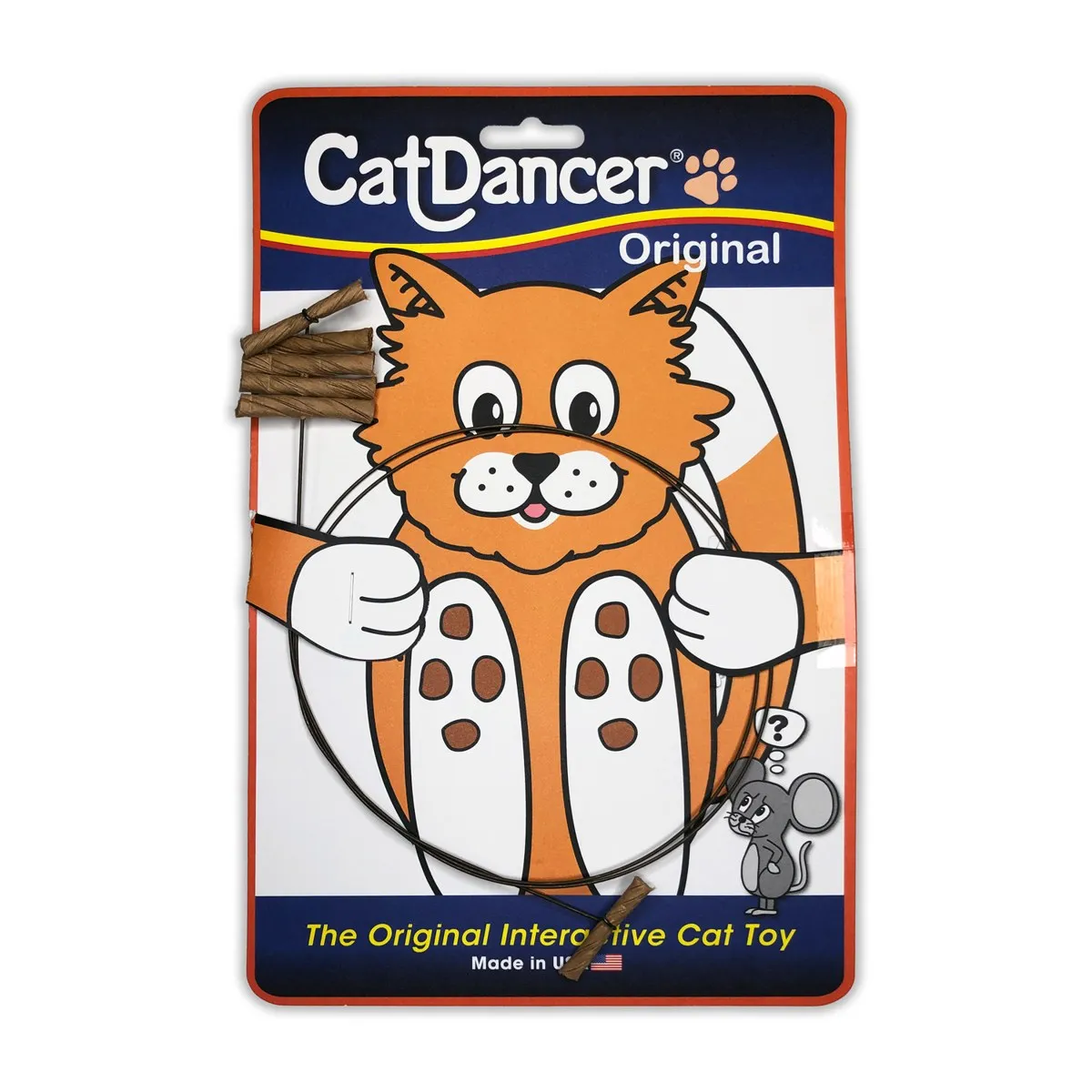
For the play itself, the pick on this site is the plain wand, and the one with published specifications is the Cat Dancer from Cat Dancer Products, listed at $3.49 on the manufacturer’s own page, read on September 19, 2026. It is a spring steel wire with a rolled cardboard lure, 6 by 9 inches, no battery, no app, no firmware and no charging cable. The page claims it has been “home-tested by over 8 million cats” and describes it as “singled out by veterinarians for its safe design”, which is the manufacturer’s wording and not a test result. The same site sells the Cat Charmer at $6.99, an 18-inch polycarbonate wand with a fabric lure, for owners who prefer a wand they can hold. One disclosure that matters: petiqlab has not tested a single motorised cat toy, which is why none is recommended here.
For the end of the hunt when you are not home, the PetSafe Smart Feed keeps meals on a device-side schedule with a battery backup and no subscription. Treat it as a product rather than a badge. PetSafe’s brand-level Trustpilot score measured 2.2 across 228 reviews with no reply-rate badge on September 19, 2026, and the reason to buy this unit is that the schedule lives on the device instead of a server.
For the test in check two, the TP-Link Tapo C210 records to a local microSD card with no subscription, so a week of footage answers the only question that matters before you buy another toy: does the cat use the one it has? Owners in other categories describe the same use for it, checking when a cat last ate, and petiqlab’s subscription trap map explains why the local option is worth the extra thought.
FAQ
Why does my cat cry after I turn the laser toy off? Because the chase never resolves. In the September 17, 2026 r/cats thread an owner described five minutes of play followed by a cat that cried, demanded the light back, and screamed when it stayed off, and the toy was returned the same day. The top reply with 23 upvotes asked the owner to look up laser pointer syndrome, and the practical advice that followed was to stop the laser and offer a toy the cat can physically catch.
Is laser pointer syndrome a real diagnosis? It is a label owners and trainers use rather than a diagnosis with a test behind it, and the same comment sections contain cats that ignore the dot completely. One reply with 215 upvotes reads “She doesn’t even mind that she can’t catch anything physical, she just loves chasing after it.” The behaviour the label describes is documented in these threads: pacing, crying at the hand that holds the pointer, and losing interest in toys that can be caught.
Can a laser toy hurt my cat’s eyes? That is the physical risk owners raise most often. In the September 2026 thread, a reply with 11 upvotes warned that lasers “can damage their eyes” and that the cat chases without ever catching anything physical. The rule in those threads is simple: never point a laser at a cat’s face or eyes, and keep the dot on the floor or a low wall rather than sweeping it past the cat’s head.
Does ending a laser session with a treat work? Usually, but not always. Comments on a 231,000-view YouTube video recommend shining the light on a treat so the cat gets a “got it!” moment, and one line with 259 likes is “I always serve food after playtime no matter what we play with.” A Bilibili comment with 10 likes documents the failure: the cat reached the treat, saw the red dot land on it, and refused to eat even after the dot disappeared. If that happens, stop using the laser rather than repeating the session.
Why did my cat stop playing with the automatic toy after a week? Predictability, not wear. One r/CatAdvice poster wrote that her cat “had very little interest in the interactive toys” and that even the wand toy she loved became boring “after a week or two”. The recommended fix in the same thread is to change the movement rather than the toy: let the lure disappear behind a cardboard box, pause, then peek it out again so the cat has something to stalk. Rotating simple toys and running short sessions with you works the same way.
What should I do if I am not home enough to play with my cat? Combine a machine with a routine. Owners in these threads run sessions of about 10 minutes when they are home, rotate the toys they already own instead of buying more, and use the meal as the end of the hunt. A feeder on a device-side schedule can deliver that meal, and a locally recording camera shows whether the cat plays with anything while you are out, which costs less than another toy that sits in a box.
Updated: 2026-09-19. Sources: r/cats thread 1wieui1 (an owner whose cat played a laser toy for about five minutes, became fixated, cried and screamed when the light stopped and demanded it back, the replies ranked 23, 17, 11 and 10 upvotes including the “intruder” explanation, the eye warning and the suggestion to imitate a kill, and the owner’s decision to return the toy, September 17, 2026, 15 comments), YouTube video iMk0QDjQ9Wk “Can a Laser Toy Make Your Cat Crazy?!” (231,319 views, 1,068 comments; the top-voted 1,300-like account of a cat that walked off and returned with a pom-pom ball, 1,000 likes on shining the light on a treat, 478 likes on finishing the hunt-catch-kill-eat cycle, 259 likes on always serving food after playtime, 365 likes from a rescue volunteer on using the laser for cats that do not trust people, 215 likes and 115 likes as counter-samples), r/cats thread 1wd0axv (an owner who never bought a laser pointer whose cat chases reflections from a phone, a microwave and a desktop screen, described as more alert, sleeping less and losing interest in other toys, September 11, 2026), Bilibili video BV1QwDEBaEHF (26,345 views, 860 likes; a 17-like long review covering twelve toys with the ball that rolls out of reach and the motor loud enough to annoy neighbours, a 21-like comment on hiding freeze-dried treats and leading the cat to them with the laser, and the assessment that every battery toy delivered a short burst of novelty while the plain wand stayed interesting), Bilibili video BV1C84y1Z7qX (a 10-like comment describing a cat that reached the treat, stared at the red dot sitting on it and kept searching for the dot after it vanished), Bilibili video BV1ZS4y1J7oc (71,469 views; a 275-like comment on placing food in several spots before a laser session, a 401-like report of a rainbow elastic ball chewed into pieces and swallowed with a resulting bowel obstruction, and a 146-like report of a plastic bag a cat could not free its head from), Bilibili video BV1964y1e7Lz (a suction-cup self-play wand whose feathers were gone within days and whose suction cup stopped holding, per two comments), r/CatAdvice thread 1wd7pqf (an owner whose cat had very little interest in interactive toys and grew bored of the wand after a week or two, with the reply suggesting the lure disappear behind a cardboard box, pause and peek back out, September 11, 2026), r/CatAdvice thread 1wevwri (an owner who cannot always be the one playing, September 13, 2026), YouTube video 1stMRqAA0YQ “Automatic Interactive Cat Toys Don’t Work. Do This Instead.” (a 14-like comment that nothing beats the classic wand toy at about five dollars a pack, a 2-like comment totalling years of spending as hundreds of pounds on toys only the owner played with, a comment that an automatic ball would not charge after a short time, a comment raising cheap lithium batteries as a fire risk, and a comment from an owner who found her cat ignored every automatic toy until she switched to rotating simple toys and 10-minute sessions), r/cats thread 1wj9c5i (a 12-like account of a cat killed by the cord of a space heater it chewed, a 3-like suggestion to cover cables with wire loom, and a 2-like recommendation of a 3 to 5 foot paracord length as a substitute toy, September 18, 2026, 17 upvotes and 16 comments), r/cats thread 1wbdqpl (an owner asking for smart toys that satisfy hunting instincts without frustration, and the 2-like reply that the cat is “bored with a capital B” and needs a job, September 9, 2026), r/cats thread 1wjyitc (a 15-upvote toy appreciation thread, September 19, 2026), Cat Dancer official product pages for the Cat Dancer (spring steel wire and rolled cardboard, 6 by 9 by 0.25 inches, $3.49, “home-tested by over 8 million cats” and “singled out by veterinarians for its safe design” as the manufacturer’s wording) and the Cat Charmer (an 18-inch polycarbonate wand with a fabric lure, $6.99), read September 19, 2026, the PetSafe Smart Feed product page reference price of $134.99, and Trustpilot’s profile for petsafe.net (TrustScore 2.2 across 228 reviews with no reply-rate badge, September 19, 2026).