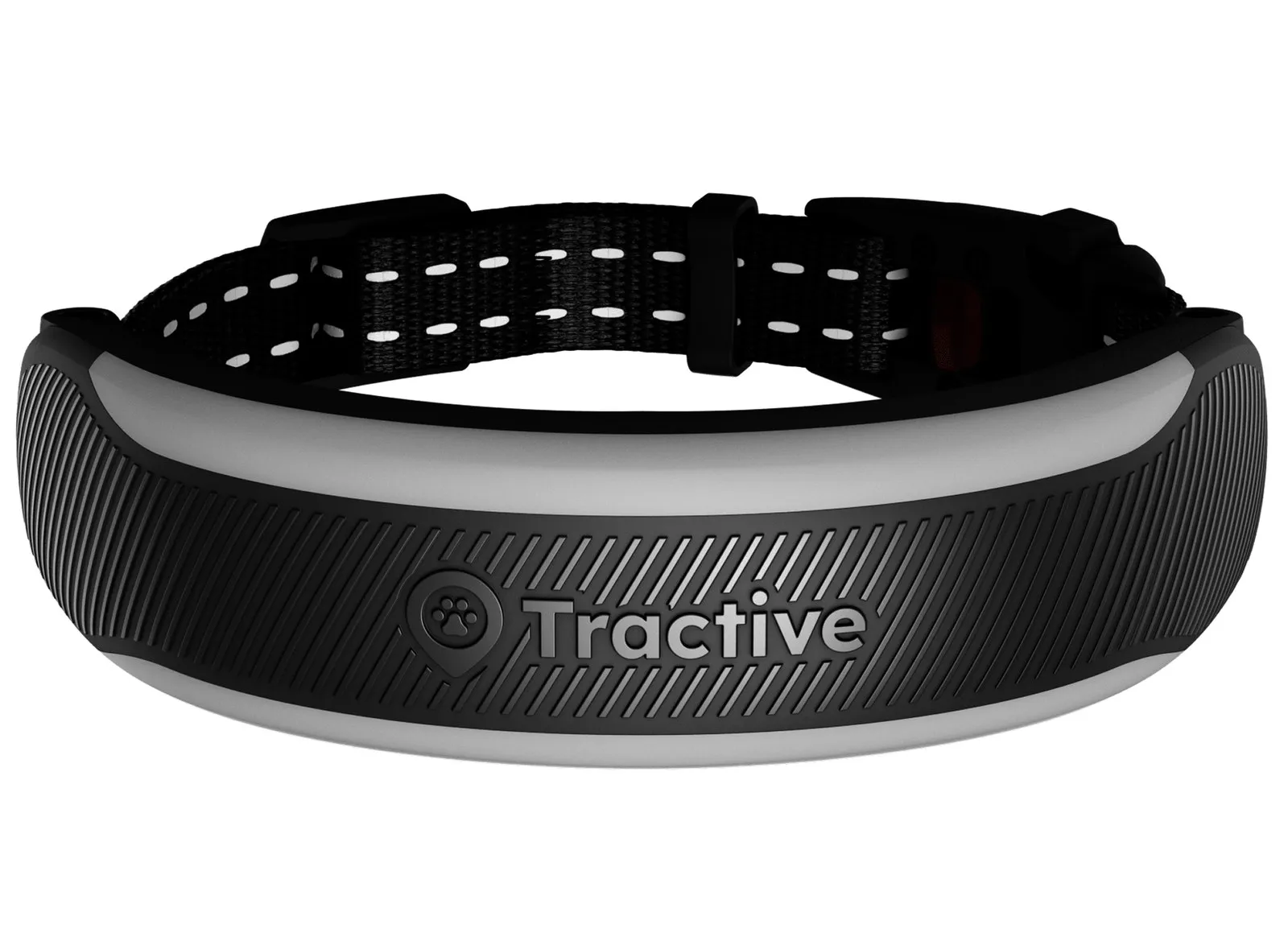
Tractive Shows Movement When Your Cat Isn't Moving
The short answer: a tracker reports a position, not a fact, and Tractive’s own help centre says so. The company promises accuracy “within 8 meters (about 26 feet)” outdoors in open sky, warns that a badly pinned Power Saving Zone will “always show your pet in that location,” and admits LIVE Tracking can “jump” indoors. Owners push past that spec. On October 25, 2026 a user took the tracker off the cat and set it on the ground outside, and 20 minutes later the app drew “a mess of marks showing movement all over the yard.” The CAT 6 Mini costs $49 plus a plan from $5 a month. Test the dots in your own yard before you need them.
I read Tractive’s one-star page with the product page open in the next tab, braced for the usual battery complaints. They were there. But the reviews that stopped me were about something quieter, a device that keeps talking after it has stopped telling the truth. A cat asleep indoors, a trail across the lawn. Two collars lost in the same garden. A plan still billing for a tracker sitting under a hedge somewhere.
That is a different failure from a dead battery, and it gets solved differently. Dead hardware announces itself. Wrong data looks exactly like right data.
What does Tractive itself admit about the accuracy of the dots?
The manufacturer publishes both halves of the answer, in two help articles that most buyers never open.
The first is a specification. Tractive’s accuracy page states: “Tractive trackers are usually accurate within 8 meters (about 26 feet) when your pet is outdoors in open spaces.” It then lists what erodes that number: thick cloud cover, heavy rain, dense forest, steep hills, buildings. Indoors it gets worse, because walls and roofs block satellite signals.
The second is a configuration warning, and it is the one that explains the strangest owner reports. From the article on inaccurate tracking:
If your Power Saving Zone isn’t pinned to the right spot on the map, your tracker will always show your pet in that location when it detects that WiFi.
Read that again with a cat asleep in the house. The tracker detects your home WiFi, decides the pet is home, and reports the coordinates of the pin. If the pin sits on the neighbour’s garden or the middle of the road, the app will put your cat there, confidently, for as long as the cat stays put. The same page tells owners not to use LIVE Tracking indoors because it “can jump or act weird,” and recommends a 10-minute outdoor walk with LIVE Tracking as the way to see the tracker at its best.
Tractive’s accuracy page states that trackers are usually accurate within 8 meters (about 26 feet) when a pet is outdoors in open spaces, and lists thick cloud cover, heavy rain, dense forest, steep hills and buildings as conditions which erode the figure. Indoors, walls and roofs block satellite signals, so the app may show a last known location slightly off. The same help centre warns a Power Saving Zone not pinned to the right spot on the map makes the tracker always show the pet in the pinned location once home WiFi is detected. LIVE Tracking can jump or act weird indoors, and low battery also reduces accuracy. The October 25 owner set a tracker on the ground outside and watched a mess of marks spread across the yard. Screenshots at minute 0, 10 and 20 are the evidence a support queue can act on.
None of that is a scandal. It is how consumer GPS works, and Tractive describes it more plainly than most brands. What the documentation never covers is the case owners keep reporting: a device left motionless outdoors, in open sky, that still produces a trail.
Can a 20-minute still test prove the tracker moves with no cat?
Tractive recommends a 10-minute walk. Owners need a different test, because a walk only shows you the good conditions. Here is the version that catches a drifting unit, and it costs one afternoon.
- Take the tracker off the cat and put it outdoors on a fixed surface, powered on, with a clear view of the sky, away from walls and metal.
- Turn LIVE Tracking off, so you are watching default reporting rather than the high-frequency mode.
- Screenshot the map pin at minute 0, at minute 10, and at minute 20.
- Compare the spread against the 8 m (26 ft) figure in Tractive’s own documentation.
- Then bring it inside, still on the table, and watch the same spot for 10 minutes. Jumps here are expected and documented.
- Open Power Saving Zones in the app and confirm the pin sits on your house, not on the street outside it.
The October 25 report is what a fail looks like. The owner wrote that the “tracker shows the cat moving when it is 100% NOT moving,” that they “even removed the tracker and placed it outside to check,” and that “20 minutes later there is a mess of marks showing movement all over the yard.” When they asked for a replacement, they say the reply explained how to reset the device, followed by “silence for 11 days and counting.”
A second review, from October 14, 2026, describes the same thing in fewer words: “Sometimes it shows in a completely different place on the app than it actually is.”
Two things are true at once here. A stationary GPS receiver does wobble, and a few metres of wobble is normal, not a fault. A trail that crosses a yard is not a few metres, and it is not explained by anything in Tractive’s documentation. The test above is how you tell those apart, and the screenshots with timestamps are the only evidence a support queue can act on. Complaining that the dot is wrong gets a reset email. A 20-minute series showing a fixed device walking 30 metres gets a case number.
Which part of the $49 CAT 6 Mini actually leaves the cat?
Everyone worries about the GPS chip. The part that actually goes missing is the strap.
The CAT 6 Mini is not a tracker you bolt onto an existing collar. Tractive sells it as an “integrated safety-release collar,” sized for necks of 7.5 to 9.0 inches, weighing 1.1 oz including the collar, for cats between 3 and 17.6 lbs. The safety release is a genuine piece of animal welfare engineering. A cat collar that cannot release under load can hang a cat on a fence, and feline medicine has recommended breakaway designs for that reason. The trade is the whole story: the collar leaves the cat on purpose when something pulls hard enough.
Owners then meet the second half of that trade. A review from October 3, 2026 puts it in one line: “due to the poor clasp we’ve now lost two of the trackers both in the same garden.” That buyer replaced the unit and reported the new one was gone “within 24 hours in the same garden.” A September 20 review says a part of the collar broke after six weeks and that the company refused a replacement collar even on a premium plan, then sent a voucher code that did not work.
Sizing adds its own comedy. An October 18 buyer with a cat too large for the supplied collar ordered the larger size twice and says both orders arrived as a dog collar, product number TRDOG7CLNRL, which has no breakaway section. Whether that is a listing error or a picking error, the buyer ends up with the wrong safety behaviour on the cat.
The best argument for the product sits next to all of this. On October 27, 2026 a five-star reviewer described the cat coming home without her collar, then checking where she had been during her outing and sending a son out to retrace the route, which found the collar. That is the honest case for a tracker. Not that it never leaves the cat, but that its history tells you where to look after it does.
Which is why the plan tier matters more than the marketing suggests. The plans page lists 365-day location history on Premium, and a Basic tier that keeps 24 hours. If the collar comes off today and you notice tomorrow, one of those tiers can retrace the route and the other cannot.
What does Tractive Care actually pay for on a $49 tracker?
The subscription is not insurance, and the insurance is not a search party. Tractive Care “adds protection in case your tracker is lost, stolen, or damaged,” and the page is explicit about limits: one claim per subscription period on a 1-year plan, two claims on 2-year and 5-year plans. Each plan is also “tied to a single tracker,” which is fine until the tracker is the thing that disappeared.
The worst version of that loop is in an October 8, 2026 review, which reads like a man doing arithmetic out loud:
A GPS tracker that needs its own GPS tracker. The first one disappeared on my cat’s very first outing. The replacement disappeared too. Two trackers, the same model, the same problem: an attachment system I simply cannot trust. Meanwhile, I paid £162 for Premium and Tractive Care, with my subscription running until January 2028. Tractive’s brilliant solution? A 40% discount on yet another CAT 6 Mini. That is not a solution. That is asking the customer to finance another round of product testing.
Two things in there are worth separating. The 40% offer is a discount on hardware, which is what a replacement policy tends to look like. The £162 running to January 2028 is a service attached to a device that is no longer on the cat, and the cancel terms explain why it does not snap back: cancel after 30 days and “your subscription will remain active until the end of the current billing period.” There is no pro-rata refund for a tracker you cannot find.
Tractive lists the CAT 6 Mini at $49 plus a plan, priced on 27 October 2026 at $132 for one year, $180 for two years and $360 for five years, which works out at $11, $7.50 and $6 a month. A full refund is available within 30 days of purchase, and cancelling after 30 days leaves the subscription active until the end of the current billing period, with no pro-rata refund for a tracker nobody can find. Tractive Care covers a unit lost, stolen or damaged, with one claim per subscription period on a 1-year plan and two claims on 2-year and 5-year plans. Premium keeps 365 days of location history and Basic keeps 24 hours. Each plan is also tied to a single tracker, which is fine until the tracker is the thing that disappeared. An October 8 reviewer paid £162 for Premium and Tractive Care running to January 2028, then was offered a 40% discount on another unit.
Prices as listed on October 27, 2026, for one tracker:
| Term | Billed up front | Effective monthly | Claim limit with Tractive Care |
|---|---|---|---|
| 1 year | $132 | $11 | 1 claim per period |
| 2 years | $180 | $7.50 | 2 claims per period |
| 5 years | $360 | $6 | 2 claims per period |
Add the $49 tracker. On the five-year term the hardware is roughly 12% of what you are committing, which is the clearest way to see what the business actually sells.
What happens when a CAT 6 Mini dies 15 hours into a search?
The battery complaint is old news on this brand, and the GPS buying guide already worked through the gap between the advertised week and daily charging. What October added is how fast the end comes.
Tractive’s product page promises “Up to 7 days (with Power Saving Zones).” An October 22, 2026 review describes the other end: a tracker that had been lasting several days began draining “within 24 hours,” the owner contacted support and got “fobbed off with an AI bot suggesting I hard reset,” and then the battery died “about 15 hours after charging it.” The cat was missing, in an unfamiliar area, after a house move. A replacement was sent. The reviewer’s own verdict: “too little too late.”
An October 15 review covers the slower version: “under 1.5 years and it no longer holds charge. I have to charge it every single day,” with support reaching only “a loop with an AI customer assistant.” One October 24 reviewer claims the older device’s battery “lost half its capability when next generation device came out.” That one is an owner’s inference rather than a documented behaviour, and it belongs in the file as a claim, not a finding.
Battery and accuracy are not separate problems. Tractive’s own accuracy page ends with “low battery can reduce accuracy,” so the last hours of a charge produce both a missing dot and a worse dot.
Signature 1
The dot drifts
Tractive sizes outdoor accuracy at 8 m (26 ft). A 20-minute still test on a fixed surface shows whether your unit stays inside that circle or draws a trail.
Signature 2
The collar leaves
Safety release, 7.5 to 9.0 in necks, 1.1 oz including collar. After it opens, only location history finds the strap: 365 days on Premium, 24 hours on Basic.
Signature 3
The report stops
Advertised up to 7 days with Power Saving Zones. One owner report has the battery dead 15 hours after charging, with a cat missing. Low battery also lowers accuracy.
What survives all three: a microchip and a visible ID tag with a current phone number. A tracker supplements them; it does not replace them.
What should you check in the first week of owning a CAT 6 Mini?
Most of the practical value in these reviews is scheduling. Do the work inside the 30-day refund window, while a return is still cheap.
- Run the still test above on day two, outdoors, with screenshots.
- Walk a familiar route with LIVE Tracking on, then compare the trail to where you actually went.
- Check the collar fit at the neck, then pull gently against the release to confirm it opens and recloses cleanly.
- Photograph the tracker, the collar and the box label, and note the SKU (TRCAT7BK, TRCAT7BR or TRCAT7LA). If a part fails, the photo is the claim.
- Pin the Power Saving Zone exactly on the house.
- Read which history depth your tier includes before you need yesterday’s route.
- Note how many Tractive Care claims your term allows, and the date your plan renews.
Anything that fails inside those 30 days, return. The subscription trap map covers the general pattern of paying for a service after the hardware stops earning it, and the fix here is the same one: decide inside the refund window, not in month seven.
What should you buy when the escape risk is real, and when is a $29 AirTag enough?
The uncomfortable finding is that this category has no clean winner. Long-range tracking is a genuine capability, and a cat that bolts across a road at night is not a job for a $29 tag. If you decide the risk is real, buy the GPS with a term you can afford, and use the 30 days to run the tests above rather than trusting the map.
If the risk is hypothetical, buy the cheap thing. An AirTag costs about $29, carries no subscription, runs for months on a coin cell, and a lost one is an expense rather than a grievance. A 4-pack covers the multi-cat household for about $25 per tag. Its limit is range: it needs Apple devices nearby, so a cat in woods with no phones around is invisible to it. That is the no-subscription camera guide logic applied to a different sensor. Buy the free-ish tool for the case you actually have.
Whatever you hang on the collar, the ASPCA’s guidance on pet identification keeps coming back to the unglamorous layer: a microchip and a visible ID tag with a current phone number are the parts that work when the battery does not. A tracker is a supplement to those, not a substitute. The same reasoning shows up in the dog-collar GPS fence checks, where a device’s own instructions turn out to be the best list of its limits.
And when the app does misbehave, escalate with evidence rather than adjectives. The human handoff playbook is written for exactly the loop described in the October 22 review: a bot suggesting a hard reset to a person whose cat is missing.
Tractive is rated 4.7 out of 5 on Trustpilot today, and that number is not wrong. The five-star reviews describe walks with a husky, a no-go zone alert that fires before a cat reaches the woods, and a mother retracing her daughter’s route to find a lost collar. The product works often enough to earn that. What the one-star page adds is the shape of the misses: a dot that lies, a strap that leaves, a plan that keeps running. Knowing which of the three you are looking at is the difference between a support ticket and a search.
FAQ
Why does my tracker show my cat moving when she is asleep on the sofa? Three mechanisms explain most of it. Tractive’s help centre says a Power Saving Zone that is not pinned to the right spot on the map will make the tracker always show your pet in that location once it detects your home WiFi, and that LIVE Tracking jumps and misbehaves indoors because GPS cannot get through walls. The third is ordinary GPS scatter, which the company sizes at 8 meters (about 26 feet) outdoors with a clear sky. A dot that hops inside that circle is the specification working. A dot that walks a yard while the tracker sits on a table is not, and that is the case worth documenting.
How accurate is a Tractive tracker meant to be? Tractive’s help centre states that trackers are usually accurate within 8 meters (about 26 feet) when the pet is outdoors in open spaces. Accuracy drops with thick cloud cover, heavy rain, dense forest, steep hills and buildings. Indoors, walls and roofs block satellite signals, so the app may show a last known location that is somewhat off. Tractive also warns that low battery can reduce accuracy, which matters because the two problems tend to arrive together: a dying tracker reports worse positions right when you need them.
Can I get my money back if the tracker is lost? Two different things are being sold. The plans page says you can cancel at any time, get a full refund within 30 days of purchase, and after 30 days your subscription stays active until the end of the current billing period without auto-renewing. Tractive Care is the add-on that covers a tracker that is lost, stolen or damaged, and its claim limit depends on the term: one claim per subscription period on a 1-year plan, two claims on 2-year and 5-year plans. That is hardware cover, not a search service, and the plan stays tied to the single tracker it was bought for.
Why does the collar keep coming off my cat? The CAT 6 Mini ships as an integrated safety-release collar, which is a deliberate design: a cat collar that cannot release can strangle a cat that snags it on a fence or a branch. The release doing its job is also the release letting the tracker leave the cat. Fit is the variable you control, and Tractive specifies necks of 7.5 to 9.0 inches for a 1.1 oz collar on cats between 3 and 17.6 lbs. Owners report clasps and collar parts failing anyway, and one buyer says two larger collar orders arrived as a dog collar, model TRDOG7CLNRL, without the breakaway section.
How long does the CAT 6 Mini battery really last? Tractive advertises up to 7 days of battery life with Power Saving Zones enabled, and that caveat is doing a lot of work because the zone depends on your home WiFi being detected and pinned correctly. Owner reports range from a tracker that drained in roughly 15 hours after charging to one under 1.5 years old that needed charging every single day. Charge it before any trip, check the app’s last update time before you leave, and treat the advertised week as a best case rather than a plan.
Is an AirTag a real replacement for a GPS tracker? For a yard, an apartment and most home-range escapes, yes. An AirTag costs about $29, needs no subscription, runs for months on a coin cell, and replacing a lost one is cheap. What it cannot do is report location on its own: it relies on nearby Apple devices, so it fails on a cat that bolts across a town or into woods with no phones around. A GPS tracker earns its subscription on unlimited range. If the escape risk is real, keep the GPS. If it is hypothetical, the tag covers the case you actually have.