Warranty Replacement, a $119.99 Plan, Then Silence
The short answer: a warranty replacement can arrive tied to a paid plan, and the reviews that document it are the ones with dates. Frances Li’s feeder stopped connecting to the app on August 27, 2026; support offered a replacement unit in early September on a condition she quoted directly, “purchase a $119.99 cloud service subscription, and they would dispatch a brand-new replacement unit alongside the service.” She paid on September 16, sent four follow-up emails and opened two tickets between September 18 and 23, and heard nothing back. The same page carries two more shapes of the offer: one sold before anything breaks, and one that ends in a private message and silence. Four things to settle before you accept a replacement are below.
The review that stopped me this week is not about a broken feeder. I spent the morning in the one-star pool on PETLIBRO’s Trustpilot page, and the most expensive entries are the ones where the machine broke and the replacement became a negotiation. Frances Li paid $119.99 in September for a replacement unit that a support agent had offered her. She is still waiting.
Her review works as evidence because she dated every step. On August 27, 2026 her feeder stopped connecting to the app, so she opened a ticket. On September 1 and 2, support made the offer, and she quoted it directly: “purchase a $119.99 cloud service subscription, and they would dispatch a brand-new replacement unit alongside the service.” The payment link they sent did not work, and it took two weeks of email to get a functional one. She paid on September 16. Between September 18 and 23 she sent four follow-up emails and opened two new tickets. All of it went unanswered, and her review closes with a chargeback and complaints to consumer protection bureaus.
Her own summary is the sentence to carry into a purchase: “Conditioning product replacements on paid subscriptions” is how she describes it, and the timestamps are what make it stick.
A warranty is usually sold as protection against a failure. What this cluster of reviews describes is a different arrangement, where the failure opens a sales conversation, and the shape of that conversation varies enough that buyers miss it.
Three shapes the same offer takes
The first shape arrives with a plan attached, and the money moves in the wrong order for the buyer. The customer paid for the replacement before it shipped, which gives up the one thing a warranty claim normally provides, an unpaid balance the company still wants. Once $119.99 has cleared, the only remaining question is whether the company responds, and in that case it did not for at least a week.
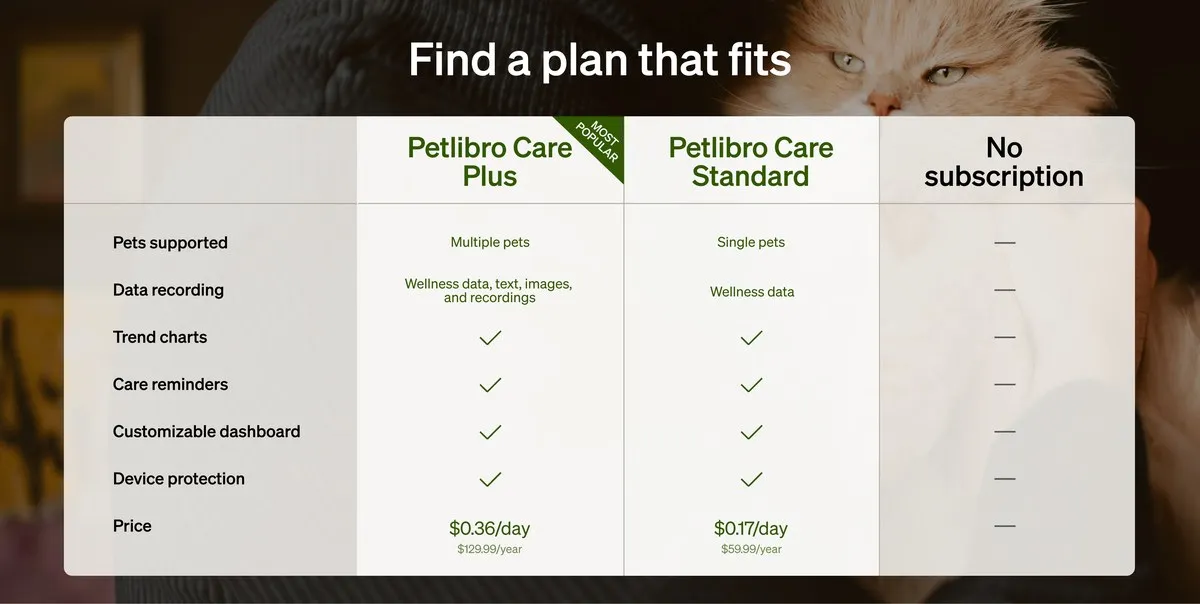
The second shape is sold before anything breaks. PETLIBRO runs an annual plan called Petlibro Care at $47.99 for Care Standard and $103.99 for Care Plus as of October 7, 2026, with list prices of $59.99 and $129.99 shown beside them. The headline on that page is “Free device replacement coverage.” The comparison chart on the same page puts a device protection row in both tiers, and lists what each one includes, which is data tracking for a single pet on Standard and multiple pets on Plus.
The third shape costs nothing to make and nothing to keep. A second PETLIBRO owner wrote that the public reply promised to reconsider, a private message called the offered unit the only resolution the company could provide, and then nothing happened. His account of the sequence is worth reading in full, because it is the clearest description of how a support thread can be used as a stage.
| Shape | What the owner is told | What it costs | Source, read October 7 2026 |
|---|---|---|---|
| Replacement dispatched with a cloud plan | Buy the plan, and the unit ships alongside it | $119.99 | Trustpilot 1-star review, September 21, 2026 |
| Annual care plan, sold in advance | Free device replacement coverage | $47.99 or $103.99 a year | petlibro.com Petlibro Care page |
| Public promise to reconsider | Someone will contact you within 24 hours | Nothing, and nothing arrives | Trustpilot 1-star review, September 27, 2026 |
| Replacement part, no upselling | A power cable is on the way | No charge, at least 7 days down | Trustpilot 1-star review, October 2, 2026 |
The warranty conversation, dated line by line
One review is more useful than a summary of several, so here is the sequence from Frances Li’s account, in the order it happened.
| Date, 2026 | What happened |
|---|---|
| August 27 | The feeder stops connecting to the app. A support ticket is opened |
| September 1 to 2 | Support offers a replacement if a $119.99 cloud service subscription is purchased |
| September 2 to 15 | The payment link is broken. Two weeks of email go into getting a working one |
| September 16 | The $119.99 is paid and confirmed the same day |
| September 18 to 23 | Four follow-up emails, no shipping confirmation, two new tickets unanswered |
| September 21 | The review is published, and a chargeback is started |
Nothing in that table describes a machine that failed twice or a buyer who misunderstood the terms. It describes a process where the payment step worked and the delivery step did not, and where the customer had already given up the one thing that keeps a claim moving, which is the unpaid balance.
A second owner is still in the same position with less documentation. Debbi Tilleman wrote on September 7 that she “Received an email stating they would send a replacement unit for my automatic feeder. It’s been weeks and now they won’t reply,” and added that she had followed up on her ticket at least 10 times and opened a second ticket to ask that the first one be answered. Her voicemails went unreturned as well.
The line that separates a repair from a sale
Christopher’s case has been running since his $199 large-dog feeder failed at 10 months. Getting the warranty honoured took six weeks of emails. The replacement then failed with the same vacuum-pump fault 13 months later, which is the pattern this site described in when a replacement unit breaks the same way, and the brand’s written answer to his request for an equivalent product or a refund reads: “this is the only resolution we are able to provide at this time.”
The review then contrasts two versions of the same company. In private, that line. In public, a reply saying the company understood, would reconsider, and would have someone contact him within 24 hours. In private again, according to his account, nothing, and the feeder shipped anyway. “This is customer service theater,” he writes. “PETLIBRO becomes remarkably attentive when there is a public review to respond to. Actually resolving the customer’s problem is another matter.”
That is the mechanism to watch for, and it is not unique to one brand. A public reply costs a company nothing and resets the clock on a complaint. A written private answer, which is what Christopher kept, is the part that can be quoted back months later. This site has covered what a reply rate does and does not measure, and his thread is the human version of that finding: PETLIBRO’s Trustpilot profile shows replies to 69% of negative reviews, a number that counts responses and says nothing about whether the machine was fixed.
What the plan promises, and what the page says next to it
It is worth reading the Petlibro Care page closely, because it is a fair description of what the paid layer buys. The plan is annual, it tracks feeding and hydration data, and its comparison chart puts device protection in both tiers, with multi-pet tracking reserved for the $103.99 tier.
Two lines on the same page deserve equal billing. The first is that the plan is optional. “No subscription is needed to use your Petlibro smart feeder or fountain,” the page’s own FAQ states, and it adds that essential feeding, watering and device operations all work without one. The second is that the machine already carries a 24-month warranty and a 30-day money-back window when bought from the brand directly.
So the accurate version is not that this brand charges for warranty service. It is that the company sells a plan whose headline benefit is exactly the outcome a warranty claim produces, which means the support desk is also a sales desk. That is a normal arrangement in this category, and it is one of the four stages in the subscription map this site published: the charge can appear at checkout, at the end of a trial, after an app update, or in the middle of a repair. It becomes a problem when the paid route is the one that works and the free one is the one that goes quiet, which is what the September reviews describe.
The same desk when it works
Two counterweights belong here, because a support organisation is not a single behaviour.
A Furbo owner who had been told his out-of-warranty camera could not be replaced wrote in a five-star review that he was “given a discount on a replacement which arrived promptly.” The same trade, in the same category, executed as a purchase the buyer understood and got value from. And a PETLIBRO reviewer in September described the opposite experience of the one above: “Customer service is great and very responsive,” Sarina wrote, adding that the replies were detailed enough to address her specific issue.
There is also a review that splits in half within a single paragraph, which is the most honest sample of all. Mrs O wrote that her fountain was excellent, that one part broke, and that the company “answered immediately and informed me of a 24 month warranty.” Then she adds that after that, she heard nothing.
Against those, the brand’s public reply to a third owner in late September is worth quoting because it concedes the pattern. It acknowledges that “Due to a significant increase in customer inquiries, our response times have unfortunately been slower than usual,” confirms the order was still inside the 24-month warranty, and promises contact within 24 hours. When a company says the queue got long, the date a message was sent is the only part of the claim a buyer controls.
Why the desk is the cheapest place to sell a plan
Support is where a plan sells itself with no marketing spend. The customer has already chosen the brand, the old unit is broken, and the decision is binary in the moment. Add an annual product whose stated benefit is a free replacement unit, and the conversation that used to end with a shipping label can end with a checkout page instead. Nobody has to lie for that to happen. The incentives simply line up in one direction, which is why the four questions below matter more than the company’s rating.
The cost of a paid route is easy to underestimate. At $47.99 a year, a feeder bought with the plan carries a second price tag that repeats, and the plan’s own chart prices the tier above it at $103.99 a year, before shipping, tax or a renewal you might forget.
The alternative is not a perfect company, and the comparison is worth making honestly. When Elena’s $1,000 Litter-Robot 5 died inside a month and left only “a split-second red flash,” Whisker sent a replacement power cable at no charge, with no plan attached and no upsell mentioned. She still waited at least 7 days with a machine that did not work. Free and slow is a real cost, and it is a smaller one than paying and slow, which is the arithmetic in the September review above.
Four things to settle before you accept a replacement
- Ask which resolution the warranty covers on its own. Support will describe the offer in one sentence; ask it to split the sentence into the warranty part and the paid part, and keep the reply.
- Ask what the plan costs in total, not per day. $0.17 a day reads like nothing. $47.99 a year, repeating, on a device you may replace in three years, is a different number, and the tier above it more than doubles.
- Ask for a ship date in writing before paying anything. A date is falsifiable and a promise is not, and the timeline above shows what happens without one.
- Ask whether the offer is one time. Christopher’s written answer used the words “one-time courtesy,” which is a term worth noticing before you accept a unit that does not fit your animal.
Two habits go with those questions. Keep every message, because a dated public review and a written private answer are what let an owner escalate later, and the five checks for a support thread start with the same two artifacts. And pay in a way you can reverse, which is the step that turned a dead end into a chargeback and a complaint in one of the cases above.
What to buy when you would rather not depend on the desk
The pattern to shop against is simple. The fewer things that must be true for the product to do its main job, the less room a paid layer has to appear between you and a repair.
Three products on this site’s standing recommendations fit that test. The PetSafe Smart Feed (B07NR47N2Q) keeps its schedule on the device with a battery backup, at $134.99 on the maker’s own page, so the feeding routine survives without an account, and its container is dishwasher safe. The SureFeed microchip feeder (B00O0UIPTY) opens for the cat whose implanted chip it reads and needs no app, no login and no cloud, which is why the microchip guide treats it as the low-dependency option. The TP-Link Tapo C210 (B095CLQ1PT), around $35 to $40, records to a microSD card with no subscription, and it is a cheap way to watch a feeder’s bowl for a week before you trust the schedule.
Three disclosures belong with those picks. PetSafe’s brand profile on Trustpilot stood at 2.1 stars from 231 reviews on an unclaimed profile with no reply badge, and the same feeder line carries a one-star complaint about failing to connect even on the right network, which is why this site has always recommended the Smart Feed as a single product rather than the brand as a whole. Furbo’s profile measured 3.2 stars from 137 reviews on October 7, 2026, and its AI summary lists deep dissatisfaction with price, including mandatory subscriptions, which is the same complaint this article is about in a different form. PETLIBRO supplied the plan page and two of the reviews read for this article, and nothing here links to its store.
The honest summary is that a paid replacement plan is not a scam. It is a second product, priced annually, sitting in the same queue as the warranty claim you already own. Knowing which queue your message is in costs nothing and changes what you do next, starting with the sentence you ask for in writing.
FAQ
Can a company make me buy a subscription to get a warranty replacement? It can offer a plan as part of the resolution, and you can refuse. What the reviews in this article show is a replacement described as available when a $119.99 cloud subscription was purchased at the same time, and a second case where the written answer to a warranty claim was that the offered unit was the only resolution available. A warranty is a term you already paid for when you bought the machine, so the useful move is to ask support to state in writing which part of the claim is warranty work and which part is a paid product.
What is Petlibro Care and does it cost anything? It is PETLIBRO’s annual care plan, sold on the brand’s own product page at $47.99 for Care Standard and $103.99 for Care Plus as of October 7, 2026, with list prices of $59.99 and $129.99. The page headlines the plan as free device replacement coverage, and its comparison chart carries a device protection row for both tiers. The same page states that no subscription is needed to use the brand’s smart feeder or fountain and that essential feeding, watering and device operations work without one.
Does a paid replacement plan replace the warranty? No, they are separate things, and the confusion is the point. A warranty covers a failure that the maker is responsible for. A care or cloud plan is a product you pay for, often yearly, and the replacement it promises can be the same unit a warranty claim would produce. Whisker’s case is the cleanest illustration of the difference: it shipped a replacement power cable for a $1,000 Litter-Robot 5 that died inside a month, at no charge, and the owner still waited at least a week with a dead machine.
How long should a warranty replacement take? The reviews here describe a range from two weeks to six weeks of email, plus a further wait once the offer is accepted. In one case a feeder that failed on August 27 was offered a paid route on September 1, paid for on September 16, and had no shipping confirmation by September 23. In another, getting the brand to honour a warranty took six weeks of emails. Ask for a ship date in writing before you pay anything, and keep every message.
What should I do if support offers a replacement only with a purchase? Ask three things in writing. Which resolution is covered by the warranty on its own, which one requires a purchase, and what the offer is worth if you decline the paid part. Then compare the plan’s annual cost against the price of the product, since $47.99 a year on a feeder is a recurring line rather than a one-time fee. If the answer is that the paid bundle is the only option, that is worth knowing before you accept it, and worth writing down next to the dates of every message.
Which pet feeders avoid this problem entirely? Gear whose core job does not depend on an account or a subscription. The PetSafe Smart Feed keeps its schedule on the device with a battery backup at $134.99 on the maker’s own page. The SureFeed microchip feeder reads an implanted chip and needs no app, no login and no cloud. The TP-Link Tapo C210 records to a microSD card for $35 to $40 with no plan attached. All three are on this site’s standing recommendations, and none of them asks you to buy something else to reach a repair.